Whew! What a term. I hadn’t expected to be away from the blog for so long, but somehow, life just kept interposing itself between my fingers and the keyboard. It feels good to be back though…finally!
And what have I come back to, exactly? What the heck, let’s review. A lot has happened over the past several months—much of it highly enjoyable. 52 wrapped up in style thanks to the Oolong island shenanigans, the Morrisonian metamorphosis of Mr. Mind, and the return of the multiverse (hooray!). Hard to say yet whether or not Countdown will be a worthy follow-up given its luke-warm first issue, but the commercial and creative success of 52’s weekly universe-spanning adventure bodes well for those of us who revel in this sort of thing.
Regardless of how Countdown fares (and I’m optimistic about its chances), I’m pleased that DC will be reprinting the Kirby Fourth World material in omnibus format. Though it is perhaps sacrilegious to say so, Kirby’s DC work has always felt like a poor relation to his truly “senses-staggering” work for Marvel—but that may only be because I’ve read so little of the former. Now I’ll have no excuse. Also, the reprinting of the Kirby material does something quite ingenious: it simultaneously showcases another part of DC’s rich history, while at the same time covertly “Marvelizing” that history (in a good, 1960s Marvel way) for readers like me who (ignorantly) associate Kirby primarily with Marvel—all at the very moment that Marvel itself seems to be deemphasizing its own mythic past (eg. Lee/Kirby FF) in favor of a more pedantically “realist” approach to superhero storytelling.
In any event, even though DC’s everything-old-is-new-again approach isn’t for everyone, I at least find the current regime’s dedication to linking newer material more fully to the mythic sensibility of the company’s roots very gratifying. In fact, the very concept of the multiverse—with all the creative chaos that such a model implies—sits perfectly with that mythic sensibility. (Classical myth, after all, presented its interpreters with perhaps the original set of fanboy problems: multiple versions of characters with similar but not identical histories, continuity glitches, etc.). Bring on the contradictions!
Meanwhile, JLA has finally emerged from its six-issue coma (the Geo-Force/Tara Markov teases have me a-tingle), and Geoff Johns and Dale Eaglesham’s dazzling Justice Society of America continues to set the bar for mainstream superhero storytelling. 
Of course, these books are also currently hosting the long hoped-for return of the classic (and best) Levitz-Giffen Legion (newsarama’s recent feature on The Great Darkness Saga had me getting all misty the other day). Now that we’ve got ourselves some multiple earths, surely it can’t be too long before we see the classic Legion back in monthly action…I hope!
And what of DC’s trinity? Not a rosy picture, despite several strong starts. Of Detective, Batman, Superman, Action, and Wonder Woman, the only title I’m still buying is Batman—though Morrison’s all-prose issue was almost enough to make it a clean sweep. I’m not a huge fan of the stand-alone stories, so Dini’s Detective was always one of the last books I read on the week it came out; it was good, I suppose, but I don’t particularly miss it. Needless to say, the bungled scheduling of the Super-titles has been frustrating. The main story arcs in both of those books felt like potential classics, but I finally reached the end of my patience with fill-ins and will be waiting for the trades on the Johns/Donner/Kubert saga and Busiek/Pacheco’s Camelot. At least there’s hope for Wonder Woman. Gail Simone, as everyone knows, is not just exceptionally talented. She’s a professional. She’s also a genuine fan with an unusual level of commitment to the books she writes. There is simply no better writer for this series; it’s a shame that it took Didio so long to realize this and that the relaunch had to stumble so badly in the meantime.
Meanwhile, my post-Civil War disenchantment with Marvel continues. One book deserves a mention, however, and that’s Ellis and Deodato’s Thunderbolts. I had my reservations about this one, but I’m completely won over: this book is riveting…and gorgeously drawn. My favorite Marvel title by a fair stretch; the fact that it is a satire of mainstream Marvel doesn’t hurt either.
In the world of superhero cinema, Ghost Rider was mildly entertaining—if you could get over the increasingly cadaverous Nicholas Cage and his distracting collection of hairpieces. A challenge, frankly. Nonetheless, some of the effects were nifty and the scene in the desert where the two riders are side-by-side was a beauty. Speaking of Marvel films, I’m surprisingly enthused about the new Fantastic Four movie this summer, which looks pretty wonderful, actually. Despite its many, many flaws, the goofy first installment of the FF franchise was at least fun to watch, which is more than I can say about a number of recent superhero films. Some time ago, I argued that in order to be truly great, superhero films had to take the characters and the scenarios seriously. I still believe that, but after the guffaw-inducing bathos of Spider-Man 3 (more on that below) I’m really ready for something lighter—you know, like Galactus and the end-times.
Ah, Spider-Man 3. Anthony Lane’s New Yorker review called it “a shambles,” which is generous. After the superb Spider-Man 2, I guess it was inevitable that things would go off the rails at some point, and woooo! did they ever. I don’t want to be merely dismissive of the third film, because it did contain a number of spectacular sequences (the fight scenes between Peter and Harry early in the film were standouts). As a story, though—ugh. Shockingly boring. For the last hour of the movie I must have checked my watch more often than I did for the entire duration of Singer’s bloated Superman. When Mary Jane was finally caught in that giant web all I could feel was relief. Yes! The big battle! We’re almost done! And then the film ended…several times. Apart from its terrible pacing and inconsistent tone, Spider-Man 3 suffered from the same problems (though perhaps not quite as severely) as the egregious X3. In both cases, the filmmakers attempted to cram the plots of two potentially great movies into a single script, leaving us with an underwhelming, narratively flaccid pastiche of characters and ideas. Did we really need Sandman and Harry Osborne and Venom and evil Peter Parker and Gwen Stacey? Apart from a few nice action sequences, the best scene in the film—the most authentic feeling scene—was, ironically, the totally charming, totally throwaway omelette-making bit between Harry and MJ that culminates in Harry accidentally dropping half the omelette on the floor when he tries to get too fancy with the skillet. (There’s a metafilmic metaphor in there somewhere, but why bother?) The point is that this was one of the very few scenes that actually made me for a moment believe in the reality of these characters; compare the emotion of this scene with the histrionics of the conclusion. Was there a single opening weekend theatre-audience that did not greet Peter’s waterworks with gales of laughter? I doubt it. Even I laughed...albeit mirthlessly. I really can’t do better to sum up my feelings about this one than to quote the closing lines of Lane’s review: “‘People really like me,’ our hero says at the start, adding later, ‘They love me!’ Not for long, Whiny-Man, not for long.”
Didn’t mean to leave things on such a crabby note, but there it is. I’m pinning my hopes for summer superhero fun on the Surfer.
Saturday, May 12, 2007
Double Articulation Digest #3: 52, Countdown, Kirby, and Spider-Man 3


Wednesday, February 28, 2007
On Bookfair: Tales of the DC Decade (Part 2)
On Saturdays, I liked to take the Corydon bus downtown to Portage and Hargrave and spend my allowance at Bookfair. This was in the early eighties when Bookfair was still quite a large store whose front section of used paperbacks half-concealed an enormous showroom of new comics and back-issue bins. What I was there for, though, were the 25-cent bins at the very back of the store: voluminous, neatly-kept, and filled with a surprising abundance of relatively new comics that other kids like me had brought in to exchange for store credit.
Those were the days, huh? Hard to imagine bringing in an old pile of comics to your neighborhood store today and being given a choice of “cash” (30% of their resale value) or “trade” (50% of their resale value, which could be “spent” in the 25-cent bins). Even if you could, they would be dollar bins now, I suppose.
But that was Bookfair in Winnipeg, 1983.
Browsing through those bins was exciting, of course. It was the main way that I tried new things and rediscovered old ones. Swamp Thing. All-Star Squadron. Dazzler. Avengers. Uncanny X-Men. Night Force. Legion of Superheroes. Somerset Holmes. Evangeline. Elric. It’s also where I began “filling in” my first collections: The New Teen Titans, for instance, which I had really only started collecting with issue 21.
The bins were wonderful, but it’s the transactions at the counter that really stay with me. These exchanges of money for comics—or even better, comics for comics—were exciting and intimidating in a way that is difficult to explain adequately from the perspective of adulthood when the act of buying something has become second-nature.
What accounted for this mixture of excitement and nervousness that accompanied these transactions? Perhaps it had something to do with the fact that Bookfair seemed to be run entirely by middle-aged women whose (to me inexplicable) knowledge of comic books (and, it must be said, pornographic magazines) gave them a curiously witchy aspect. The unsettling thing about them was that they were my mother’s age, and yet they had an intimate knowledge of a largely male world that (I imagined) my mother had no interest in, did not approve of, and would hardly have traded in, much less superintended!
These “weird sisters” (as I think of them now) were not friendly and did not smile. And they imbued Bookfair with a kind of sinister glamour that made the store into a sort of pocket universe, a liminal place where the regular rules that governed my life and my sense of the order of things no longer quite applied. This was a place where children’s pleasures brushed up against the scary but coveted world of adult things, and the counter was the site of that fraught but thrilling exchange.
The woman with short grey hair and butterfly-frame glasses is the one I remember best and most fondly. It goes without saying that I never learned her name, but I have a vivid memory of standing at the counter on any number of occasions as she sorted the pile of comics I’d brought to trade. Her face was all business. She separated my stack into comics she was willing to take and comics she would pass on, checking the spines to make sure they weren’t curled or opening a comic to the middle to check the snugness of the staples. I admired the thoroughness of her inspection and held my breath in anticipation of which comics would make the cut.
Sometimes, if most of the comics were good, she’d throw the few rejects back onto the pile and say, “four dollars for the lot.” But that was rare. Usually, when she was satisfied, she’d square the stack of good ones on the counter, count them up, and make a calculation on the small noisy adding-machine that printed receipts on a spool of white paper. Finding out how much you had to spend was almost as much fun as spending it.
Of course, the receipt wasn’t for you, but for the store. The grey-haired woman would remember who you were when you went up to pay. In the meantime, she would write down the value of your trade on a scrap of paper taped to the counter by the cash register—a scrap of paper that contained numerous other (mostly crossed-out) sums. After you’d made your selections from the 25-cent bins, she’d cross out your sum too and everything would balance, even if you had to top up your credit with a few dollars from your allowance. If you had trade dollars left over, you left the store with your pile of new comics and a credit receipt in you pocket for next time.
It was magic, of a kind.
Saturday, February 24, 2007
Double Articulation Digest #3: The Helmet of Fate
 DC’s Helmet of Fate event has been really quite good so far. The premise of this series of loosely linked one-shots is that Fate’s helmet is flying through the magical quadrant of the DC universe looking for a suitable candidate to serve as the new Doctor Fate, a format that allows each writer/artist team to explore a different magic-based character for a single issue before the helmet moves on to its next stop on the magical mystery tour. There are lots of ways this kind of thing could flop, but so far the quality of both the stories and the art has been top-notch, and the reintroduction of DC’s obscure magicians and sorcerers has been a truly delightful journey.
What I’m especially enjoying about the series is its tone. Unlike the more comedic superhero/sorcery hybrid Shadowpact (which went from great to so-so as it leapt from miniseries to monthly), these stories treat their subjects with a touch of gravity and wonder that recalls Vertigo’s Books of Magic and that I hope the upcoming Dr. Fate series will run with. This pitch-perfect tone is particularly evident in the two strongest issues of the event to date: Ibis the Invincible #1 and Sargon the Sorcerer #1. In the former, Tad Williams and Phil Winslade chronicle an Egyptian-American boy’s Captain Marvel-like transformation into an ancient Egyptian sorcerer; in the latter, Steve Niles and Scott Hampton tell a wonderfully gloomy story of inheritance and revenge as down-and-out drifter, David Sargent is tricked into assuming his grandfather’s identity as the sorcerer Sargon. Both books are blessed with the kind of dark, creepy artwork that I wish we saw more of in contemporary comics. Of the two stories, Ibis is somewhat lighter and jauntier, but Winslade’s art keeps the mood sinister and foreboding, particularly in his pulp-style rendering of the Egyptian tombs, sarcophagi, and ancient gods. Scott Hampton’s work on the attics and alcoves of Sargon’s gothic mansion is equally strong; here too, he is clearly drawing on an older pulp tradition of gothic interiors, complete with suits of armor and grim family portraits. These two issues are in a completely different class than DC’s other current mainstream magic offerings, Tales of the Unexpected and Shadowpact, and I would gladly buy either Ibis or Sargon as monthlies with these creative teams at work on them. The opening chapter starring Willingham’s somewhat too precious Detective Chimp (art by Dr. Fate alum Shawn McManus) and the most recent issue featuring Gail Simone’s Black Alice (Duncan Rouleau on pencils) are not as much to my taste, but both are respectable entries.
 Of course, what the classic-creepy goodness of Ibis and Sargon is really arousing in me is my old desire for a rapprochement between the horror titles that ended up in the Vertigo line—Swamp Thing and Hellblazer—and the mainstream DC universe. Since this is unlikely to happen, let me once again register my plea for a reintegration of horror comics more generally into the DCU. A better Spectre series would be a good start (how I miss the old Moench/Colan Spectre with Madame Xanadu and her tarot readings!), but the two other obvious contenders for revival are I…Vampire (once Lord Andrew Bennett decamps from the high camp back-up in Tales of the Unexpected) and Night Force (the Wolfman/Colan version, of course). Either one of these dusty concepts could serve as the basis for a Swamp Thing-style injection of horror into the DCU—in the right hands. That is, provided that they are not played for laughs. In the meantime, I’ll be keeping my eye on Dr. Fate.
Thursday, February 22, 2007
Civil War #7: R.I.P. Marvel
 Watching Joe Quesada and Mark Millar destroy the Marvel universe has been no fun at all.
In fact—and pardon my hysteria—it’s even felt a little bit sinister. A bit? Okay: very sinister. Or maybe that should just be cynical.
How does one assess the motives of storytelling this reactionary?
Sure, sure. Cap’s “radicalized underground” (!) is still out there, no doubt itching to carry on the good fight against Tony’s evil (oops, I mean “equally valid”) machinations. And heck, maybe we’re even supposed to see that last panel as irony. But you know what? It doesn’t matter, because the problem with this stupendously awful series is bigger than whose side “wins.” Much bigger.
I’m referring to the fact that this series has changed the way we “read” Marvel superheroes, a change that has something to do with the political content of the story, but even more to do with its form.
Wishful thinker that I am, I sometimes delude myself into thinking of superhero comics as a progressive, sub-cultural pocket of the mainstream media that has at least a minimal investment in challenging particularly odious forms of authority and orthodoxy. And there might even be some justification for this semi-delusional way of thinking, despite the obvious rejoinder that comics are just a storytelling medium like any other and are home to stories that implicitly or explicitly endorse any number of political positions. Despite, too, the equally inevitable rejoinder that superheroes are inherently “fascistic” or “authoritarian,” a topic that has been explored (and refuted?) both intelligently and otherwise within the medium itself (Watchmen, The Authority, The Boys, etc.).
The argument against both of these claims—and against the claim for the inherent conservatism of the superhero genre in particular—is basically formal and goes something like this: Superheroes are not real. Superhero comics are therefore fantasies. That is, they present events that break with reality and in so doing suggest ways in which “reality” as we commonly know it is inadequate or dissatisfying. Fantasy is always, in some sense, a critique of the present. If we take the fantasy of the superhero literally, it is easy to see how it could be described as a sinister longing for fascist solutions and transformations. But must we take the fantasy literally? Not necessarily. Like any literary work that depicts events that do not happen in real life, the superhero comic and its superhero fantasy can also be taken metaphorically. And when we read superheroes as metaphors (or better yet, as symbols), their meaning—especially their political meaning—is no longer so simple or so certain. This ambiguity about how to interpret the fact of the fantasy itself (which is a formal feature of the genre) is why the superhero can be either a terrifying ubermensch or a liberating metaphor depending on how you read him (or her)—and is often both of these things simultaneously.
The reason Civil War has felt so flat and depressing from the beginning is that its architects have done everything possible to completely jettison the liberating (and less rigidly fixed)metaphorical reading of the superhero in favor of a dreary literalism that can produce only the most plodding and banal of political allegories. What if there really were superheroes?, Civil War asks earnestly. The inevitable answer follows: they'd have to register with the government! This, I submit, is a silly question that not only serves as a pretext for a rather unsavory civics lesson, but also calls forth a particularly limited form of reading. In other words, it isn’t just that the conclusion of Civil War is morally bankrupt (which it is), but that, like the rest of the series, its overblown political allegory removes the ambiguity of the superhero fantasy itself and thus robs the series of the rich metaphorical resonance that made us all fall in love with superheroes in the first place.
In the new Marvel universe, we no longer have to think about the metaphor of the superhero and what it might mean in political terms or in any other terms for that matter. Joe Quesada and Mark Millar have already done our allegorizing for us.
To the extent that they manage to contain and limit the metaphorical possibilities of Marvel superheroes in Civil War, Quesada and Millar have simply embellished and generalized the work that Chris Claremont did (much more palatably) on mutants as a metaphor for various forms of social outsidership in the 1980s and 90s. In both cases, there is a turn away from the chaotic complexity of symbols (whose meaning is unstable and thus impossible to pin down) towards the greater simplicity of allegory (where individual images or characters stand in for particular ideas). The difference between Claremont’s quite supple mutant allegory and the crude political cartoon of Civil War is that Claremont, whatever his faults as a storyteller (and they are fewer than people commonly suppose), had years to work out an allegory of enormous resonance and complexity whose delicious reversals and Byzantine storylines produced a genuinely thought-provoking narrative that frequently transcended its allegorical premise. (The fact that it was driven by a powerful and credible moral imperative didn’t hurt either.)
By contrast, the allegory of Civil War has about as much complexity as Pilgrim’s Progress. And this is reflected in the utter flatness of the miniseries’s treatment of character (something that always suffers in works of pure allegory). People (not me) accuse Geoff Johns of “action-figure” plotting; Mark Millar’s messy script for Civil War makes him the true owner of this mantle, and the lack of characterization in the series isn’t helped by Steve McNiven’s pretty pencils. Yes, McNiven is a very talented guy, but all you see on any given page of Civil War is McNiven—the characters themselves are just posed, empty figures.
Marvel has always distinguished itself from DC by rooting its stories more firmly in “the real world”—and Civil War is certainly in keeping with this tradition. It’s just too bad that by rooting its superheroes so uncompromisingly in a “real world” allegory it’s made a mockery of its own internal history, turned half its cast into monsters, and reorganized its universe into a place I can no longer recognize as a space of meaningful fantasy.
Sunday, January 14, 2007
On Escapism: Tales of the DC Decade (Part 1)
 No, not this one. The other DC Decade. The one Marv Wolfman announced in 1984.
I was twelve years old in 1984, the year that DC initiated its hardcover/softcover plan, splitting The New Teen Titans and Legion of Superheroes into regular “Mando” and deluxe “Baxter” format books. Wolfman’s trumpeting of the details of this plan in a guest editorial for Dick Giordano’s “Meanwhile…” column is worth savoring in full (click to enlarge, left), for it captures a moment in comic book history when DC’s commercial and creative impulses achieved an exquisite symbiosis (a symbiosis whose details uncannily anticipated DC’s current 52/One Year Later experiment). Even now, I find Wolfman’s palpable joy at the prospect of new, brighter paper for Perez’s Titans drawings totally disarming and totally charming. He is speaking here in the voice of fan and co-creator, not businessman, and he is as smitten with the idea of simultaneous “hardcover” (direct market) and “softcover” (newsstand) editions of the Titans being released each month as I was.
I don’t think it would be possible to overstate the degree to which my twelve-year-old self reveled in this new plan. In its original form, The New Teen Titans was the comic series that I already regarded as a confirmation of my own mature tastes: “Runaways,” “Who Is Donna Troy?” and the just-wrapped “Judas Contract” were not kid’s stuff after all! So when DC’s invention of a second, “Deluxe” edition of the Titans promised to launch me into even more sophisticated territory, I was thrown into what I can only describe as a kind of rapture or ecstatic fit. And I’m sure I wasn’t alone, for what Titans fan could fail to appreciate the magnitude of a plan that would take a book that was available to just anyone on the newsstand (the “softcover” regular series, renamed Tales of the Teen Titans and destined to be a reprint book after a final year of original stories) and supplement it with a “hardcover” title that was available only to the elite readership that frequented comic book specialty shops?
In my case, what made this “evolution” of the Teen Titans so electrifying was that the change in format corresponded almost perfectly with my transition from primary school to the unforgiving world of junior high—a transition that was, to say the least, bumpy. In the same year that my social fortunes plunged from the relatively comfortable heights of grade six (in a school that I knew) to the nerve-wracking depths of grade seven (in a school that I didn’t), at least my fantasy world was ascendant and expanding.
The plan—a softcover newsstand edition that would print original stories for a year at the same time that the hardcover direct market edition would jump a year ahead in continuity so that the softcover edition could seamlessly begin to reprint those stories twelve months later—turned out to be a kind of microcosm of the dual temporal track upon which my own life at that time was destined to run. My dreams may have been Baxter, but day-to-day life was, without a doubt, Mando all the way—and it was appropriate that the stories in the Mando newsstand edition of the book were themselves a little drab. The idea that I could literally jump ahead by a year in the better, glossier hardcover book while the regular book continued to trudge along was a luxury whose symbolic resonance was not lost on a kid who would have liked nothing better than to fast-forward through grades seven and eight.
It helped that in the new hardcover Baxter series the Titans themselves were more adult-seeming than ever. Dick and Kory were shown (scandalously) waking up in the same bed, and the remarkably horror-driven Raven plot reached new levels of darkness and seriousness. And of course, Marv was right about the paper. George’s art had never looked better than it did in those first two self-inked issues of The New Teen Titans, vol. 2. This was a book for connoisseurs only—a “mature” title at every level of its production. Script, art, and now format—a total achievement and a whole new level of comic fetishism to mark a new phase in the Teen Titans’ (and my own dreamed of) coming of age. That it was available only through subscription or “through the special network of comic book shops”—perhaps the most profoundly important counter-space to the official world of the school for many kids—confirmed an exclusivity that was already deeply felt.
For me, the new Baxter series of The New Teen Titans represented the acme of juvenile fantasy, not simply because it was so fanboyishly satisfying (which it was), but because it provided a very unique sort of consolation for the misery and uncertainty of junior high: it was an object that validated my precocious snobbery—my belief in the sophistication and maturity of my tastes and my conviction that, even though I felt like I had little in common with most of my classmates, there was some parallel universe in which a twelve-year-old’s capacity to appreciate the beauty, darkness, and, yes, profundity of the world was actually recognized. The book was also a peculiar kind of fetish. To read it, to hold it in my hands, was to regard a perfected self. A self that was, in its own mind anyway, already fully grown and complete, though it was of course a self that was totally incommunicable. No doubt, like all comic books, the hardcover New Teen Titans was an “escape,” but it was not merely “escapist” in the way that people usually mean when they invoke that word to characterize the preoccupations of twelve-year-old geeks. This was an “escape” that actually pointed somewhere. Not (just!) to some never-never land of perpetual narcissism, but to that hazy realm past secondary school, past even high school, towards the (relative) autonomy and freedom of adulthood.
to be continued...
For New Readers: The Best of Double Articulation
On Allusion
All-Star Superman #1 and “The Golden Apples of the Sun”
On Love
Clichés, Obsessions, and Objects in The Amazing Spider-Man #205
An Archaeology of Affect
What I Learned About Gender from The Defenders #53
On Existentialism
Why Paper Dolls Do(n’t) Cry, or Steve Gerber’s Myth of Sisyphus in Marvel Two-In-One #7
What is the Impossible Man?
Mighty Marvel Metafiction in Fantastic Four #176
Spoilers Abound (Vol. 1, No. 6)
On Villains United
What I Did On My Summer Holidays
Notes on the Cabin Bookshelf
and, just for nostalgia’s sake, the first post: My Golden Age
Thursday, January 04, 2007
Double Articulation Digest: Wish List 2007: CrossGening DC’s Science Fiction Titles
 Many moons ago, I fantasized about repairing The Outsiders. This year, I fantasize about the science fiction titles I’d love to see from creators whose work I enjoy more than a little. Sure, the Green Lantern Corps is back in deep space action in a (mostly) nifty book by Gibbons, Champagne, and Gleason, and DC’s reinvestment in its other space characters is heartening. But imagine how good these ongoing titles would be:
The Omega Men
Written by Tony Bedard / Art by Paul Pelletier
Yeah, so, they work for Marvel now. That’s what contractual loopholes are for. It’s a crime that they didn’t get a chance to finish Negation, CrossGen’s superior space adventure, but at least that series gave a sense of what this duo can do with a space-faring group of misfits. An Omega Men book with a (resurrected) classic cast written by Bedard and drawn by Pelletier would be a grand slam. Bedard knows how to have fun with space-faring teams and Pelletier’s visual imagination is ideally suited to the kind of universe-spanning adventure and interplanetary intrigue that the Omega Men are all about. In the hands of this cult creative team, the book would sell better than it ever has before and it would provide a roving camera for exploring both the familiar worlds of the original series as well as the weirder pockets of the DC universe.
Captain Comet
Written by Chuck Dixon / Art by Scott Eaton
Hmm… This creative team seems familiar too. Are you sensing a theme here? The thing is, CrossGen had it largely right: their books had incredible established and up-and-coming creators working on classic genres in a thinly-veiled superheroic mold. Dixon and Eaton’s Sigil was a great-looking space opera bursting with potential, but it (like most of CrossGen’s books) was held back by the dead hand of the corporate metastory that ended up killing the entire line. Put this pair on Captain Comet, age the protagonist back to his grey-templed glory, and turn it into the science-adventure it was meant to be. Eaton grew enormously as an artist at CrossGen—and he can draw spaceships like nobody else. Give the man some work!
Legion of Superheroes
Written by Keith Giffen / Art by Andrea DiVito
I seem to be in a minority, but I just don’t like Waid and Kriston’s Legion. Kriston’s art doesn’t do it for me, the kids are annoying, and the whole enterprise is just a little too knowing for its own good. Give me the young adults, the low concept, and the pure soap operatic melodrama of the Levitz/Giffen LOSH any day. And who better to restore the Legion to its roots than Legion alum Giffen and on-the-rise penciller DiVito? In fact, DiVito’s pencils even have an early-Giffenesque feel to them and between Marvel’s Annihilation and CrossGen’s The First he’s already proven that he’s adept at drawing both space sagas and books with outrageously overpopulated casts. Please, Dan Didio, I don’t WANT to beg, but I’m not above it. I’d even settle for an out-of-continuity Tales of the Legion or Legion: Classified sort of thing. What do you say, huh?
Double Articulation Digest: The Year in Review (Part 3)

On Probation
1. The All-New Atom – I was surprised to learn that Entertainment Weekly named this title book-of-the-year. Gail Simone is the bee’s knees, but this book hasn’t completely won me over. I’m grateful that they dumped Byrne, but even without his arrogant scribbles, there was something a little too tongue-in-cheek about the opening story-arc for my taste. Nonetheless, I’m intrigued and sticking with it.
2. Blue Beetle – I’m rooting for this series, but I dunno… Love the characters and the premise. Curious about the New Gods connection and the ongoing mystery of the alien tech. Not thrilled with the pacing of the series, the inconsistent art, or the meandering nature of the story so far. Loathe the Beetle suit. Fingers crossed.
3. Green Lantern Corps – This book is in certain ways more entertaining than the main Green Lantern title—Guy is just a lot more fun to read than Hal Jordan. Gleason’s sensational art is also a major plus. However, this book suffers from a fairly dull supporting cast and, in Dave Gibbon’s hands, was cursed with the most pointless fill-in story arc since the endless Justice League Detroit saga torpedoed both JLA and JSA Classified titles earlier in the year. Thankfully, things are looking up again with the brand new “Dark Side of the Green” storyline.
4. Shadowpact – Another book I’m prepared to love, if only it would let me. Much of the charm of the miniseries seems to have vanished along with Justiano. The villains are too silly for my taste and the stories need a denser texture.
5. Tales of the Unexpected – The Spectre story is pretty good but the art is a bit rough. The Doctor 13 back-up is a hoot.
6. Ms. Marvel – This started off as one of the more entertaining new Marvel books of 2006, but has since become a casualty of Civil War politics. The recent Wieringo fill-in issues didn’t work for me either—the tone of Ringo’s art is all wrong for this title. Better days ahead, I hope.
7. Omega Men – I like the concept behind this book better than the execution, but I’m in it for the duration because I want to see more of these characters.
Disappointments
1. Teen Titans – I’ve been holding out for the big pay-off, but I think it’s time to admit that it just isn’t coming. There’s no momentum here at all, partly because Johns never really allows things to simmer and because there are so many new (or new-again) characters flying through these pages that the reader never actually gets a chance to care. The perfunctory handling of Kid Devil’s origin in the most recent issue, which Newsarama’s Koben Kelly accurately describes as “com[ing] off like a fill-in issue,” is another sign that Johns isn’t quite the right writer for this series, despite his superb instincts for reinvention. I know how I’d fix Teen Titans from a creative standpoint, but I’d be curious to know what others think.
2. Astonishing X-Men – This is a strange situation. I love Joss Whedon’s TV, and I can see that “objectively” this has many features of a “good” book: drama, tension, surprises, likeable characters, witty dialogue—the whole nine yards. One problem is that it isn’t an X-Men comic—it’s an episode of Firefly masquerading as an X-Men comic. And as much as I enjoyed Firefly, I would really like to enjoy a good, involving, non-cutesy X-Men comic that moved at faster clip. The pacing is just brutal. But the underlying problem here is that I find myself bored senseless by the X-Men generally. I routinely pick up new X-Men stories in the hope that something will hold my interest, but all of it just feels blah. I think I need a little vacation from the X-Mansion.
3. JSA (Levitz/Morales) – What a shame to end the series with such a whimper.
4. OMAC – I was drawn in by the first couple of issues, but MAN has this series killed my interest. Is that big satellite STILL in the sky? Is it still sending signals to that kid-OMAC? Is he STILL in bed with that girl? Is it all a hallucination? Did he just wake up again? Wait, where is he now? Did the sheriff come and get him, AGAIN? Is this, like, the most boring road movie I’ve ever had to sit through? Did this REALLY need to be eight issues long? Is it over yet?
5. Aquaman: Sword of Atlantis – A valiant but apparently doomed effort on the part of Busiek and Guice. The pictures are pretty, but I’ve finally had to give up on this waterlogged King Arthur yarn.
6. Trials of Shazam – Not at all what I’m looking for from a Captain Marvel story. Awful.
7. Martian Manhunter – My expectations weren’t all that high to begin with, but I wasn’t sufficiently hooked to stick around past issue #3. Not a fan of the cone-headed J’onzz either.
8. Creeper – This “Brave New World” experiment hasn’t worked out so well, has it? The series has really fallen apart since the loss of Justiano—or rather, it’s revealed how thin its premise was to begin with.
9. Mystery in Space – I think I might actually hate The Weird, despite having briefly convinced myself that his return was something to be excited about. My reservations about de-aging Captain Comet are already on record, so I’ll only add that the problem with this series is its rather claustrophobic focus on the protagonist. Captain Comet is awesome, but the canvass doesn’t feel big enough.
Unmitigated Catastrophes
1. Civil War – Too harsh? I don’t think so. It’s high production values can’t disguise the fact that it is the most loathsome book of the year and the epitome of everything that is wrong with the company’s current, utterly humorless creative “vision” for its mainstream titles. It’s killed my interest in Marvel for the time being—and not because of its notorious lateness. What’s so awful about this series (aside from the multifaceted idiocy of its premise) is the way that it has made character subservient to the dictates of a high-concept plot, with the result that it utterly poisons some of its most significant characters. And then it has the gall to pretend that the plot really is “character driven” and all about “character moments” after all. Right. The reason this rings so falsely is that the manipulations leading up to the series (getting Peter into bed with Tony Stark, for example) were all utterly transparent, crude, and unconvincing. But, you know, it isn’t even that that really irritates me. It’s the self-importance and utter humorlessness of the project that turns me off. I could elaborate, I suppose, but why bother?
2. Flash – Someone must have owed someone a favor. How else to explain the shockingly incompetent handling of the relaunch of a title that had been climbing in quality and popularity for the past several years? It’s hard to say what’s worse: the writing or the editorial decision-making behind this fiasco.
3. New Avengers – How did a promising start go so completely off the rails? This book has been in a death spiral since the end of the Savage Land story, and most of the Civil War issues have been pointless filler. The Luke Cage issue was good, I guess, but not the reason I read the Avengers (New or otherwise), and Maleev’s art in the most recent issue was lovely, but Hawkeye—wha? I’m really just done with Bendis. The post-Civil War sister book isn’t cause for optimism either.
4. Hawkgirl – An object lesson in the “if it ain’t broke, don’t fix it” rule. The infuriating thing about this title is that it had finally established its viability as a nearly first-tier superhero book when it was shot out of the sky by One Year Later.
5. Outsiders – As if its pseudo-hipster status weren’t enough to make you flee, the unsuspenseful stories themselves moved at a snail’s pace. Run, Katana—run to Birds of Prey while you still can!
Friday: My 2007 Wish List for DC’s Science Fiction Books: 3 Redesigns
Sunday, December 31, 2006
Double Articulation Digest: The Year in Review (Part 2)
 On Saturday, I looked at my favorite books of the year. Today I cast an eye over books that are ripe with potential but are still finding their feet, as well as books (or partial runs of series) worthy of particular praise, even if they don’t quite make the cut for “Best of the Year.”
Promising and Notable Books (2006)
1. Justice Society of America – The most exciting #1 of the year. Hands down.
2. Batman (Morrison/Kubert) – A tantalizing and overdue return to a more colorful Bat-sensibility, but where’d it go? There’s something cozy about the merely passable Ostrander/Mandrake “Grotesk” story arc currently in progress, but its tone couldn’t be further removed from the James Bond Batman that Morrison was developing. A “re-imagining” of the magnitude Morrison promised requires consistency to work, even if it is only within a single Bat-title. It would be too bad if Morrison’s jauntier playboy Batman ends up to be just a missed opportunity.
3. Wonder Woman – Alan Heinberg and the Dodsons? I love it. I’m even prepared to wait for it. My only complaint is that there are too many superheroics (and heroes and villains) hogging the spotlight in this frantically-paced opening arc. Let’s hope this is followed up by one of those “day in the life” issues laden with character moments and subplots, hmm?
4. Checkmate – Intelligent and compelling. Arguably DC’s slickest, most adult mainstream book. And it reintroduced the sorely missed Suicide Squad.
5. Justice League of America – I haven’t liked the pacing of this opening arc at all. (Meltzer needs to worry less about the feints and reveals and more about basic storytelling.) It has been an undeniably exciting ride nonetheless. More than anything else, I’m excited about the possibilities for this book down the line and the incredible JLA line-up that exploits the as yet untapped potential of DC’s lost 80s generation (about which you will be hearing a lot from me this year). Vixen? Geo-Force? “Doctor Jace”? Black Lightening? Arsenal? Trident? Cyborg? This is the first time since Morrison that the JLA has felt like a truly fresh property.
6. Nightwing – Wha… huh? You bet. The Wolfman is back, baby. Granted, Marv’s first story arc was saddled with the turgid pencils of Dan Jurgens, but thank goodness for the return of some old-school storytelling. The half dozen issues of this title prior to Wolfman’s assignment as writer were mind-bogglingly unreadable. Truly awful stuff. What a breath of fresh air to have this character back in the hands of the writer who defined him. You show those punk kids how it’s done, Marv. Your reward? The talented Jamal Igle!
7. Manhunter – May the appearance of Wonder Woman in the new arc finally help this entertaining and distinctive book find the elusive wider audience it’s been seeking.
8. Green Lantern – I’ve been enjoying the return of Hal Jordan for the last couple of years, but I haven’t been completely grabbed by the series until the last few Global Guardians issues (I especially enjoyed the reintroduction of all those weird Green Lantern science fiction villains in issue #15). After a year or so of housecleaning and set-up, the series finally feels like its heading into interesting territory. And finally, the return of the only Green Lantern villain worth getting really excited about: Star Sapphire! Reis is the ideal artist for this series, and I hope he stays because the book would take a serious hit without his sumptuous visuals.
9. Jonah Hex – It’s wonderful to read a book as assured as this one, whose gritty and engrossing re-energizing of the Western genre continues to impress. The current Hex origin story is fantastic, and I wish that Bernet would stay on as artist indefinitely; failing that, I’d love it if they could tap Eduardo Barreto as regular artist.
10. Detective Comics – It’s been awhile since I’ve been a regular Batman reader, and I’m enjoying Dini and Kramer’s stand-alone Bat tales quite a bit. Kramer’s art looks better here than it did on JSA and Dini is doing a very nice job of rebuilding Batman’s rogues gallery—in fact, the storytelling “model” here feels very similar to what Geoff Johns did on Flash, and that’s a good thing.
11. Moon Knight – Brutal, ugly, gratuitous...and ingenious. One of the few Marvel books that I enjoyed this year. Can Huston and Finch sustain the momentum? Here’s hoping.
Wednesday: Year in Review Continues with: On Probation, Disappointments, and Unmitigated Catastrophes
Saturday, December 30, 2006
Double Articulation Digest: The Year in Review (Part 1)
 Let’s take a look at the old pull-list, shall we? It’s always tricky to evaluate comic books by year, given the wild fluctuations in quality that perennially afflict ongoing titles (and even miniseries) over the course of twelve months. In an effort to make some meaningful distinctions, I’ve categorized the books I buy according to several sub-lists that I will be posting over the following week: The Best of My Pull-List (2006) (today), Promising and Notable Books (Monday), On Probation, Disappointments, and Unmitigated Catastrophes (all on Wednesday). Not included on any lists are several books that I’m way behind on and buying as trades (Fables, Y the Last Man, Godland--all excellent).
The Best of My Pull-List (2006)
1. All-Star Superman – Despite a disappointing cinematic interpretation, 2006 was Superman’s year. Who cares if this series only comes out every six months—it’s one of the few that can legitimately make the argument that great art takes time. These are stories for the ages.
2. Seven Soldiers of Victory – Morrison at his most maddening and dazzling. The last page of Seven Soldiers #1 is perhaps the purest encapsulation of Morrison’s beautiful secularization of religious themes yet. I want the poster.
3. 52 – I can’t really argue with Ian Brill’s charge that many of the individual issues seem uneven or even (sacrelige!) mediocre, but this series is greater than the sum of its parts and has reset the bar for comic book “events” by addressing the temporal experience of reading and the distribution schedule of the medium rather than just focusing on the content of the story itself. (What other event can claim to have captured the “Wednesday” experience in a bottle?)
4. Birds of Prey – What can I say that I haven’t said already? If you’re still not reading this book, you’re missing DC’s best monthly.
5. Infinite Crisis – Uneven, but riveting. Although it never quite achieves the gravitas of the original Crisis, it hopscotched its way through a memorable series of emotional (and adrenaline filled) highs and lows.
6. Superman (Busiek/Pacheco) – With only a handful of issues under their belt, Busiek and Pacheco have infused more excitement and sheer coolness into Superman than I thought possible. Morrison and Quitely’s All-Star Superman is a science fiction myth; Busiek and Pecheco’s Superman is a seamless blend of Metropolis story and sf superhero saga.
7. Doctor Strange: The Oath – Remember wit? This one was a very pleasant surprise, and Entertainment Weekly agrees. Finally, the Doctor is in! Er, out! Er…whatever!
8. Action Comics (Johns/Donner/Kubert) – Exhilarating. But be warned: for sentimentalists only.
9. Secret Six – Not quite as good as Villains United, but pretty damn close. Brad Walker stepped into Dale Eaglesham’s considerable shoes from out of left field and completely made these characters his own. Simone’s lurid, titillating, so-wrong-it’s-right, Alice-in-Wonderland script does not disappoint.
10. Freedom Fighters – I have enough Canuck prejudice in me that I never thought I could enjoy a book whose primary theme was American patriotism. Palmiotti, Grey, and Acuña proved me wrong—waaayyy wrong. In an entirely different league than the silly miniseries that spawned it and a tonic for its line-wide counterpart at Marvel. (Sure, it’s cartoon politics, but still!)
11. Thunderbolts – Nicieza and Grummett have recaptured the magic of the Byzantine original, and how does Marvel thank them? By kicking them off one of the last bastions of classic Marvel storytelling. Hmph. Ellis and Deodato had better be worth it, gang.
12. Annihilation – A rip-snorting cosmic adventure that gathers steam with every issue. Jaw-dropping moments galore, even if, like me, you only recognize about half the cast. Pure militaristic fanboy fun.
Monday: Promising and Notable Books of 2006
Wednesday, December 27, 2006
Mirth Without Mischief: Twelve Pleasing Pastimes
Holy cow, is it Christmas?
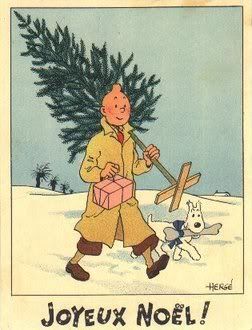
Not quite sure what happened to December, but I have briefly (and temporarily) reemerged from work-related things long enough to clean up the apartment, deck a fake tree, and read plok’s dangerously head-swelling post from December 3rd (!) on that enigmatic little triptych of mine. What a Christmas present—bless you, sir!
I had grand ideas for this year’s holiday post, but I’m sufficiently burnt out from term that the follow through just wasn’t in me. Maybe next year. Instead, let me recycle last year’s reflections on a favorite Daredevil Christmas story of mine (I would have found a way to say the same things again in a different form anyway), and offer a few remarks on twelve things that have kept me afloat these last few months and for which I give thanks on these (already in progress) Twelve Days of Christmas.
12. James Bond - Stephen King recently remarked after seeing Casino Royale: “I came out of the theater thinking it was the best Bond since Goldfinger. A subsequent viewing of Goldfinger…has convinced me it’s the best Bond ever.” I couldn’t agree more, but that’s no reason not to give in to the temptation of the 4 vol. James Bond Ultimate Edition collecting the twenty (official) films of James Bond B.C. (Before Craig). I watched many of these films a few years ago during a TBS Bond Marthon (“Superbond on the Superstation”)—over Christmas break, I believe. I was doped up on Sinutab at the time and all the movies sort of bled into each other in an extraordinarily pleasing way.
11. The Wild Wild West - And when you run out of Bond, there’s always West, James West. Please, forget everything you think you know about this series from the dreadful-looking Will Smith/Kevin Kline summer suckfest of the same name (I didn’t see it). Yes, the 1960s TV show is a rip-off of James Bond set in the American West, but it’s a spectacularly entertaining rip-off, and that’s all that matters. Season 1 (currently out on DVD) is in black and white, but don’t let that discourage you. These episodes are perfect '60s mixed genre tales with a little something for everyone: a cowboy/martial artist (!) hero (the usually shirtless Robert Conrad), an affable, resourceful, and long-suffering sidekick (Ross Martin), gorgeous, dangerous women (usually femmes fatales rather than damsels in distress, though often both), scenery chewing villains with world-conquering ambitions played by an array of classic character actors (who later had careers on nighttime soaps in the 1980s), more gothic traps (and trappings) than you could shake a stick at, an endless stream of steampunk sci-fi spy gizmos, and, of course, a seriously pimped out train. The stories—precisely because they were camp to begin with—stand up remarkably well.
10. Birds of Prey - Rarely is a first-tier series that is already running like a finely oiled machine retooled so gracefully. Gail Simone and incredible new find, penciller Nicola Scott (hopefully destined for a long run on the book), are keeping the Birds flying high—possibly even taking them to new, more exhilarating heights with the expansion of the cast to include such unlikely (but delicious) additions as Big Barda, Manhunter (star of another stellar book), a new Spy Smasher, and an unexpectedly appealing fangirl/Batgirl wannabe. Under Simone’s tenure (and with the help of a great group of artists), Birds of Prey has reached a level of storytelling quality, creative energy, and consistency that makes it one of a handful of DC’s unmissable books. It is quite simply the best treatment of a primarily female superhero cast in recent memory, and it is probably the best character-driven book in contemporary comics period.
9. Justice Society of America - And speaking of impressive retoolings of already excellent books… Dale Eaglesham? Geoff Johns? Dawnstar?? Kingdome Come??? The excitement level for this book is off the charts. The relaunch of JSA as the cornerstone book of the new DCU looks simply incredible. I met Eaglesham at a convention this year and learned that, in addition to being a superb artist, he’s also one heck of a nice guy—I couldn’t be happier that he’s the artist on this title. I’m also delighted that Johns will be pouring his energies into this book, since JSA has been, arguably, the strongest and most consistent work of his career so far. (I think it’s time to pass the Teen Titans on to someone else—Marv?) The first issue of Justice Society of America was a winner, stuffed with great new characters, tensions, mysteries, revelations, and teases—all wrapped up in an immediately engrossing story foregrounding the series’s legacy theme, which I love. Time to collect All-Star Squadron and Infinity Inc, DC.
8. YouTube - There is much that is (delightfully) ridiculous about the content on You Tube, but occasionally the ridiculous takes a detour through the sublime. Exhibit A: the lo-fi stop-motion mini epic, Tony vs. Paul. Spectacular. Less sublime, but still gratifying is the ubiquitous Live Action Hamster Video Game. And on the subject of YouTube and gaming, is it wrong to be a fan of the elastic-faced Angry Video Game Nerd and his sophomoric profanity? He has an informative rant that attacks sequel numbering fuckups in movies and videogames with a rigor that I appreciate.
7. Andy Goldsworthy - This is who I would like to be, if I were a talented, faintly tortured artistic genius. Goldsworthy’s fleeting and profound art/nature “installations” are a perpetual source of wonder. He provides the best gloss on the significance and power of his art in this clip from Rivers and Tides (the stunning documentary on his work) when he says, “I am so amazed at times that I am actually alive.” Here is a second excerpt from that film. Stefan Beyst has a nice essay on the artist. And here are some photographs of the work.
6. Calvin and Hobbes Snowman Cartoons - I certainly don’t want to encourage the war on Christmas lunatics, but now that the snowman has become the prime signifier of ecumenical winter cheer it’s nice to remember that he need not be as dull as he often seems. This is nice too.
5. George Perez Storyteller - A Christmas gift from a good friend that I tore through on Christmas day. There have been collections on Perez before, usually in the form of interviews, but this is the first time I’ve been walked through his entire career. What a trip. Particularly fascinating for Perez fans will be the middle sections on his post-Titans decline, his mid-career fumbles, and the subsequent rejuvenation of his reputation following his run with Kurt Busiek on the “Heroes Return” Avengers. Perez recounts a priceless convention moment when, after his Avengers work allowed his “discovery” by a new generation of fans, one kid told him that he was such a good artist, he had the potential to be the next Todd McFarlane! Ever-gracious, Perez resisted the cheap shot. An attractive and surprisingly revealing book. (Finally, the cringe-inducing Sachs and Violens at least makes sense.) The Newsarama interview here. And a preview of Storyteller too.
4. Tintin: The Complete Companion - Tintinology 101 by noted Tintinologist Michael Farr. A superb account of Herge’s career and influences, and also a fascinating record of the twentieth century. I received this as a gift from a friend earlier in the year and have been delving into it with enormous delight for the past few months. I have been intending to explore my fixation on Tintin ever since I started this blog, but have always held off—I think for fear of not doing justice to a body of work that means a great deal to me. Working on it…
3. The Office - I’m usually not all that fond of comedies. Cheers, Seinfeld, Fawlty Towers: these are the obvious exceptions. Comedies whose humor seems (almost) timeless. Don’t know if the American version of The Office will stand the test of time or not, but few comedies make me actually ache with laughter, and this one does. Not sure I’ve ever seen such a deft juggling of mockery and sympathy.
2. 52 - Still the first comic I read every week, and always among the most enjoyable. But even when a given issue fails to dazzle, the momentum of the weekly experience carries me through. Watching it unfold is exhilarating for many reasons. Partly, it is the form—the thrilling momentum of weekly seriality as such. Partly it is the brilliant interweaving of high-pleasure comic book staples such as the training of a successor (The Question/Renee Montoya), the “who is behind the mask” mystery (Supernova), and the Romance-Quest (Ralph Dibney). Partly (and this is a big part), it is the focus on secondary characters. But beyond this, it is the sheer line-wide scope of the storytelling, both at the level of plot and in terms of stakes and implications (what is “52”? the “Grant Morrison factor”, etc.). Thrilled to hear that DC plans to revisit this kind of storytelling in the future—it’s the essence of comics, comin’at’cha every seven days. Wonder what Marvel could do with this?
1. Battlestar Galactica - Just watched the miniseries and am starting Season 1. OMFG.
Happy New Year, everyone.

 Posts
Posts

