 As I confessed in my previous post, my resistance to Harry Potter has flagged recently, and under the pressure of direct appeals and subtle gambits by fellow bloggers, I've decided to go all the way and crack open Harry Potter and the Philosopher's Stone. As I throw away my jealously guarded Potter virginity, however, I'd like to invite all those Potterphilic Muggles who haven't yet taken the plunge to crack open the first and/or second volume of a considerably earlier classic children's series: Susan Cooper's Over Sea, Under Stone and The Dark Is Rising.
 As I mentioned in the comments section of the piece on Potter, I'll be posting a review essay that compares Cooper's fantasy to Rowling's in a couple of weeks. In the meantime, if anyone has thoughts of their own about either or both of these series, please post them here or send me a link to the entry on your own site, which I'll post below. What are the aesthetic virtues of each series? What, if any, are their weaknessness? Which is the superior "classic"? How unfair is this comparison?
Most importantly, will Jim really follow through on his latest promise to actually read one of these books? Will he ever stop lying about his intention to read Rowling? Find out in Stone v. Stone: The Susan Cooper - J. K. Rowling Challenge!
Tuesday, November 29, 2005
Stone v. Stone: The Susan Cooper - J. K. Rowling Challenge


Sunday, November 27, 2005
Oh God, It's Finally Happened: Confessions of a Lapsed Potterphobe
 Maybe it’s just that time of year. You know, what I mean. November. Everything’s just a little bit depressing: the leaves are gone, the sun is gone, the skies are grey, real snow isn’t here yet, vacation is immanent, but not immanent enough to be consoling. And you’re tired. Deeply, achingly, down-to-your-bones, tired. Maybe I just finally got worn down. I don’t know how else to explain it.
I saw Harry Potter and the Goblet of Fire last night. And I liked it.
I’ve been resisting Harry Potter for what feels like forever. “But it’s so good,” my friends would cajole. Smart friends. Friends with good taste in books, with opinions I trust. “It’s not just a kid’s story—really. Once you start it you won’t be able to put it down. They’re addictively good. Much darker and more sophisticated than you might think. Besides, you of all people should like this sort of thing, Jim. You read comics and The Wheel of Time for goodness sake! It’s better than all that!” And always, eventually, this last-ditch appeal to what was ultimately chalked up to my literary snobbery: “It’s very well written.” Uh-huh. Usually I’d make that sour face I make when confronted with things that wound my delicate aesthetic sensibilities. Invariably, I’d grouse about the novels’ ugly, childish cover art. (My wife tells a wonderful story about an architecture professor who once protested the bylaw requiring him to place wheelchair ramps in front of his austere modernist buildings by declaring: “We all have disabilities. My disability is that I cannot bear ugliness.” I feel a certain kinship with this vain idiot.)
“Don’t judge a book by its cover,” I’d be told apropos the Potter books. “Besides, there are editions with different cover art, designed for adults.” Sigh. Occasionally, if I was feeling magnanimous, I’d pretend to give in. I’d smile faintly. I’d make noises of acquiescence to indicate that yes, yes, eventually I intended to read the books, it was only a matter of finding the time to do it. I was lying, of course. And I suspect my friends knew this, even though they were too kind (or too exasperated) to press the issue.
What was my problem, exactly? Why did I despise Harry Potter without ever having read a word of J. K. Rowling’s prose? What was it about the prospect of this little darling wizard-in-training that made me want to retch?
Well, to begin with, it all seemed a mite…precious. I mean really: Muggles? That’s fine for seven year olds (barely), but when I hear sane adults pronounce cutesy nonsense words like this, I want to tell them, politely but decisively, to kindly fuck off. Also (and this admission is not as ugly as it sounds), I’m a bit of an Anglophobe. Not a real Anglophobe, mind you. Just someone prone to knee-jerk intolerance for North American Anglophilia, which sometimes unfairly, and prejudicially spills over into an irritation with British fantasy proper. (People of Britain: I mostly love you. Okay not you, Margaret Thatcher. Not you either, Mr. Blair.) Perhaps this is my ex-colonial ressentiment talking, but I’ve come to find the Canadian and American fascination with the dream of a British childhood more than a little cloying. So when Rex Murphy’s acerbic jeremiad against Harry appeared in The Globe and Mail earlier this year, I was only too happy to have my prejudices confirmed. Suddenly, I had more fuel to add to the fire, a neat quasi-political justification for my irritation with bespectacled British wand-wielding moppets. Yes, Rex’s bombast was overblown—even I could see that. But when you develop an spontaneous hate-on for something that the herd seems unequivocally to adore, the contrarian pundit is your friend, and it’s all too easy to forgive a little hot air, especially when you’re puffing a bit of it yourself.
Problem is, as much as I hated Harry and the myth of a “magical” English childhood he embodies, I’m also a total hypocrite. You see, I bought into this myth—deeply—a long time ago, I’m still in it’s grip, and, truth be told, most days I don’t really want to be released.  When I was about eight or nine, a very close friend of mine introduced me to a book by Susan Cooper called Over Sea, Under Stone (1965), the first book in a genuinely magical British series of contemporary Arthurian adventures that also includes The Dark Is Rising (1967), Greenwitch (1974), The Grey King (1975), and Silver on the Tree (1977). Set in Wales, Cornwall, and Buckinghamshire, and focusing on six British children, the series infuses the secret world of childhood with danger and a haunting evocation of myth and legendary history that remains a touchstone for my own memory of what is most valuable about the melancholy innocence of that time.
The foreignness—the Englishness—of Cooper’s setting was important. It made for a kind of grave play, a serious innocence that is more difficult (though not impossible) to achieve in North American settings. And of course, behind this feeling is the sense of historical depth—the deep temporality of Celtic myth and Arthurian legend—that animates the entire proceedings and which is unavailable within a North American scene. At the time, the English settings of Cooper’s fantasy were somewhat estranging, making my identification with the children in those stories incomplete, opening a gap that—phenomenologically-speaking—gave me a taste of melancholy separation from childhood that I would later experience as an adult. Ultimately, the gap created by the foreign British setting expanded. In adult memory, the geographical distance between myself and those children came to stand for the now unbridgeable temporal distance between past and present. Nostalgia, it would seem, is amplified when it concerns geographically distant adventures. 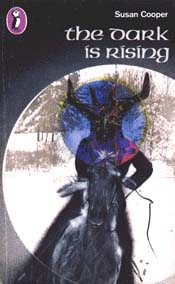


This dynamic, I suspect, is not unique to my experience and perhaps reveals something about the insatiably nostalgic Anglophilia of US and Canadian readers, about that strange overlap between childhood and Great Britain in a certain “North American” imagination. (Scare-quotes around “North American” are necessary because clearly this “imagination” cannot be attributed willy-nilly to some sort of transcultural North American groupmind. And of course one could provide other, more depressing reasons for the continued prominence of British fantasies centered on the heroic destiny of white children in the context of “global culture,” but it’s Sunday afternoon, and I’m trying not to bum myself out unduly.)
So how could I have loved Susan Cooper without ever giving J. K. Rowling a chance? Are their fantasies really so different? Or is it just that I’m too old to be moved by children’s stories (even sophisticated, well-written ones) that can, at best, only remind me of my own (more perfect) memories of the distant geography of childhood?  Well—for starters, they do seem different. Very different. Arthurian legends and enchanted objects in the English countryside are one thing. Schools of wizardry with preciously-monikered professors that turn into cats are quite another. And I genuinely don’t “get” the English boarding school setting of the Potter books. What the Potterverse seems to lack—from my totally uniformed point of view—is privacy. There may be a belfry where Harry can go hang out with the owls, but the adventures themselves do not appear to perform the fundamental Peanuts-like excising of the adult world that marks what are, for me, the most pleasurable childhood stories. (Granted, I don’t think Susan Cooper does this completely either, but the private nature of magical tutelage in The Dark Is Rising is fundamentally different from the Grand Hall setting of Hogwart’s Academy, from what I remember.) And yes, I probably am too old to have any unmediated or uncritical experience of new children’s fiction. If it can really take me back to Cooper’s Wales, then I’ll happily hitch a ride, and perhaps I can suspend my disbelief for few minutes. But if the fit isn’t quite right, it’s liable to make me cranky. At least, that’s what I thought until last night.
Yes. I liked Harry Potter and the Goblet of Fire. It’s a sweet, well-made movie. It ably captures the awkwardness of adolescence (especially the abject horror of the school dance), and it generates more emotional involvement than I was expecting—partly because the characters themselves are appealing and partly because it so ingeniously exploits the symbolism of its material. The final image of the departing students from other schools, with the boat sinking below the sea as the carriage drawn by winged horses rises into the clouds is sublime. Quite simply one of the loveliest images of death and transcendence that I’ve seen in a little while. (The ascending carriage seems almost to become a coffin.) Likewise, the movement through the maze with its terrific grail imagery and the climactic encounter in the graveyard with a scary, noseless Ralph Fiennes are magnificent. Granted, I still haven’t read any of the books, and quite frankly, am unlikely to embark upon that 4000-page quest anytime soon. At this stage, I’m more likely to be able to sustain a hit of nostalgia from the spectacle of film than from a 500-page doorstop anyway. I have, at least, stuck my pinky toe into the bathwater at Hogwart’s and found it, on the whole, more inviting than I expected. Whatever its darkness (and certainly the promise of a “darker” installment of the fantasy appealed to me), Harry Potter and the Goblet of Fire is an optimistic story. Like Susan Cooper’s eerie recreation of the Arthur legend, it is a work of Romance—that genre that is at the root of so much storytelling, if not of story itself. Sometimes, for better or worse, such a return to myth is exactly what one craves. Especially in the bleak days of November.
Saturday, November 26, 2005
What is Multiplicity? A Response to Marc Singer
 Marc Singer paid me the compliment last week of writing a collegial critique of my own rather scattered musings on the politics of multiplicity that I saw (or hoped to see) in DC’s Infinite Crisis. Marc’s reply to On Multiplicity: The Pleasures and Politics of Infinite Crises on Infinite Earths was both thought-provoking and fair—in fact, I wish that all academic interlocutors were as generous about disagreeing with someone as Marc is in Multiple Articulation. As Marc’s essay makes clear through its numerous asides and qualifications, our positions are not always as far apart as they might seem. Nonetheless, he raises two significant (and interrelated) objections to my argument that I can’t resist exploring a little further here. As will quickly become evident, Marc’s essay stimulated a lot of thoughts, and although I begin each section by responding to some of his concerns, I usually end up wandering off along tangential paths that are no longer direct responses to his critique, and sometimes circle back to common ground.
Marc’s first objection to my reading of the DC multiverse concerns my claim that comic book representations of multiplicity could have genuine political value. “As a scholar of popular culture I wouldn't dismiss [such arguments] out of hand,” Marc writes, but it’s “a pretty big leap” from the insular world of comic book Hyperverses or Multiverses to “political manifesto[s]” about multiplicity because what such imaginary stories give us is “multiplicity without any practical effects.” I’ve written about my critical method before, and I could simply take the coward’s way out and say that I’m not doing pure criticism here so much as using Crisis as a sounding board for my own tedious preoccupations, as I so often do. But that wouldn’t be entirely true, since I really am interested in thinking about the political implications of popular culture—particularly in what are regarded as its most conservative forms. On this point, Marc and I agree on one thing at least (maybe more); as he acknowledges throughout the essay, I share his scepticism that “any particular narrative framework guarantees any particular type of politics.” But I would frame the issue in a slightly different way, and this has to do with that slippery word, “guarantees.”
Marc’s warning about the danger of seeing something like Infinite Crisis as politically subversive takes issue with what I would call “strong” formulations of the relation between culture (“narrative frameworks”) and politics. His argument here is really with Will Brooker, who, by Marc’s account, does appear to offer a genuinely “strong” formulation to the culture-politics relation (in his discussion of Hypertime’s political frisson) and thus seems to leave himself vulnerable to the accusation of naïve wankery that haunts all avant-garde criticism. Of course, my own blogging courts precisely this accusation as well! But my starting point is quite different from the one that Brooker stands accused of adopting: I’m asserting only a “weak” formulation of the culture-politics relation on the grounds that, with the possible exception of pure propaganda from either the left or the right, most forms of popular culture are ideologically uneven and contradictory, containing both reactionary and subversive political messages and that this ideological unevenness is especially visible in popular forms like superhero comic books—mass market yet strangely subcultural fantasies which do not simply mythologize but also interrogate the cultural/political contexts in which they are produced. Certainly, I agree with Marc that no narrative framework “guarantees” politics, but narrative frameworks do constantly “register,” “reflect,” “map,” or “model” ways of conceptualizing political thought, even if they do not overtly or primarily “intend” to—though, as every fan knows, mainstream comics have had ambitious, explicitly political content for a very long time now. What this might mean for interpretation is that even mainstream, continuity-driven events like Crisis contain alternative forms of political modeling that strain against their overt (corporate) aims, and exist in tension with what Johanna Draper Carlson has recently called the innately conservative nature of all superheroes.
Are images of pluralism (even pseudo-pluralism) in superhero comics simply an example of “multiplicity without any practical effects”? Perhaps. But that depends in part on how one defines “practical effects.” Again, I would offer a “weak” formulation of this concept rather than a “strong” one. If comic book multiplicity has any “practical effects,” these would necessarily be pedagogical, long term, and probably unconscious (which is not to say inconsequential, particularly if you believe, as I do, that our political choices are profoundly determined by unconscious investments and not simply by our dispassionate weighing of options on the one hand or by media-manipulation on the other). Moreover, many forms of cultural production, comics included, are capable of providing optics through which to view the world in which we live with fresh eyes. Like Brechtian drama, in other words, comic book representations of postmodernity might have a defamiliarizing effect, something about which Mark Fossen has recently reminded us.
Of course, these are all somewhat airy speculations, and whether or not they really illuminate the new Crisis is highly debatable, not only because we’re talking about a work that is only half started, but because its ideological investments may end up swinging so far in the direction of 1950s values as to negate any meaningful “multiplicity” at all (though I doubt it). My main point is simply that in the context of the current depressing ascendancy of strong ideologies like nationalism, imperialism, and religious fundamentalism (both within “the West” and outside it), I’ll take my multiplicity where I can get it. (Yes, even if I have to make it up!) In all seriousness, though, the circulation of even very basic and decontextualized representations of multiplicity can only be said to do “nothing”—to have no “practical effects”—if we accept the premise that cultural artifacts must be free of the taint of a dominant (conservative) ideology to achieve political purchase. This is a question I think a great deal about, and to be honest, I have yet to answer it to my satisfaction. Still, I’m not prepared to accept the argument that superhero comics are an inherently conservative form, if only because this isn’t true to my own experience of reading—something about which I apparently have no shortage of things to say. (And just for the record: I don’t think that Marc is claiming that they are either—I’m just riffing here, as usual.)
Marc’s second and more serious objection to my reading of Infinite Crisis concerns the value of “multiplicity” as a political concept, and this may be a point on which we genuinely disagree, though even here, I’m not sure our positions are all that far apart. His concerns about my “celebration of multiplicity for its own sake” stem primarily from the extent to which he sees my position overlapping with Will Brooker’s euphoric brand of relativist postmodernism (a celebration of multiplicity as “empty pastiche” or “fluidity and play”) and, more tenuously, with what can only be called the appalling hijacking of “minoritarian” rhetoric from the Culture Wars debates of the 1990s by the cynical and opportunistic architects of the “Intelligent Design” lobby. As Marc acknowledges, the comparison of my take on the virtues of multiplicity to the obscene, depressing appropriation of a legitimate and necessary multicultural politics by religious fundamentalists is not just “unfair” but “completely unfair” (whew!). Nonetheless, I take his point: “a point that too many left-wingers and academics ignore,” namely that “openness and diversity are not always worthwhile goals in themselves, and certainly not the only worthwhile goals. They don’t automatically guarantee a progressive politics, or even a diverse politics.” To the charge of being a left-wing academic, I can only plead guilty, and of course, Marc is absolutely right about the dangers of an uncritical celebration of “multiplicity.” Anyone who argues for “multiplicity for its own sake” will inevitably get a bloody nose when they run up against the brick wall of such “diverse” viewpoints as fascism and fundamentalism.
So, what do I intend (beyond simply amusing myself) when I say hyperbolic things like “bring on a politics of Infinite Crisis. It’s past time to make an ‘infinite’ peace with multiplicity”? This certainly sounds like “multiplicity for its own sake,” but that’s not quite what I mean. In general, what I was alluding to were several different notions of multiplicity that I rather clumsily lumped together in an obfuscating rhetorical flourish.
1. In one sense, it’s true, I was taking multiplicity to simply mean “pluralism” or even simply a clash of ideologies. And on this point I would reaffirm Marc’s warning that an uncritical pluralism has many pitfalls and can lead to some dangerous impasses. But there is a difference between pluralism (as a social practice) and relativism (as a philosophical postulate), and I don’t think that the former can necessarily be reduced to the latter. The thorny question about pluralism obviously concerns how one adjudicates situations in which a respect for cultural diversity runs up against cultural practices that are either morally repugnant (according to one’s own cultural values) or which directly challenge the viability of the social contract. Within the context of civil society, institutions like the law ostensibly operate as a brake that prevents “pluralism” from become an anarchic clash of values with no common basis for appeal. There are all kinds of problems with this, of course, since the law is always someone’s law rather than a neutral bearer of “universal” values. My point is only that “multiplicity” in this social sense does not imply a sort of nihilistic “postmodern” relativism (and, as I will suggest below, postmodern multiplicity should not be reduced to this shorthand caricature). In a certain sense, superhero comics could be said to exemplify this kind of tension in the productive conflict that emerges between the multiplicity signalled by their main motifs (superheroes, sometimes thematized in explicitly minoritarian terms, as in X-Men) and their controlling themes (justice, right, the nature of good and evil—themes which have happily been complicated by the “dark” turn that DC has recently taken). In a work like Crisis, this tension is heightened further: the issue of multiplicity becomes more explicit and thematically central, even as, in a curious way, it is juxtaposed with the sort of simplistic 1950s morality that we have come, with good reason, to mistrust. Difference and sameness, multiplicity on common ground. In Culture and Imperialism Edward Said speaks eloquently of the need for a “new humanism” that would not eradicate or ignore genuine cultural differences, but would nonetheless provide the basis for a common language through which to negotiate urgent questions of global justice. It would be naïve to think that any contemporary society has achieved that “new humanist” dream of multiplicity on common ground, but it is not impossible to see such a utopian paradox represented (in a yet imperfect and contradictory form) in the weird hybrid genre of superhero comics, absurd as that may sound. Moreover, the fact that DC’s (formerly) “infinite” earths draw attention to the global dimension of these questions is, to say the least, suggestive.
2. But “multiplicity” has also acquired another set of connotations in postmodern thought that really pose a fatal challenge to the multiplicity of the sort that I’ve been describing so far. Whereas the more traditional way of thinking multiplicity as “pluralism” or even “cultural relativism” tends to emphasize the boundaries between cultures (to treat cultures and cultural viewpoints as if they were organic wholes), postmodern multiplicity (as it is articulated by Deleuze and Guattari or Judith Butler, for instance) challenges the idea that it is either accurate or desirable to speak of “multiplicity” on this level at all because, at the end of the day, “identity” (be it cultural, sexual, or whatever), is a falsifying projection. Human beings are really composed of a sort of micro-multiplicity that obtains at the level of both mind and body, now imagined as split, fragmented, polymorphous, and criss-crossed by diverse, often conflicting social codes and desires. This suspicion of “identity” arises from many sources, but it emerged especially as a challenge to the type of identity politics that animated (and some would say stymied) the Culture Wars of the 90s. The critique of identity this branch of modern theory offers is typically complemented by an endorsement of a notoriously idealist “micro-politics” that emphasizes somewhat dubious but sometimes effective forms of culture jamming and political protest organized around temporary fluid alliances based on shared interests, rather than on universalizing political programs based around a single unifying idea (eg. Marxism or feminism). This type of multiplicity might be signalled abstractly through the language of “crisis” and “infinity” in DC’s current crossover, but it is probably most evident more generally in the representation of the mutant or superhero body as a site of constant movement and transformation. I could multiply examples on this point, but I’ll save that discussion for another day.
3. Finally, this version of postmodern multiplicity is itself multiple, for it has another dimension that acknowledges the simple fact that identities are not simply “ours” to shape and control but are often (indeed inevitably) imposed on us by social codes and practices whose operation can be more or less violent, but is certainly not voluntary. Human beings, no matter how internally “multiple” they might be, have no choice but to engage with the power structures that address them and to demand recognition within those structures. For this reason even the most utopian postmodern tributes to the liberating annihilation of conventional identities often contain precisely the sort of caution that Marc’s essay eloquently provides against the dangers of uncritical multiplicity. The following parable is one of my favourite passages from A Thousand Plateaus, a book of postmodern philosophy by Deleuze and Guattari that for the most part extols the liberating virtues of demolishing conventional notions of identity and politics (which they associate with “striated space”) to create a “smooth space” of perpetual movement, flux, alliance, and transformation. Note the all-important qualification at the end:
What interests us in operations of striation and smoothing are precisely the passages or combinations: how the forces at work within space continually striate it, and how in the course of its striation it develops other forces and emits new smooth spaces. Even the most striated city gives rise to smooth spaces: to live in the city as a nomad, or as a cave dweller. Movements, speed and slowness, are sometimes enough to reconstruct a smooth space. Of course, smooth spaces are not in themselves liberatory. But the struggle is changed or displaced in them, and life reconstitutes its stakes, confronts new obstacles, invents new paces, switches adversaries. Never believe that a smooth space will suffice to save us.“Never believe that a smooth space will suffice to save us.” This is how Marc concludes his essay too, and it’s a caveat that I took to be implicit in my own musings about making “infinite” peace with multiplicity, even though it was murkily conveyed. It cannot be repeated often enough. As for the larger issues: how do these three forms of multiplicity fit together? can they be reconciled? do superhero comics provide a useful sounding board for thinking about multiplicity and its relations? These are not easy questions, but they’re certainly questions worth exploring further...
Saturday, November 05, 2005
On Multiplicity: The Pleasures and Politics of Infinite Crises on Infinite Earths
 In 1985, my DC Universe was three-tiered. At the top was a trio of utterly transcendent books: The New Teen Titans, Batman and the Outsiders, and Swamp Thing. Below these were DC books that I enjoyed and bought occasionally (the quirky Blue Devil or pseudo-science fiction titles like Legion of Superheroes and Atari Force) as well as recently cancelled, proto-Vertigo masterpieces (Thriller and Night Force). Finally, below this middle tier was a whole sea of titles featuring iconic DC heroes that I wouldn’t touch with a ten-foot pole. Superman, Batman, Wonder Woman, Flash, Green Lantern: two of my three favorite titles were team books, and on the whole, I preferred teams to individual heroes, so it’s little wonder that I wasn’t interested in these graying heroes who all seemed so stodgy and flat anyway. Of the old guard only Batman exerted a mild gothic tug of attraction. (I had, after all, bought the occasional issue of Detective Comics in the days before I styled my 13-year-old self a “collector.”) But even Bats was only ever really palatable to me as part of an ensemble like the Outsiders. In fact, “my” pre-Crisis DC Universe was rigidly and snobbishly “new.” This is why, despite my love of team books, the venerable Justice League of America and even ostensibly “newer” teams like All-Star Squadron, and Infinity Inc were completely unreadable to me back then. The latter two were tied to an incomprehensible history (the history of my parents’ generation at that!) and JLA was made of heroes I didn’t care about. If Superman embodied everything that bored me about the classic pre-Crisis DCU, Batman’s resignation from the JLA on the cover of BATO #1 was, in retrospect, emblematic of precisely the direction I intuitively wanted my DC comics to take.
As it turned out, DC editorial was way ahead of me, for this was exactly the direction they did take in 1985 with the launch of Crisis on Infinite Earths. At first, I wasn’t sure I was going to buy this “maxi-series” at all. I had heard about Crisis before The New Teen Titans #6 (vol. 2) came out, but it wasn’t until I read Marv Wolfman’s terrible confirmation in the letters page of that issue that George Perez was leaving the just-launched “hardcover” Titans series to work on Crisis that I really made up my mind to see what all the fuss was about. If I couldn’t have Perez on Titans, I may as well at least enjoy his art on this new book (which had the added attraction of being written by Wolfman), even if the premise didn’t completely hook me and despite the lousy in-house ad featuring a silhouette of the Monitor that (inexplicably) did everything possible to hide the fact that Perez had drawn it. Crisis was the first book I ever decided to buy, sight unseen, on the strength of the creative team that was producing it.
I wasn’t disappointed—Wolfman and Perez’s work was sensational and involving. But the experience of reading Crisis on Infinite Earths—particularly the early issues—was very, very strange. Suddenly, I was reintroduced to characters that I hadn’t thought about for years (The Crime Syndicate?) that I had never associated with the universe in which the Teen Titans operated (Blue Beetle? The Freedom Fighters? Captain Marvel?) or had never heard of at all (Psycho Pirate? Kamandi? Solovar?). As a reading experience it was truly uncanny—the floor of “my” DCU had just dropped out from under me, and beneath it was a deep, puzzling history that I had been, until that point, quite successfully ignoring. Reading Crisis was therefore both exhilarating and unsettling, familiar and strange—my very small DC Universe was being given extraordinary depth and complexity at the very moment that this complexity was about to be collapsed to a fresh new singularity.
Of course, the “uncanniness” of Crisis stemmed not just from the confrontation of my own self-created mini-DCU (Titans, Outsiders, Swampy) with the “repressed” (i.e. ignored) contents of its history (Superman, the JSA, the Golden Age, etc., etc.), but was a basic structural feature of the series’s paradoxical premise. On the one hand, it was written to solve a problem that I (without realizing it at the time) embodied utterly. As everyone knows, Crisis came about in the first place to simplify a universe whose continuity had become unmanageable and was costing the company readers—specifically, new readers like myself who weren’t interested in the adventures of geriatric supermen whose books looked and felt like the remnants of an older generation’s diversions. Crisis on Infinite Earths was written specifically to get people like me to buy something other than Teen Titans. And yet, by its nature, the story (despite a cast of thousands), had to revolve around two unappealing groups of characters: those iconic characters that interested me the least, whose books I did not buy, and those obscure characters that I had never heard of, but was at least beginning to discover in the pages of Who’s Who, which DC had cunningly begun publishing at exactly the same time with exquisite crossover-implied Perez covers. For the first few issues of Crisis, I found myself looking (in vain!) for Titans and Outsiders among the panels, but ultimately the story won me over, and I found myself moved literally to tears by the deaths of characters that I had never cared about, and in some cases of whom I had barely even been aware. A strange experience indeed.
My memories of Crisis on Infinite Earths are thus not the memories that a slightly older fan might have, a fan who had some investment in the question of which of his or her childhood favorites would live or die, or of how the unruly multiverse would be “rationalized” and reordered. Rather, my memories are a curious mix of intense, but relatively contentless affect. I was moved by the nobility of Flash’s death, but I didn’t really know who Barry Allen was. I mourned for Kara, like everybody else, but really, she was just an image of a pretty girl, brought momentarily to life by the sublimity of Perez’s rendering. The into-the-sunset happy ending given to the old Superman and his Lois, to Superboy and young Luthor, was genuinely touching, but aside from Luthor, these were all characters in which I had no substantial investment. Emptiness and affect. It would be fair to say that, for me, the emotional payoff of Crisis on Infinite Earths was all form and no content.
Or nearly so. Several characters did excite me, aside from my perennial favorites, and these were, not surprisingly, the new ones: Harbinger, Pariah, Luthor, and Lady Quark. This remarkable group now embodied the uncanny dead history of a multiverse of which I had barely been aware, and as such, were immediately supercharged with an unusually intense spark of being. In other words, when the dust had settled, these new characters were Crisis: they gave form to the intense but non-specific affect the series produced (through its relentless representation of death, through the strange absence of an object for a young fan like myself to mourn). I was thus genuinely disappointed that they all but disappeared from the DC Universe after the Crisis had been resolved.
The reemergence of some of these characters—particularly in the pages of Gail Simone and Dale Eaglesham’s exuberant Villains United—is one of the reasons that the build up to Infinite Crisis over the past few months has been such transgressive good fun. The original Crisis became, in effect, a new sacred text for DC, a rewriting of history so profound that even the characters who had been introduced through it became strangely taboo. How else to explain, for instance, why Lyla has never really been revisited? why the Anti-Monitor has never returned? why even a relatively straightforward character revamp like the female Doctor Light has never been able to generate more than a glimmer in the post-Crisis DCU? (Did Lady Quark show up again in L.E.G.I.O.N.? I can’t remember.) Crisis served its purpose and clearly the company’s writers felt that to revisit these characters in any significant way would be too much of a reminder of the very history that DC was trying to convince a potential new readership to forget.
As a reader whose enjoyment of the original series was rooted precisely in the way that these Crisis-survivors (especially Lyla, who becomes the recorder of DC history, a double of the Monitor and a sort of prototype for Oracle) embodied both a rich but mysterious past and the thrilling affect of the series itself, I’ve been delighted by the reintroduction of Luthor, Pariah (all too briefly!), Lady Quark, and the Crisis-era Dr. Light in various DC books over the past few months—reintroductions (in the case of Pariah and Luthor) that are thrilling precisely because they violate a taboo.
 Blasphemy is always welcome, and as far as I’m concerned, it’s high time that DC returned to its sacred text (complete with a Kara/Christ and a Superman/Pieta) and radically desacrilized it, lovely as that Christ/Pieta reversal is. If Infinite Crisis is going to reopen the Pandora’s box that the original Crisis slammed shut, so much the better. As much as I enjoyed the promise of coherence when I was thirteen, and of course I still love “continuity,” these days I prefer a comic book universe that is nonetheless complex, multiple, labyrinthine, and contradictory, because such a universe gives us better tools for thinking about the world in which we live than a universe that gives an illusory sense of unity and simplicity. We live, frankly, in a world that would profit from less piety and more multiplicity, a world in which the metanarratives that structure how people think and behave—be they religious, national, or economic, though often all three—have ossified into catastrophically regressive and murderous ideologies of singularity that only masquerade as something like a respect for “multiplicity” (I’m thinking, of course, of “globalization,” “the free market,” “the global village” and other such code words for imperialism, still the dominant singularity of our time, albeit in an altered, “postmodern” form). We live, in short, in a world that is genuinely multiple, but caught in the grip of extremely powerful, sometimes overlapping ideologies that always present themselves as singularities. Only in such a world could multiplicity be considered a “crisis.”
 I know that some readers are irritated by the so-called “dark” turn the DCU has taken lately, symbolized most iconically in the “breakup” of the so-called trinity (the trinity for heaven’s sake!). But I say, break it up, let it all burn down. Shatter the old familiar unities and create a situation in which genuinely new sorts of relationships will have to be forged, relationships that are not pre-given or ideologically neat. This is what alliances look like in the real world where people who do not necessarily share the same world view must nonetheless come together and find ways to coexist, negotiate, and even forge strong relationships across difference. We all live “in” multiplicity just as multiplicity lives “in” us too, at the level of our own selves and our most intimate relationships. If we are really reading a story that is going to “undo” the work of the first one, DC will be poised to tell more interesting and more relevant stories as a result of its return to the language of “crisis.”
Significantly, moreover, as both of the Crisis series have shown, the term “crisis” does not simply signify catastrophe in the obvious negative sense, for what “crisis” actually becomes—through our experience of reading—is a form of pleasure (our delight in imaginary catastrophe) that projects both a version of our world (as all science fiction does) and thus, necessarily, projects an ethical or political vision that corresponds to that “world” as well (a wish-fulfillment, a satire, or as is usually the case with superhero comics, something in between these two poles). I can’t do justice to how this process might work in either series here (especially since the new Crisis has just started), but my sense at the moment is that the ethico-political implications of the two main DC Crises are diametrically opposed.
Wolfman and Perez’s Crisis ended up projecting a fairly conservative ethical vision in its reduction of the multiverse to a single universe, represented synecdochally by the singularity of earth itself. Johns and Jiminez’s Crisis promises a restored multiverse, or perhaps something even better: a single universe that is more internally riven, contradictory, and multiple than ever before. An Blakean “Infinite Crisis” within a single earth. Either way, this “blasphemous” story is about opening up artificially closed off spaces (the last panel of issue #1), about revisiting stories that had seemingly been “settled” (the happily-ever-after that wasn’t), and about shattering the (misleading) unity of personified abstractions like Justice (the JLA’s “trinity”). This is not a catastrophe but the basis for a vision of ethical and political complexity that refuses simplistic or totalizing solutions. It is also, potentially, a fortuitous (I don't claim that Johns and company "intended" this) symbolization of the critique of unity and identity that in some quarters is called anti-humanism, in others postmodern ethics, and in still others postcoloniality. This, at least, is the Infinite Crisis I want to read. And if Grant Morrison were writing it, I suspect that it’s the Infinite Crisis I’d actually get. (Oh, wait, he is writing it—it’s just called Seven Soldiers. Never mind.) Despite the fact that Johns’s superheroes are more firmly rooted in a specifically American iconography than, say, Wolfman’s were, and despite the fact that Johns appears to have a more conventional political vision than Morrison (it would be hard not to), his political stories are always more complex and penetrating than one expects. Still, I have to admit that I get a little nervous when the thrilling subversive energy of a trinity in tatters is abruptly contextualized by the image of a dead (?) Uncle Sam. Is THAT what the shattering of the trinity must be reduced to? How else are we to read this panel? Or to read the earlier one in which Uncle Sam is struck down by Black Adam who announces: “So much for Freedom.” Johns’s earlier work on Black Adam was more subtle and interesting than this jingoistic caricature. (Though there is another way to read this: Black Adam as ironic commentator on America’s recent international adventures whose “so much for freedom” comment curiously echoes the Golden Age Superman’s own judgment on Uncle Sam as fraud, which I discuss below.) Beyond the specific issue of the politics of representation at play in such images of otherness, what I am wondering more generally is: will Johns take the progressive but abstract multiplicity of Infinite Crisis and immure it within by a much more conservative (nationalist) political aesthetic—even if this walling-off takes the form of an ambivalent critique of the “Spirit of America” as it seems to do here?
I hope not. I loved Johns’s blue collar take Wally West and was impressed by the Black Adam-JSA stories, but even though Johns’s work frequently juxtaposes a beautiful—indeed utopian—fantasy of America as “justice society” with the real thing, its critical impulses usually feel merely gestural because his stories remain so deeply attached to a dream of the American way—an ideal America that never was and is, to say the least, very far from being realized in the present. This, at least, is my impression. But the politics of Johns’s stories remain elusive and it may be that the question is undecidable in any absolute sense because there is simply a radical contradiction between the liberalism of the stories’ content (eg. the original Superman, the “real” Spirit of America will step in for Uncle Sam who, in Superman’s words in issue #1 only “believes he represents the American way,” only “claims he’s as old as the country itself”—in short, “claims a great deal”) and the radicalism of their form (the genre of superhero fantasy, the plot’s shattering of unity, the emergence of difference, the release of flows, the reproduction of multiplicity). Contradiction is fine, of course. Most works of popular culture contain precisely this kind of mix of reactionary and revolutionary elements, and such a mixture does not negate the exciting ethical or philosophical questions that Johns’s comics (and superhero comics in general) bring into representation through the extravagance of their fantasy. Still, I’m glad that DC’s justly prized “continuity cop” will be shadowed at Dan Didio’s DC by criminal mastermind Grant Morrison. (Who Watches the Watchmen? Morrison!) If ever there were two figures who could bring the singularity of Apollonian form and the multiplicity of Dionysian energy into perfect Nietzschean conjunction, Johns and Morrison are that pair. Gail Simone, of course, does it single-handedly. Back in 1985, I didn’t know enough to care about the implicit political (or perhaps I should say “ethical”) messages my comic books were sending, much less notice them. And of course, I am in a sense wildly “overreading” what is simply a fun adventure epic, driven not by some nebulous impulse towards political allegory but simply by the twin forces that drive most mainstream comic writing: the desire to increase market share and to tell a good yarn. (Sorry, it’s what I do.) But the fact remains that comic stories, like all stories, mediate our relationship to the real world, become part of our consciousness, afford us imaginative places to work out ethical and political questions, and over time (often without our being aware of it) subtly shape our way of responding to and understanding the brute materiality of history. We can’t get away from politics in our art. So I say bring on a politics of Infinite Crisis. It’s past time to make an “infinite” peace with multiplicity.
Tuesday, November 01, 2005
Gone Roeg (with apologies)
 Sometimes I flatter myself extravagantly enough to imagine that someone might wonder: whatever happened to that Roeg fellah? Well, the usual. I'm still swamped at work, as always, but I've somehow managed to clear a small space for some blogging. And it feels good! I've revised, retitled, and made a substantial addition to the previous entry on The New Teen Titans #38, which is now called The Donna Troy Project. This is something I've been musing about for awhile and will be ongoing. (I'll try to add tags to this an other entires to make the site easier to navigate...soon.)
I'm even feeling ambitious enough to say that Spoilers Abound will be returning as a monthly (rather than weekly, or even "weekly") feature, though not immediately. I have a small stockpile of banal observations to make that I haven't the sense to keep to myself, so the relaunch of SA, when it happens, will no doubt be overstuffed (though not filling). Check back later this month, or in December. :)
Meanwhile, thanks to those of you who check back every now and then to see if anything new is going on. I've been barely more than a lurker in the blogosphere (what's left of it, now that it's "collapsed"!), but I'm looking forward to getting back to reading and writing about comics more regularly very soon.
Take care!
Jim Roeg
Friday, October 07, 2005
On Love (Part 2): The Donna Troy Project [Ongoing]
Preliminary
I. Who is "Donna Troy"?: Character as Golden Mean “Who is Donna Troy?” There was a time when that melancholy question could make you feel something singular. Not an emotion, exactly. Not curiosity. What?
“Who is Donna Troy?” It’s not a question but a mystery. There’s a difference. Reading those words on that cover. A broken wall. Torn posters of a girl’s face. And behind it a man, his gaze hooded. The weak glow of a lamp. The man doesn’t look at us. Only the girl does. Or rather, the poster of the girl.
“Who is Donna Troy?” It’s a question you hear, but not aloud. Somehow, it stays on the page. And it doesn't have an answer, no matter what the story says. The question is a chasm. Just empty space. And you feel it: here. Queasiness. Vertigo. And something else.
“Who is Donna Troy?” It’s a memory, but not nostalgia. Not even a memory, exactly. A “recollection” of what it feels like to discover something you never knew you lost and can never regain. What was it? “I remember this place,” Donna says. And so do you, even though you’ve never been here.
What is this place? What is this ruined wall papered with images of a girl’s face at five, fourteen, twenty? What is this spot in memory marked by a question that is not a question but a precipice. A gap.
“Who is Donna Troy?” It’s a question about memory. It’s a statement about time. It’s a mystery about love. #
Who is “Donna Troy”?: Character as Golden Mean
The perfection of Donna Troy’s character approaches the famous golden mean of Greek philosophy, that “felicitous middle between two extremes, one of excess and the other of deficiency.” This, at least, is how Marv Wolfman—the man who, with George Perez, wrote the definitive Donna Troy story in New Teen Titans #38—describes the fundamental appeal of her character:
I believed the Titans themselves needed to be emotionally at odds with each other even while they needed to be friends. To facilitate this I set up two theoretical triangles, one for the male characters, one for the female. For example, put Wonder Girl at the top of the women's triangle. Donna Troy came from an Amazon race who believed not only in peace, but were also warriors. On one corner of the triangle put Raven, whose interdimensional society were extreme pacifists who would never fight, not even to save their lives. On the other corner put in Starfire, who comes from a pure warrior culture. Three sides of the same coin, so to speak, with enough in common they could be friends, but with enough differences that would keep them at odds. This fundamental conflict, one hoped, would create good stories…. Also take a look at them emotionally: Raven was shy and introverted and found it difficult to confide in others. Starfire was outgoing and pure, lusty emotion. Wonder Girl, once again, was directly in the middle.Neither pacifist nor warrior, neither ascetic nor ecstatic: Donna Troy lays claim to a middle ground, but a strange one that passes through extreme positions rather than steering safely between them. A golden mean that must be understood as negation—neither this nor that—but also as synthesis: a raising up of these contraries by launching through them. This is why Wolfman’s metaphor of triangulation is exactly the right one. Donna does not pass “between” the ethereal Azarathians and the passionate Tamaraneans but subsumes and elevates them, remaining in constant contact with each side of Wolfman’s “golden” triangle and passing through the intensities defined by its multiple points.
 The singular achievement of Donna’s character, in other words, is to translate superheroic metaphors of desire or its negation—the alien passion of Starfire, the supernatural asceticism of Raven—into immediately human terms. What arrests us about Donna’s character is not her access to alternate “spiritual” dimensions or exotic pleasure planets, but the gloriously rich banality of her emotional life: her desire for domestic happiness with Terry Long (a desire which, in the context of a superhero universe, surely borders on asceticism!) but also the intensity of her fury when she and Nightwing knock heads in the ugly argument of New Teen Titans #19 (second series).
“Wonder Girl? My favorite. My favorite character, as far as person I would love to meet the most,” Perez confesses. Of course. Who else? She is the only Titan, except perhaps Dick Grayson, who genuinely transcends the artifice of genre conventions to become someone we could almost imagine meeting. (It’s no accident that both she and Dick are the Titans with the least “spectacular” super-abilities.) Perez has often spoken of Donna as “the girl next door,” and true to her median nature, she is a combination of both Betty and Veronica—a dark-haired “Betty.” She wouldn’t even stay within the bounds of the sweet prototype Wolfman and Perez had in mind for her characterization in their relaunched Teen Titans. “Wonder Girl originally was Marie Osmond,” Perez affirms, but “I kind of gave her a much more stately face as opposed to a wholesome all-American face as the years went on.”
The balance that defines Donna’s character is beautifully suggested by the proportion and symmetry of her name. From 1960-1969, Donna was the eighth most popular girl’s name in the United States. The girl-next-door indeed. But the sweet familiarity of “Donna” (Italian for “lady,” and also slang for pretty girl) is offset by the cool remoteness of “Troy”—a name with connotations of an entirely different sort of female beauty. Helen was a girl-next-door too, but a fatal, martial one: the face that launched a thousand ships. If “Donna” is all flesh and freshness, “Troy” has all the warmth of a marble statue. If “Donna” is close enough to touch, “Troy” is remote in time, place, and temperament. And “Donna Troy,” of course, names a position precisely between these poles of intimacy and inaccessibility, love and war. An American Trojan who is constitutively absent (because she is merely a character), yet almost real. How fitting that she finds a home in that most intimate and tactile of popular literary forms: the comic book which is itself poised between the incongruent categories of word and image, charting a path through both of them that looks rather like a golden mean.
And yet, for all that, the symmetry of Donna Troy’s character is perhaps not as perfect as it seems. She may “balance” the extremes suggested by her first and last names, but the gap between them remains vast. Familiarity and difference, present and past, love and war. Are these antinomies really so handily synthesized?
The “golden mean” describes Donna Troy in her idealized aspect only. And this is not the most interesting nor even the most important aspect of a character that has come to be known primarily as a question about identity. “Who is Donna Troy?” It is no longer possible to invoke the character without also evoking that question. “Who is…?” has become the shadow of “Donna Troy,” a sort of epistemological ghost that haunts the robust certainties her character seems to embody. With this complication of the classical values of symmetry, balance, proportion, and harmony as they cohere in an image of perfected selfhood, we can begin to look at what really makes Donna Troy feel like more than just another character. Her uncanny authenticity stems precisely from this mystery that tunnels beneath the classical structure of her identity: “Who is…?” “Who is…?” “Who is…?”
This is our question before it is Donna’s. It is this gap that makes us real. And if Donna Troy seems to synthesize oppositions in a way that we immediately recognize as beautiful and true within the imaginary order of art, the mystery of her identity discloses a more interesting and ultimately more meaningful truth: that the “golden mean” of Donna Troy, and indeed of our own sense of selfhood, is not strictly speaking “synthesized” (our fantasy of wholeness) but patched together, bound. Held in place by something very like a golden lasso. #
Continued…
Saturday, September 10, 2005
SPOILERS ABOUND: a weekly digest of reviews, notes, and rants
Vol. 1, No. 8
- - - - - - - - - - - - - - - - - - - - - - - - - - - - - - - - - - - - - - - - - - - - - - - - In this issue:
reviews of JLA: Classified #11 and Astonishing X-Men #12 / notes on GØDLAND #2, Manhunter’s gleeful geekiness, the Marvel-CrossGen rivalry, Marz and Cheung’s Scion, Young Avengers #6, Amanda Conner’s Love and...er...Rockets, my essential X-Men, and would’ya believe...even more?! / rants about what the ^%$*# happened to Jim Roeg?
- - - - - - - - - - - - - - - - - - - - - - - - - - - - - - - - - - - - - - - - - - - - - - - -
reviews
JLA: Classified #11 (DC Comics)
Warren Ellis (Writer) / Butch Guice (Artist) / David Baron (Colorist) / Phil Balsman (Letterer) How do you know that Warren Ellis and Butch Guice are good? Because nothing happens in JLA: Classified #11. And it’s still fantastic.
Yes, Ellis is clearly “writing for the trade.” In fact, given the meager degree of story advancement in this issue, it could literally have been a 6-page back-up. Be that as it may, this story exemplifies the affective power that “American-style” decompressed storytelling can wield in the hands of a talented creative team.
In a marvelous article comparing Big Two decompression to Manga storytelling techniques, using House of M and Battle Royale as examples, Mark Fossen argues that mainstream “American” comics often fail to excite because “creators from the Big Two have aped the form and structure of decompression without understanding the true content.” House of M, he continues, mistakes the mere extension of the time of narration for an intensification of the story’s emotional impact—an impact that Manga typically achieves through an intense focus on expressive character reactions. And yet, although Mark is critical of House of M in the article, he is careful to point out that American techniques (borrowed from film) are not inherently inferior:
Apart from a few notable exceptions like Kevin Maguire, American comic artists take much of their cues from the often emotionless faces found in Hollywood film. It’s a naturalist tradition that usually calls for underplaying the emotion while the director is using other tricks (editing, music, camera motion) to provide the emotional content. Mainstream American comics art emphasizes composition, dynamism, and storytelling but gives short shrift to any emotions outside the heat of combat. It’s not necessarily the poorer for it, anymore than Death Of A Salesman is poorer than Hamlet. It’s just coming from different traditions, and uses different techniques to get at an artistic truth.This is a sharp observation, and I’d propose that JLA: Classified #11 is a particularly successful example of this “American” technique where emotional power does not reside in the characters’ reactions but in the vectors of movement their bodies create.
 The emotions this issue elicits are elemental in their simplicity: they are akin to the joy or euphoria created by a roller coaster ride—and I mean this comparison very literally because the entire issue is organized around extremes of speed and movement, especially vertical movement: the lift-off, the plunge.
What would it feel like to be Superman? To be Wonder Woman? To be Flash? The entire point of this issue is to answer those questions through the metaphor of movement—extreme dynamic shifts that we can relate to, but which exceed our experience. The most incredible sequence in this regard is on pages 12-14.
On page 12, Superman buzzes the Mythos Exhibition of Curt Swan and Julie Schwartz’s work, seeming almost to emerge right out of it (nice touch), and lifts off, heading up, up, and away.
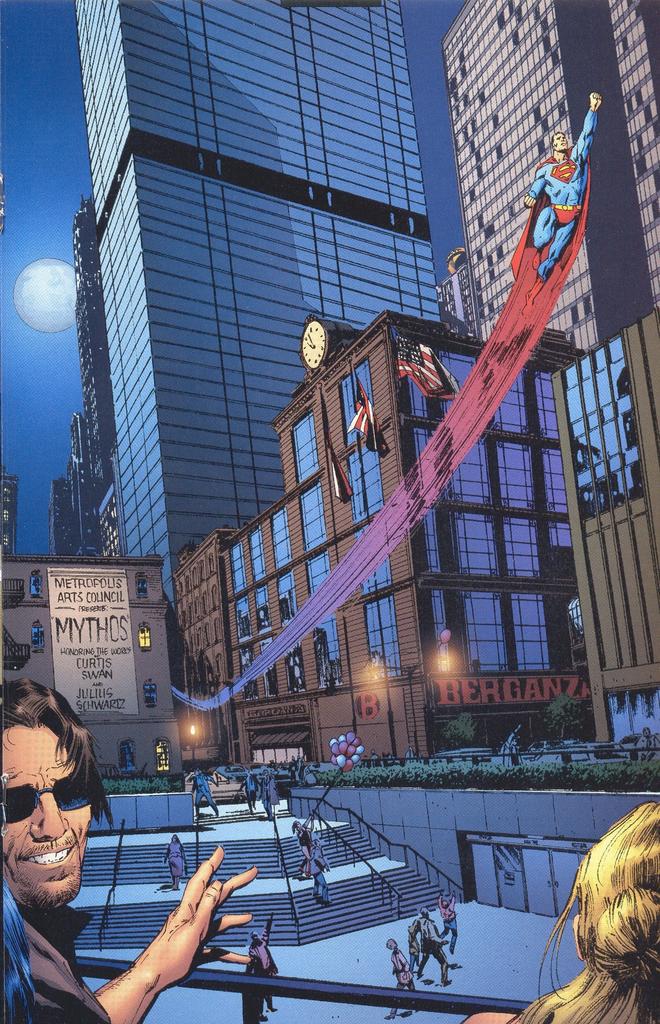 I love the smallness of Superman on this page, the way the buildings still dwarf him. Most Superman artists draw him in midrange shots or close-ups where he commands the whole panel. Guice’s long-shot conveys what is startling about the idea of a man who can fly: he is one of us, not larger than life, and this makes his flight more astounding, not less. The depth of the square in the middle ground (accentuated by the people in the foreground, surrogates for the viewer) contributes to the illusion, the ascending stairs perfectly balancing Superman’s upward arc, making him seem that much lighter. As he pulls away from the earth, the earth itself seems to bend in the opposite direction: two ends of a wishbone. This page is a précis of the issue’s aesthetic strategies in two ways. One: make Superman small, like us, small enough that we can hitch a ride on his coattails, almost imagine what it would be like to soar. Two: accentuate the vertical. Extremes of height and depth. These will be the language through which “superpowers” will be translated into experiences our bodies almost recognize.

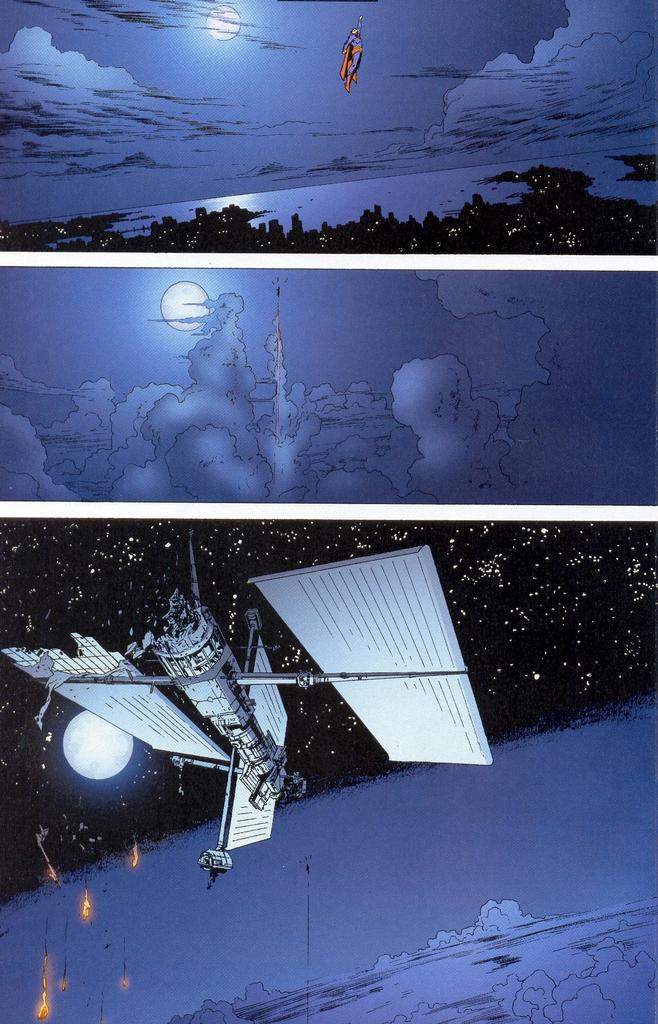 These are not two strategies, but one, and it is repeated again and again: on pages 1-3 Themyscira is falling out of the sky and Diana is rising up to meet it; on page 5 Wally West becomes Flash in a series of vertical slashes; and on pages 13-14, Superman’s higher and higher flight straight up into space is suddenly reversed by Diana’s backward plunge in the ocean’s depths. This surprising, dizzying reversal literally made me catch my breath.
If an issue is going to have as little plot as this one, it had better be brimming with affect—and this one is. It’s pure adrenaline. And the pulse-quickening excitement doesn’t come simply from Guice’s fantastic use of space and movement, but from the repetitions themselves. The visual repetitions I’ve already mentioned, but also the repetitions inherent in Ellis’s script: both the fact that all the heroes discover the same black sheet covered with phosphorescent green characters and the terrific repetition of the ending, which is stagy, but thrilling all the same:
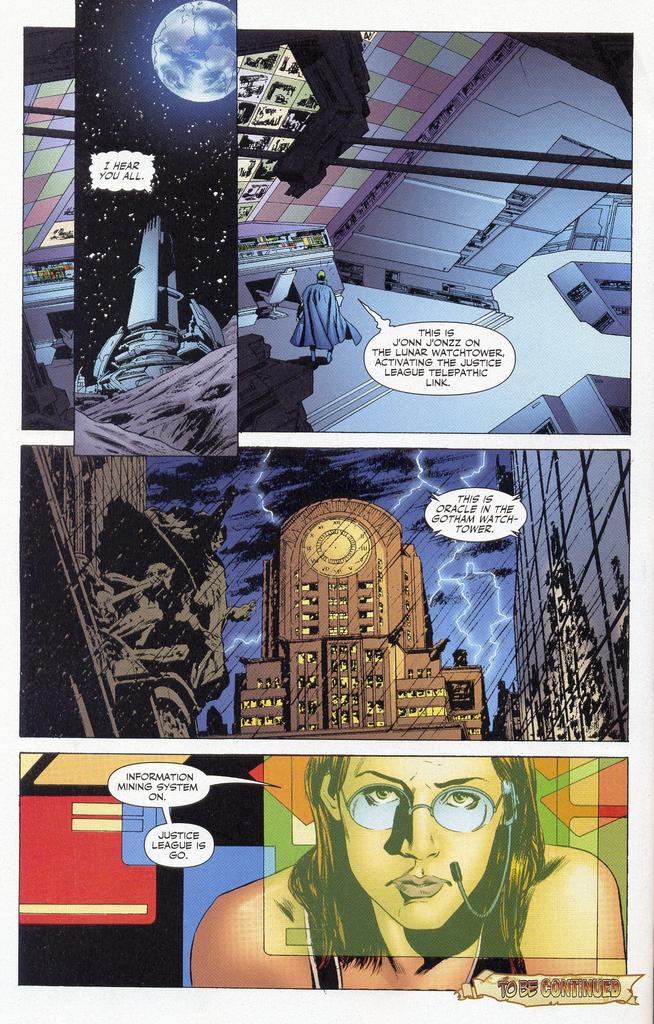 Superman: J’onn, can you hear me?
Diana: J’onn, this is Wonder Woman. I need a consultation.
Kyle: J’onn, this is Green Lantern. I could use some extra brains here.
J’onn: I hear you all. This is J’onn J’onzz on the Lunar Watchtower activating the Justice League telepathic link.
Barbara: This is Oracle in the Gotham Watchtower. Information mining system on. Justice Leage is go.
These repetitions are a perfect condensation of a thousand similar scenes in which the heroes get set to head out and do their thing. Sure we've seen this fetishization of beginnings before, and yes, it’s hokey as hell, but how often is it presented so stylishly? J’onn’s activating the Justice League telepathic link? Alright! Oracle just turned the Information mining system on? I don’t know what that is...but awesome! Justice League is go? You’d better believe it!! hrm.
If you like superheroes, buy this book.
Astonishing X-Men #12 (Marvel)
Joss Whedon (Writer) / John Cassaday (Artist) / Laura Martin (Colorist) / Chris Eliopoulos (Letterer)
 I hate it when reformed villains revert to type.
The wonderful thing about villains and villainesses who reform is that the almost inevitable result is a complex and fascinating character. To begin bad but seek the good is perhaps not quite the universal human condition we might wish, but it certainly is a powerful metaphor for the ethical struggle that most human beings wage within themselves from a very early age between selfish desires and social responsibility. Grant Morrison knew this, which is why Emma Frost was the breakout character of his New X-Men. The subtle variation on this—the pure villain who, every so often, does some tiny nice thing, is possibly even more wonderful, and more true. (For some reason, this rule does not seem to apply to Magneto, who is always boring, except when played by Ian McKellan.)
The other permutations of this scenario are rarely as satisfying, though some come close. When a hero violates some ethical code of heroism but still remains basically good, the effect is again added depth, but the feeling it produces is the melancholy of realism (Zatanna) rather than the euphoric tension of epic, where heroism in the social sense is so often underpinned by selfishness and a yearning for glory (Beowulf).
The even simpler scenario, in which a would-be hero is suddenly revealed as a traitor is thrilling in a different way, and the feeling it produces is again different: something closer to the weird catharsis of certain kinds of tragedy where the so-called “tragic hero” doesn’t have something as dainty as a “fatal flaw” but is a pathetic villain whose sheer audacity commands our attention, if not our sympathy (Shakespeare’s Macbeth, or Wolfman and Perez’s Terra).
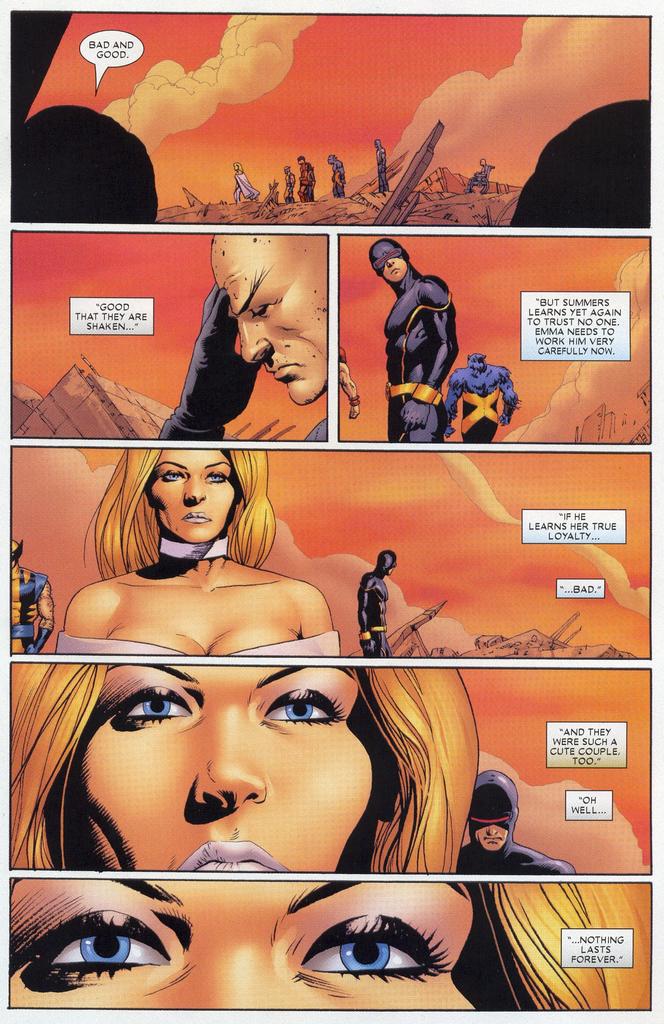 Taken alone, any of these scenarios is thrilling, and maybe I’m just an aesthetic fascist about some things (no maybe about it, actually), but I really don’t savor that moment when they’re thrown together in a pot and combined into a fourth story where the reformed villain slides back into the pit, or is revealed to have never “really” reformed at all. The reason I don’t like this kind of villain/hero/Judas story structure is purely selfish, even childish: it’s not a satisfying wish-fulfillment, but a depressing reality-check. I’m already well aware that real-life “heroism,” more often than not, has a Judas-face. So it is particularly irritating to have a story about the wobbly heroism of a morally complex, multilayered character suddenly reduced to the black and white simplicity of a traitor story. Pure traitors are fine, because our identification with such characters takes a different form than our identification with the villain-turned-edgy hero. The former are admirable only in the most abstract existential terms (we “admire” Macbeth because he never gives up, even though he knows that his own death is inevitable), whereas our involvement with nearly reformed villains like Catman and Emma Frost is far more immediate and visceral. (Which isn’t to say that we don’t “identify” with more conventional heroes as well, but that’s a different, very complicated issue for another day.)
So, did I hate the reveal in Astonishing X-Men #12?
I did not. But only because I trust Joss Whedon to be teasing us like crazy. Whedon knows soap opera and he understands the value of a good sucker punch. He knows that the best way to keep viewers interested is to figure out what they hold sacred and then to rip it away from them cruelly, with extreme prejudice—or, at least, to seem to...
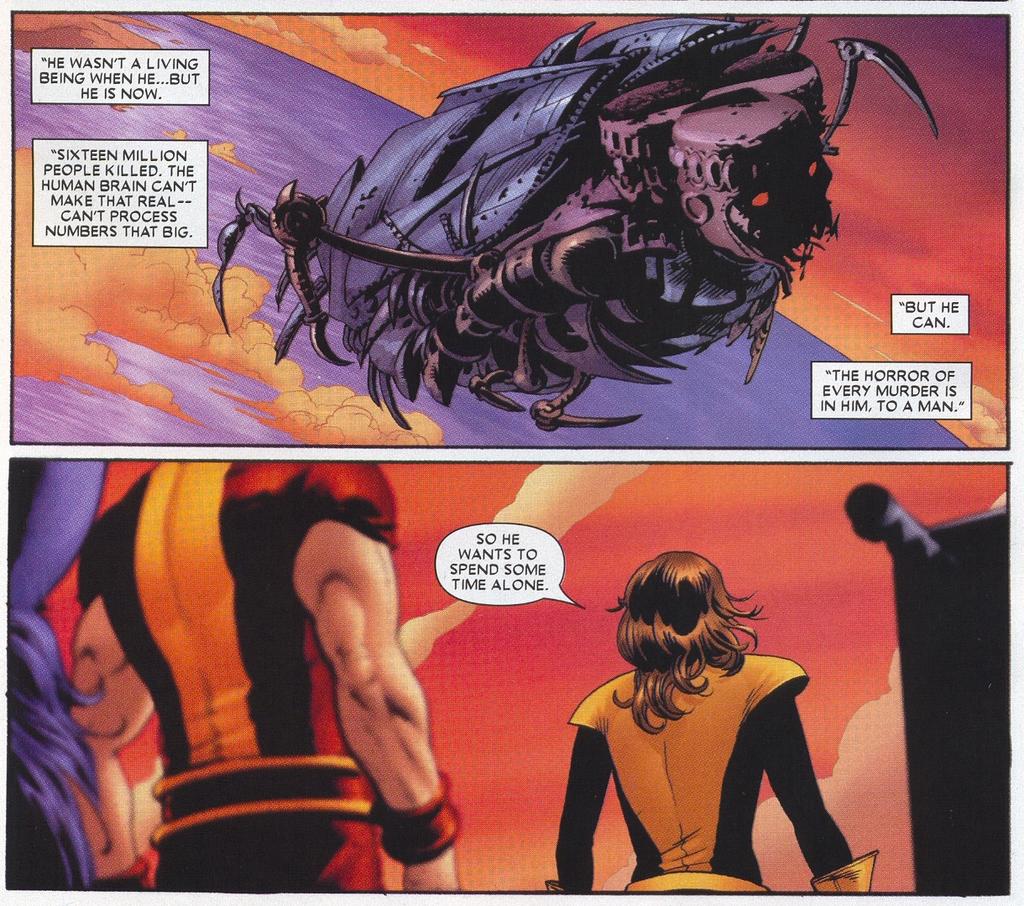 I’m not worried about Emma and Scott. Things are about to get really good on that front. I also really liked the departure of the mega-Sentinel into space in this issue. Lovely. What I did not like was the preposterous retconing of Xavier into a moronic hypocrite. Let’s hope that Whedon and company have a few unplayed cards up their sleeves that will redeem this clunker of a plot point.
notes
Splash-Page of the Week: GØDLAND #2
 My back-ordered copy of GØDLAND #2 finally arrived last week—and it was worth the wait. Holy Moley. That’s the kind of punch I want from my funny-book pictures.
In the unlikely event that you haven’t been lured into checking out the complete first issue of this heady series, now online at Newsarama, here’s the link. And here’s an accompanying interview with the artist, Tom Scioli.
As for GØDLAND #2? I can do no better than to quote Matthew Sweet: 100% Fun.
Low Blow of the Week: Wha…HUH? #1
 You can’t say that Mark Alessi didn’t ask for it, considering all the smack he talked about Marvel back in the day. And yet, there’s something not quite on about big-kid Marvel scoring points off a company that’s not only smaller, but DEFUNCT! Careful guys. You know what they say about school yard bullies...
Geek All-Stars: Manhunter’s Dylan
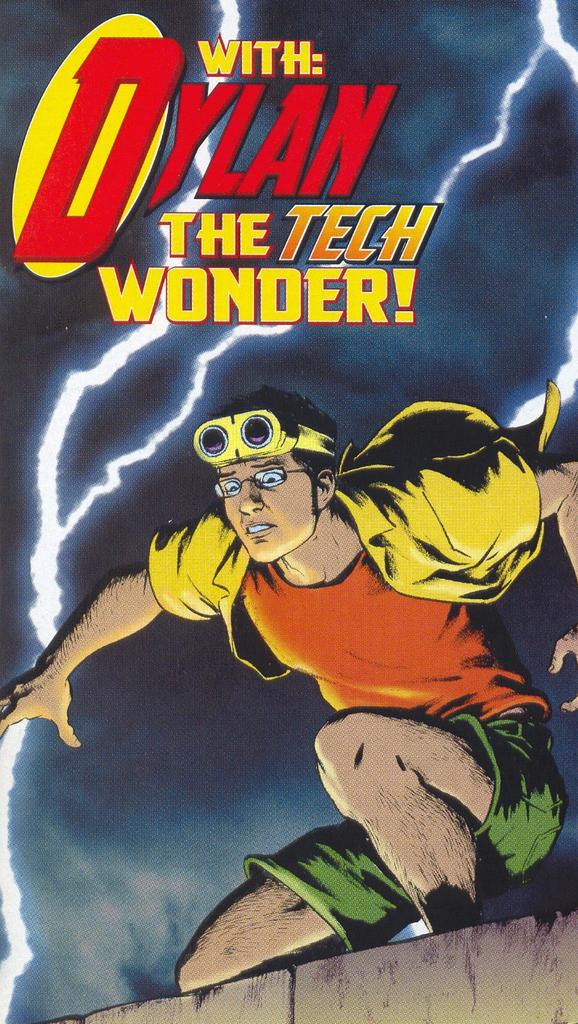
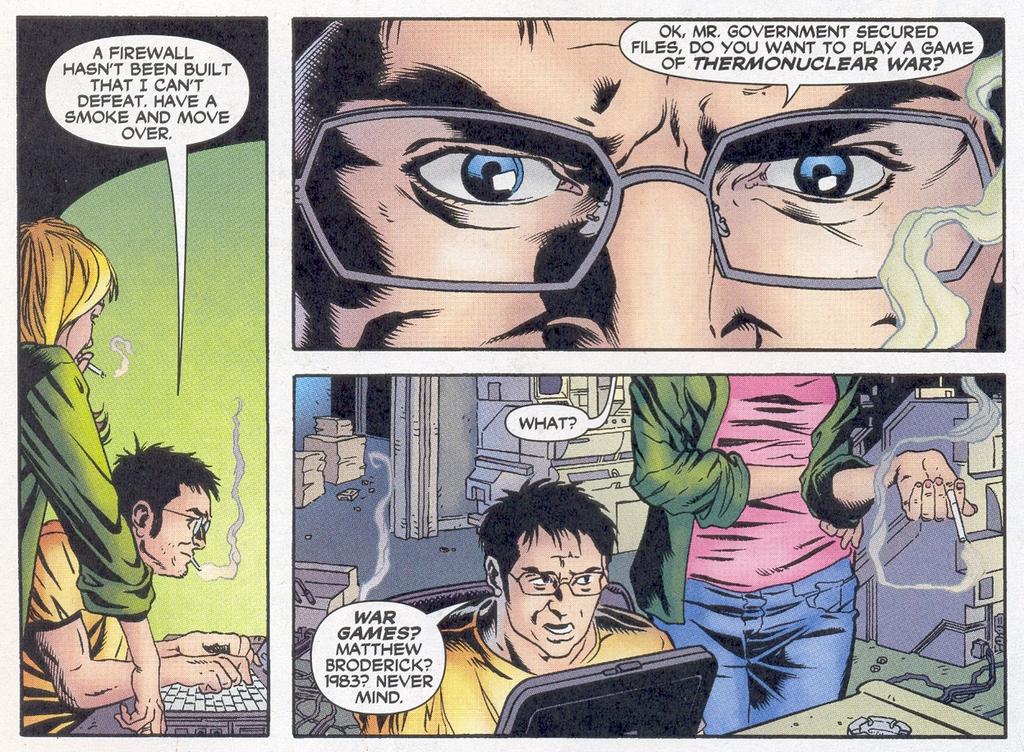 Who says that DC is pandering to the aging base of thirty-something fanboys that help keep this goofy medium afloat? Huh? Who says??
Random Young Avengers Thoughts: TV Comics Are Better Than Movie Comics, or Welcome to the Y.A., Bitch!
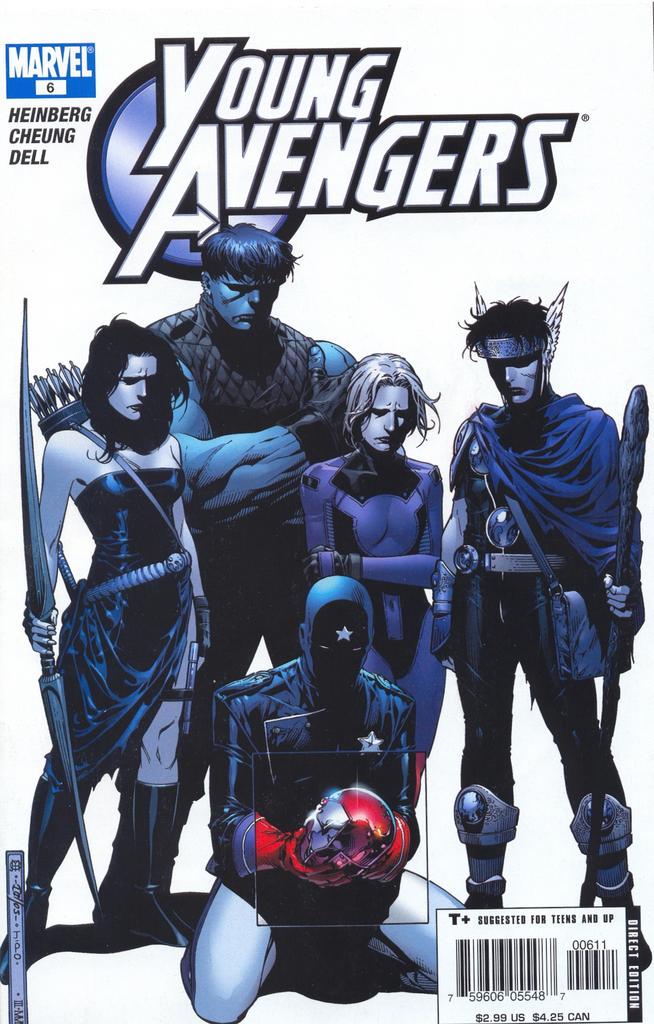 Young Avengers rocks. It’s the smartest, hippest, slickest, wittiest, funnest, most relevant comic Marvel is currently publishing. In fact, it is the only comic Marvel publishes that answers to this particular combination of epithets. I was going to write a lengthy review of Young Avengers #1-6, praising the series to high heaven in my usual tendentious and hyperbolic way. But I ran out of steam. And anyway, Mark Fossen and Michael Pullmann have already said it all and said it eloquently.
 So here’s a half-baked, completely undeveloped idea instead: O.C. writer/producer Allan Heinberg’s Young Avengers demonstrates that comics based on TV-storytelling techniques are superior to comics based on movie-storytelling techniques. Or: more TV serial-style comics (which are denser and faster-moving, even if they do take six issues to tell a story) might save us from the plodding excesses of weak “decompression.” Take it, leave it, run with it; it’s yours.
Creative Team-Up of the Month: Amanda Conner and Power Girl
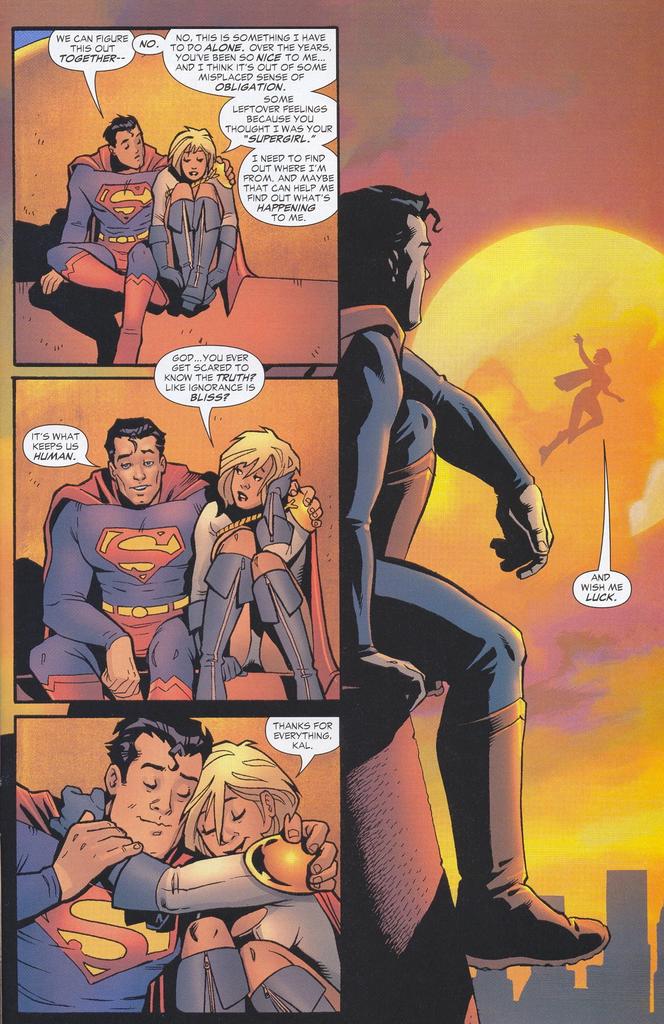
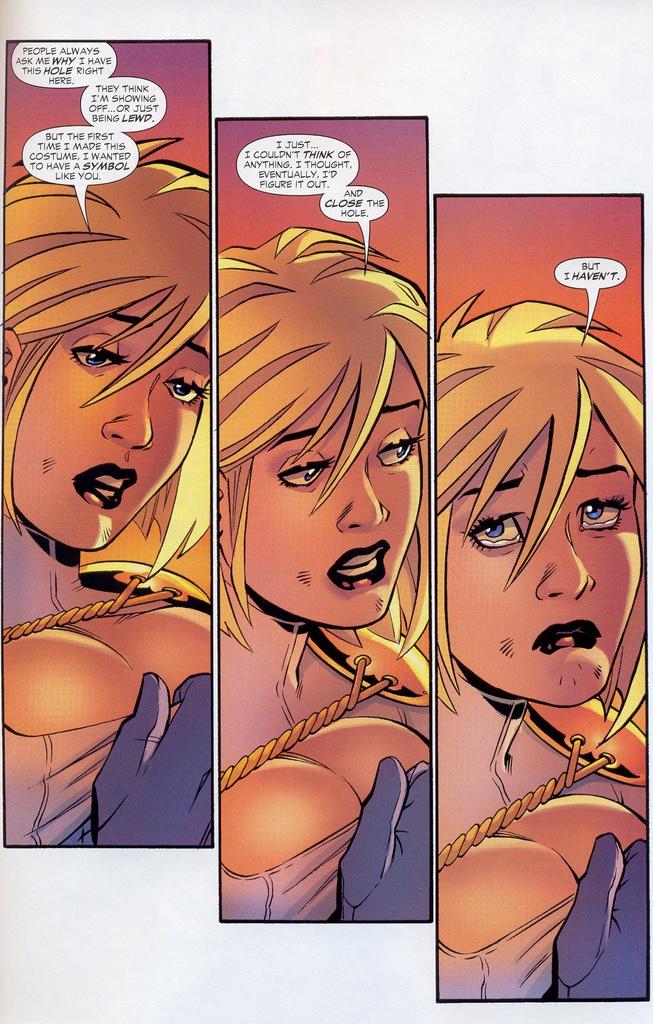 How do you make Power Girl a credible and interesting character? First, you put her in the JSA and get Geoff to wave his magic retcon wand, transforming the peek-a-boo hole in her costume into a meaningful bit of characterization. (The scene on page 19 of JSA: Classified #2 is a nifty bit of symbolic thinking because it discovers depth precisely where there seemed before to be only shallowness.)
To really make this girl (and this reimagining) fly, however, you bring in an artist whose style transcends cheesecake, transforming the protagonist into someone who feels like the real woman inhabiting this body. You find an artist who can do visually what Johns does narratively. You hire Amanda Conner.
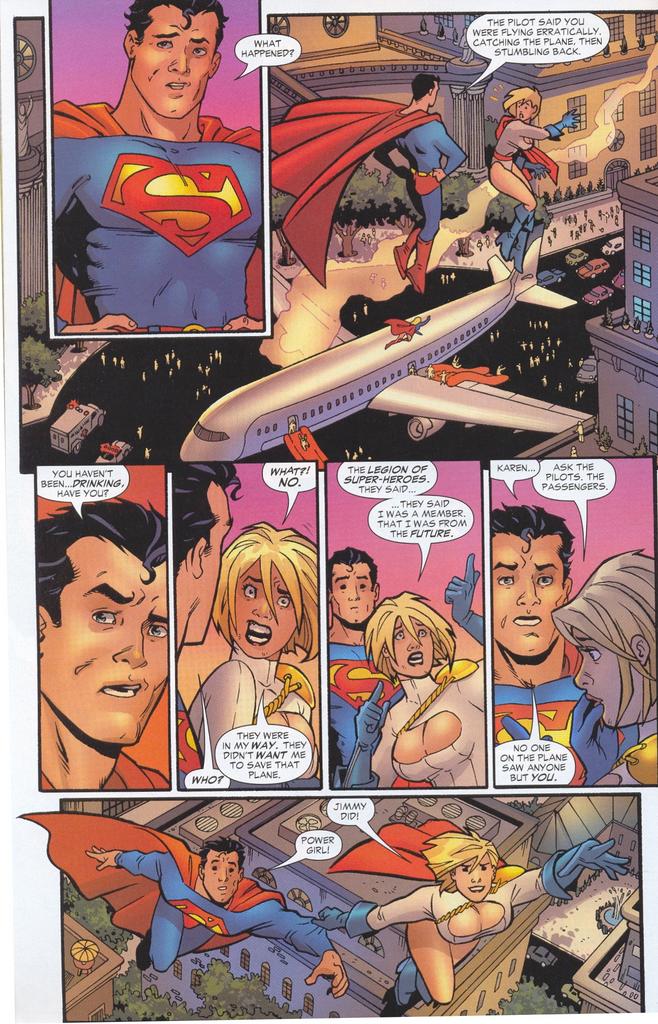
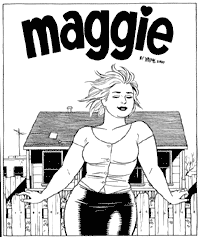
 What’s so special about Conner’s art? It’s more expressive than most mainstream superhero art. It conveys intense emotion through bursts of cartoony body language. She draws great energetic superhero action, but her style sometimes reminds me of Jaime Hernandez. Like Jaime’s, her subtle Archie comix faces are infused with tragedy and realism, and her Power Girl is specifically reminiscent of Jaime’s Maggie: beautiful, big, funny, vulnerable. She breaks your heart at least three times an issue. Is it just a coincidence that this story about Superman’s poor-relation (a would-be refugee from Krypton) could almost have been subtitled: Love and Rockets?
My Essential X-Men, Vol. 6
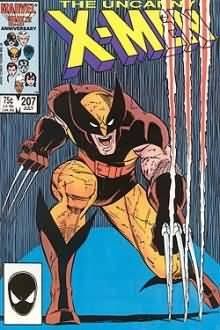 Marvel’s Essential X-Men series has finally caught up with my period of true X-devotion. Volumes 4 and 5 included many of the first Claremont X-Men stories I read: the Dave Cockrum/Paul Smith illustrated Brood Saga with Carol Danvers as Binary was the first (#162-66), followed by “Professor Xavier is a Jerk!” (one of the best X-Men stories ever—with one of the best cliffhangers too). The grimy battles with Callisto's crew in the Morlock tunnels and Barry Windsor Smith’s classic Life/Death issues were also early favorites. But Volume 6 begins almost exactly where I really got serious about this book. By issue #199, I was no longer a casual buyer, but a genuine fan who never missed an issue—despite the fact that I was never entirely sure what was going on.
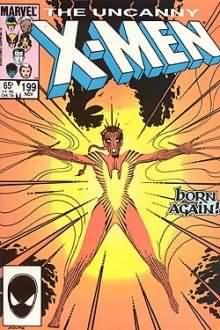 In 1985, I was 13—old enough, certainly, to follow the plot when I tried. But keeping track of Claremont’s Byzantine subplots and innumerable supporting characters involved actual work, and as I’ve already established, I was (and still am) the laziest of readers. I remember hurting my brain trying to figure out how Rachel Summers could be Cyclops’s daughter, but that was a rare instance. Usually I just didn’t try that hard to understand. I liked the mystery. At that time, the pleasure of Uncanny X-Men was not the pleasure of narrative, but the fragmentary pleasure of reading in blocks that I’ve written about before, and that no doubt reminded me of those earlier experiences of childhood reading where one is nestled between confusion and understanding.

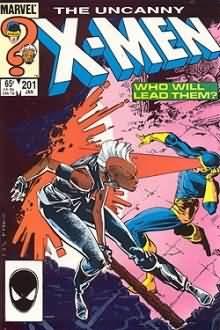 The really wonderful thing about Claremont’s X-Men was that those sections of the book that did hang together as narrative blocks really were jewels. These issues are simply packed with memorable scenes: Charles passing the torch to Magneto in the garden because he thinks he’s dying (#200), Storm vs. Cyclops for leadership of the X-Men (#201), Logan’s brutal issue-length scrap with Rachel (#207), Colossus killing Riptide and a hardcore Storm leaving the “remaining Marauders” to Wolverine as the Mutant Massacre kicks into overdrive (# 211). These scenes of operatic mayhem were truly special, and they stood out in part because they were offset by a background that was both hazy and dense.
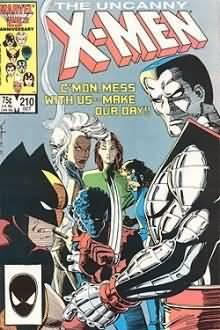 There was always so much pedestrian “business” in X-Men—the trial of Magneto and the behind-the-scenes machinations of Mystique’s Freedom Force being particularly typical examples. I found these (often issue-long) background stories unreadable, and, in fact, I often skipped over them for the fight scenes. Nonetheless, the boring bits were integral to the experience of the X-Men in those days: they gave the emotionally overwrought battles I loved a feeling of weightiness and import. In short, they made the book feel sophisticated and adult precisely because they were over my head. Claremont’s wonderful obscurantism pushed back the feeling of readerly competence that would come with adulthood a few years at least.
These are classic stories, and reading them now is in many ways a different experience than reading them then because—surprise, surprise—they really are coherent narratives after all. And good ones at that. But even just flipping through this collection is a treat; it may only be black and white, but the art is excellent. This was a great period for John Romita Jr.—his lines are fluid and free, and there’s a compositional daring to his panel layouts that still really grabs me. (I did a comic book project for a junior high class around this time in which I basically plagiarized panels from a variety of Marvel comics, several of which were Romita Jr. ones included here, like the time-lapse image of Valerie Cooper plotting at the bottom of page 6 from issue #199.)
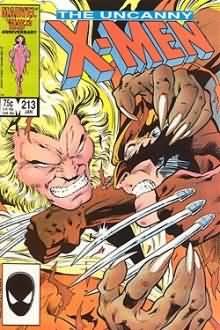 The collection also features art by such masters as Art Adams, Barry Windsor Smith, Walt Simonson, Jackson (soon-to-be “Butch”) Guice and Kyle Baker, and Alan Davis. The complete unpredictability of the art from issue-to-issue was also something I loved about this period of X-Men—which is strange, because I hated fill-in artists on any other book. Clearly, the quality of the fill-ins here was generally exceptional, but there was also something about the constantly shifting art team that made this period of Claremont’s X-Men feel “cosmopolitan.” It also distinguished it from my favorite book, the New Teen Titans, which was marked by the consistency of George Perez’s pencils. The opposite approaches to art on Marvel and DC’s rival bestsellers made them even more complementary than they might have been had X-Men had a stable art team. This complementarity ultimately balanced the scales, making these two books so fundamentally different that they were difficult to compare.
 In terms of size, Essential X-Men, Vol. 6 is a massive phonebook of a collection, taking readers from the trial of Magneto right through the Mutant Massacre to the introduction of Psylocke. It also includes the X-Factor and New Mutants crossover books from the Mutant Massacre, as well as the other ones that I never bothered buying at the time: Thor and Power Pack. And it gives us the Asgardian adventure from New Mutants Special Edition #1 and X-Men Annual #9, both gorgeously illustrated by Art Adams (whose work still looks tremendous in black and white). Marvel’s spotty Visionaries trades could learn a thing or two from the generosity of Essentials compilations like this one.
Now, if only they would get cracking on Essential New Mutants.
Make Mine Mae Mai!
 Jon Silpayamanant is not only running an outstanding blog of comics and cultural criticism called Mae Mai, where he brings an exceptional range of erudition to the analysis of comics and visual art, he’s also a hell of a generous thinker. (You’ve probably seen his name in the comments section of more than one blog, including this one.) Jon describes Mae Mai as “Comics, Orientalism, Culture and Imperialism, Comparative Neurolinguistics, and Performance Theory.” All I can say is, anyone who can bring Edward Said and W. J. T. Mitchell to bear on comics in such illuminating ways is someone everyone interested in comics criticism should be reading. Religiously.
My Ever-Shrinking Bank Account
 Ian has a great piece at Brill Building that explains why I’m such a Johns junkie: it turns out he’s one of my favorite Marvel writers, Steve Englehart, in disguise! I know what I’m buying tomorrow. That, and the Essentials collection of Steve Gerber’s Howard the Duck, thanks to this fantastic set of posts at Nobody Laughs At Mister Fish. I won’t have time to read them, but that’s another story (see Rant, below).
The CrossGen Chronicles (Part 2): Scion #13-14

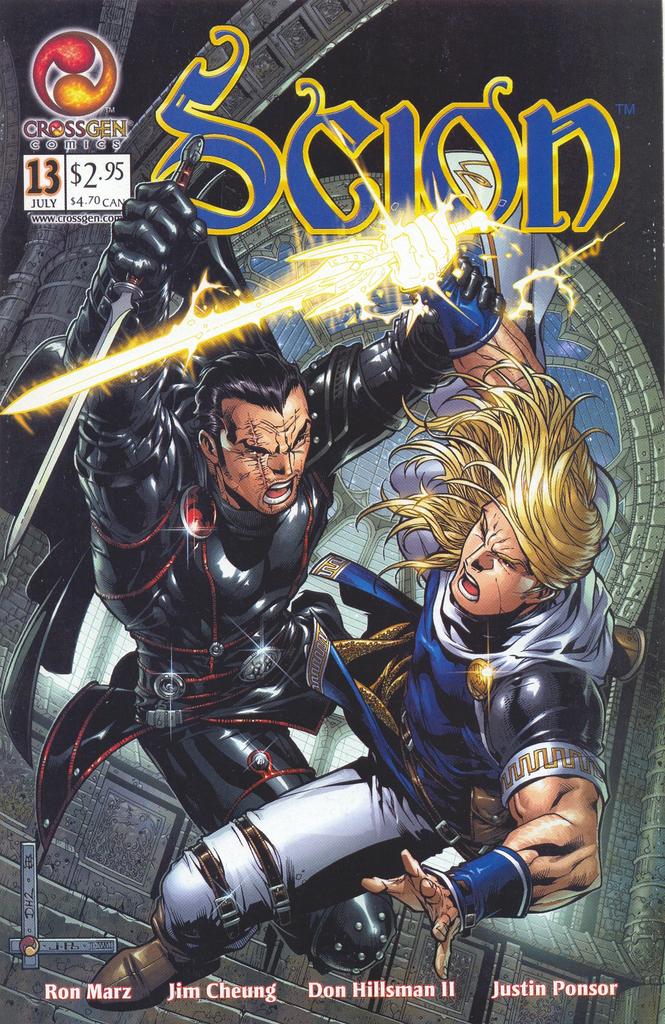 A medieval world with lightsabers and genetically engineered “Lesser Races.” Warring kingdoms: Raven and Heron. A murdered monarch. A treacherous son. A golden haired hero on a mission of vengeance. A beautiful, good-hearted princess from a corrupt kingdom. A mysterious “Underground” where the Lesser Races plot their freedom. And among them all walk godlike beings with agendas of their own…
 Everything about Ron Marz and Jim Cheung’s Scion felt familiar. Star-crossed Heron prince Ethan and Raven princess Ashleigh were essentially riffs on Shakespeare’s famous teen lovers, played as Luke Skywalker and Dana Scully in buckled tunics and leather D&D-wear. And like many of CrossGen’s titles, it seems to have sprung directly from the genetically engineered brain of Joseph Campbell that Mark Alessi and head writer Barbara Kesel kept on ice in the basement of the company’s famed (now infamous) Tampa studio. The story was self-consciously archetypal and basically conservative. Reading it was like curling up in a warm blanket on a cold day. Neither particularly challenging nor profound, it was nonetheless a comforting and beautifully-illustrated fantasy.
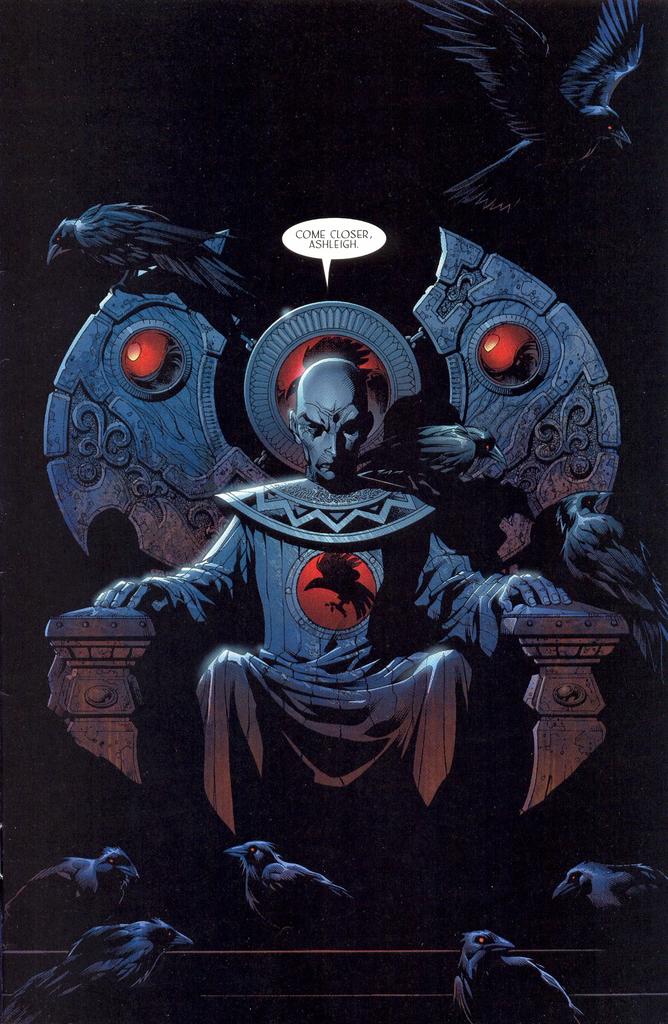 Issues #13 and #14 were the first ones I read. I bought them together off the rack the week after discovering Crux. And though I found the medieval-SF concept vaguely appealing, the real reason I bought these issues was the art by Jim Cheung (pencils) and Don Hillsman II (inks), and especially the gorgeous coloring of Justin Ponsor. Cheung was still honing his craft in these issues, but they contain some truly exquisite sequences, and it’s really something to see how quickly his work develops from the earliest issues of Scion (which I read later in trade form) to these ones, and then to compare the drawings in these issues with his current work on Young Avengers.
 Two scenes from this pair of issues really stood out as I thumbed through the comics in the store. Ashleigh’s nightmare about her brother’s regicide/patricide on pages 1-3 of issue #13 and Ashleigh and Ethan’s flight through the underground tunnels to the sanctuary at the end of issue #14. They are both chiaroscuro scenes lit only by lamplight or (seemingly) blood.
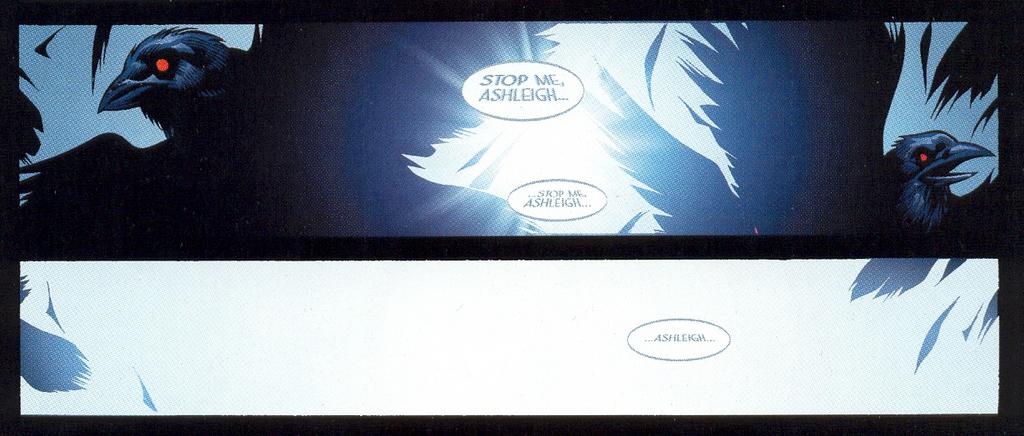 Unfortunately, the feeling these scenes convey visually is more disturbing and weighty than the series itself ultimately manages to be—clearly because it was consciously designed with a junior high school readership in mind (as part of CrossGen’s educational “Bridges” program). These scenes stand out because they convey a potential that was not realizable within the narrative constraints of the CrossGen universe (by which I do not mean their overarching continuity-driven mega-story, but the corporate calculations of things like the Bridges program which—at least as I understand it—effectively consigned certain titles within a single overarching story to never surpassing a certain “level” of reader sophistication. There was an annoying contradiction here that resulted from CrossGen trying to be all things to all readers, and having books like Scion pull double duty as both feeders for younger audiences and bricks within the larger story which had more sophisticated themes, story elements, and ambitions.
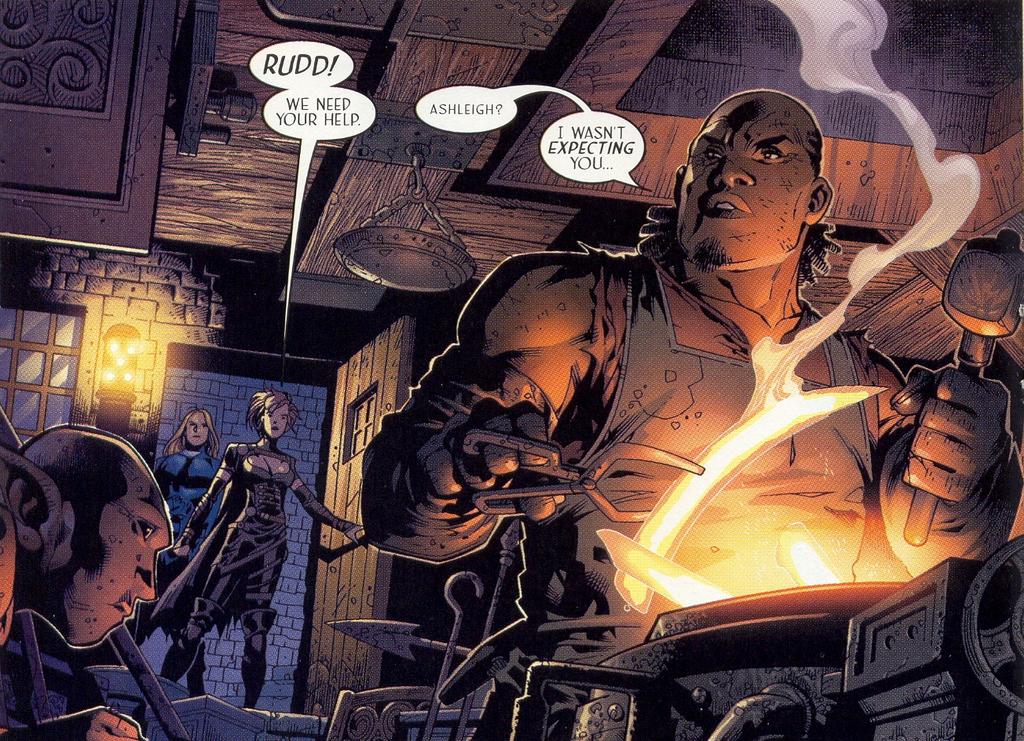 So, although I enjoyed this book, I often found myself wondering what might have been had Marz really cut loose and aimed higher, unencumbered by CrossGen’s corporate master plan. Scion was good, sometimes very good. With an art and writing team as extraordinary as this one, however, Scion could have been something far richer and deeper than it ultimately became. What Marz and Cheung’s archetype-driven Scion turned out to be, ironically, was the archetypal CrossGen book in the sense that it encapsulated both the strengths (incredibly talented and creative people) and the weaknesses (a built in set of narrative limits and restrictions) of CrossGen’s entire line—at least in its first two years.

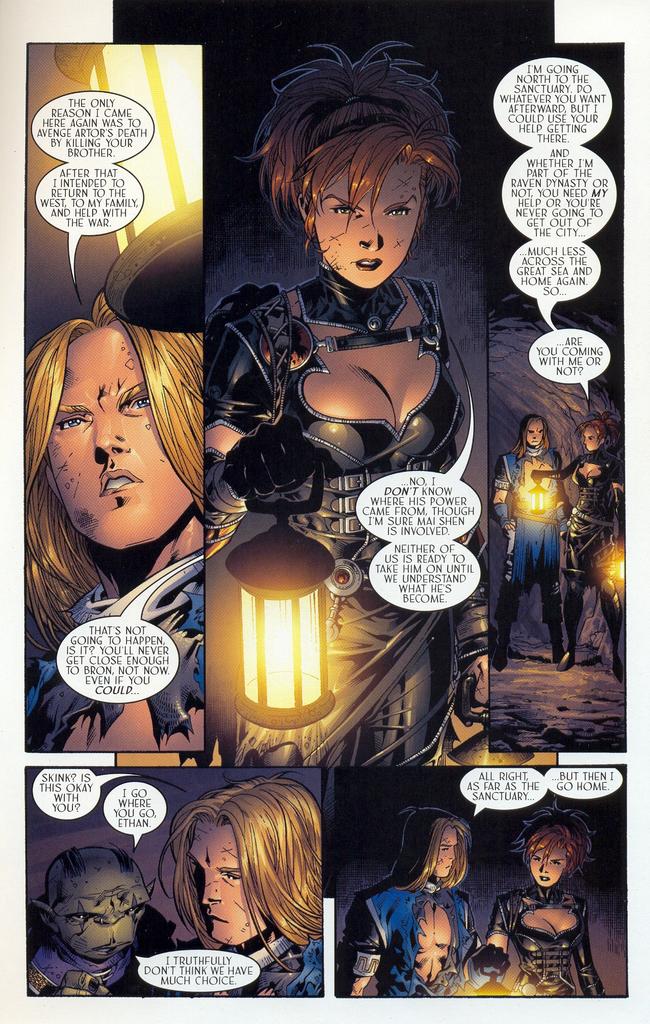 For more on Scion, see Chris Fluit’s excellent review of the entire series at Captain Comics, which charts the high and low points of Ethan and Ashleigh’s adventures. James Meeley has also been thinking about the strengths and weaknesses of CrossGen lately in this excellent post where, like yours truly, he laments what might have been...

rants
What the ^%$*# Happened to Jim Roeg?
I’ve been asking myself the same question. I’m over a week late with Spoilers Abound, I haven’t posted a new essay in weeks, and I’ve dropped the ball on several really interesting conversations taking place on other blogs. Heck, I haven’t even made it to the comic store yet this week!
Ah, September.
As anyone else out there who works in education knows, September is a vortex. No matter how prepared you think you are for the new school year, it always takes you by surprise, and it’s always more overwhelming than you remember.
In light of this, and as readers of Near Mint Heroes already know, I’m going to be taking a very brief sabbatical from Double Articulation for the next month or so to devote 100% of my energies to the work that actually keeps me in comics, sandwiches, and clean socks. You haven’t gotten rid of me for good though. I’ll be back with new essays, commentary, and all the usual self-indulgent nonsense that you’ve come to expect from this site in mid-October. I’ve got three more essays on love in comics mapped out, as well as other essays planned on the perfection of David Anthony Kraft’s Defenders, Biblical allusions in a beloved issue of the old (good) Marvel Team-Up, commodities and capitalism in The Spectre, and the seductions of fascism in the barely-remembered Super-Villain Team-Up. Probably something on my strange relationship with epic-fantasy as well, but only if I’m feeling punitive.
In the meantime, enjoy the archives, if you haven’t had a chance to check them out already and if you have a tolerance for ponderous, sentimental recollections. Before I sign off: a big thank you to Ian, Peter, Mark, and Jog for the nice attention and for sending a few more readers in this direction. Thanks a lot guys! Now that I’m slowing things down here for a bit, I’m hoping to finally catch up on your and everyone else’s blogs. (Did I say 100% of my energies will be going towards work? Make that 99.9%. You’d be amazed how much goofing off I can cram into 0.01%.)
Thanks everyone for reading and for your thoughtful comments and replies; it’s been an incredibly fun and educational summer for me. See you back here in October, and of course, around the blogverse in the meantime.
Jim

 Posts

