Sunday, November 12, 2006

Double Articulation Digest #2

Doctor Strange: The Oath #1-2 – There’s still time. If you hesitated about buying the first issue because the cover logo was so inexplicably ugly, it’s probably not too late to reconsider. My advice? Just suck it up and take the plunge. Yes, the logo is hideous; but if you turn the page quickly, you’ll forget it in no time. Brian K. Vaughan and Marcos Martin are outdoing themselves in this witty, beautiful story, which is by far the most assured and entertaining Doctor Strange tale I’ve read in many years. Vaughan’s wry take on the Stephen Strange/Wong relationship is perfection, and so is his use of Florence Nightingale fetishist Night Nurse, a salty structural stand-in for Clea who uses bobby pins instead of spells. Who says Marvel doesn’t know a thing or two about style?

Annihilation #4 – The exciting twists and turns of this space saga are further evidence that Marvel needs to liberate both its writers and its fans from the creative quagmire of Civil War a.s.a.p. Annihilation is a “traditional” space saga—by which I mean, it has an entertaining story, appealing characters, and beautiful art. This issue contains some satisfying revelations about Annihilus’s plans and gives more airtime to one of my favorite second-string Avengers: Moondragon. Oh, and it features one titanic ass-kicking. The best issue so far of a series that is shaping up to be outstanding. If only the Marvel webmasters could succeed in matching the covers with their correct issue descriptions in their on-line catalog (the actual cover to this issue is here). While they’re at it, perhaps they could make the Marvel website legible. Even after its reorganization, it is still, hands down, the most unnavigable company site on the web.

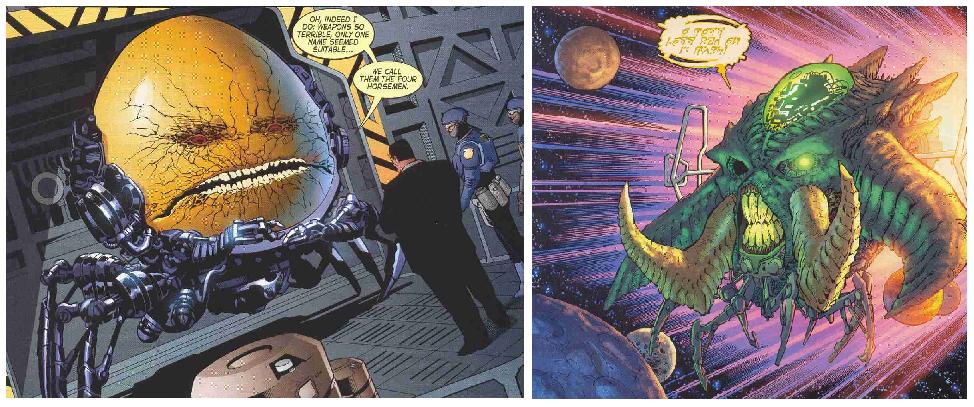
52 #25,#26, and #27 – There’s no shortage of things to praise about 52, but one thing I’m especially enjoying is its revival of DC’s more freakish characters, as well as its invention of new ones. Oh, Grant Morrison.


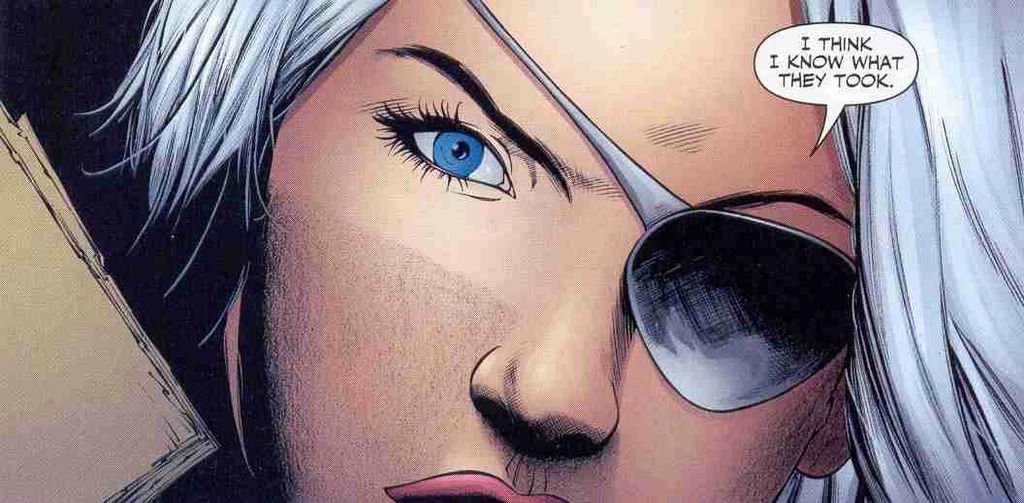
Is Chang Tzu “Egg Fu”? And more importantly, why do both he and Emerald Eyed Ekron have all those crazy robot legs?? (And who’s “driving” Ekron??? Or do my eyes deceive me?) Can we expect more disturbing monster-heads? 52 is so entertaining that someone is going to have to invent a special industry award just to honor it. Am also loving Ralph’s Orphic Odyssey. Not to mention the promised integration and rationalization of DC’s time-travel characters. Interesting too that the most recent issue appears to confirm my (and probably everyone’s) suspicion that the little girl on the cover of week 25 foreshadows of Renee Montoya’s future. R.I.P. Vic Sage; long live The Question.

Jonah Hex #13 – The already unmissable series gets gussied up a little further as Justin Gray & Jimmy Palmiotti are joined by international comics artist Jordi Bernet to tell the origin of Jonah Hex. The story is gripping and the interior art every bit as rich and expressive as the superb cover image suggests. What a treat, for as good as this series has been, the charm of this issue is that it actually looks like classic Western comic. Highly recommended.

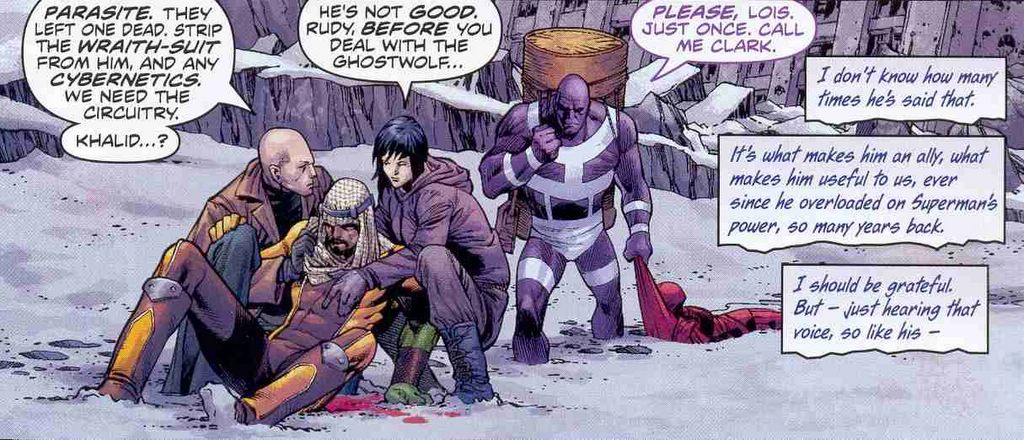
Superman #657 – This is turning into one of the best Superman stories ever told. Seriously. Busiek is on fire writing an apocalyptic future in which Superman’s own body becomes the missile that send the earth into a state of nuclear winter.


The apocalyptic future has long been a cliché of the superhero genre, but it feels different this time. The “superteam” of Luthor, Lois, Jimmy, and Parasite on the cover is...so cool. And Pacheco’s art…gasp! The cover. The two-page spread of Metropolis falling into the sea. Everything here is just so beautifully rendered. I have nothing intelligent to say about this except: more please!

Teen Titans #40 – This was a good issue. But precisely because it was good, it also reveals the main limitations of the current series. When I finished reading it I thought: “Well, that was…moderately fun. It reminded me of some great stories from the past.” But, unfortunately, that’s about the most I could say about it. As my various Teen Titans posts over the past year and half have indicated, I’m tremendously ambivalent about this series, despite my nearly sycophantic admiration for Geoff Johns’s work on virtually every other title we writes, and despite (or perhaps because of) my fetish for the Titans era that Johns’s current series is attempting to emulate. I really like the One Year Later team; for the first time since the end of Wolfman’s brilliant Titans-Hunt saga, Johns has created a Titans team that could be spectacular. The group has energy, dynamism, and strikes a winning balance between novelty and tradition. And yet, despite a lot of action, globetrotting, new characters, and revelations, the actual story of this team still feels like it hasn’t started yet. I’m still asking myself, who are these characters? Who (especially) is Raven? And not in a gee-I-can’t-wait-to-find-out kind of way. More like an annoyed, wtf? kind of way. Similarly, the reveal at the end of this issue was enjoyable. But in a Johnsian universe, it was also inevitable (even though, I admit, I hadn’t predicted it). My complaint is that being caught by surprise this way can only be a mild thrill, and after awhile, begins to feel like a cheap trick if it isn’t supported by the kind of intricate character development and extended serio-comic “a day in the life…” downtime that was a hallmark of the classic New Teen Titans upon which so much of a reader’s enjoyment of the current series depends. What I don’t like about the current series, then, is its selective use of those Wolfman-Perez stories: it keeps much of their content, but throws out the form. What this new series has made me realize is that (nostalgia aside) my love of those earlier tales had as much to do with their formal density as with their treatment of plot and character. And of course, the two things are inseparable. Between Wolfman’s verbosity and Perez’s super-compressed, multi-panel pages, the classic New Teen Titans actually had room to deliver substantial doses of action and reflection every issue. The Johns/Daniel stories, however, are still too decompressed to do this adequately, so instead, they tend to build character development and reflection into their action sequences, sequences which are themselves simultaneously rushed (because there are too few panels per page) and overextended (because they take up so much of each issue). The result is a frenzied pace that never quite allows the team to gel. For an older fan like me, it all feels a little too much like the proverbial sound and fury… And yet, fulfillment is so close, you can almost taste it. Gah!

Saturday, November 04, 2006

Kryptonian Fathers, Kryptonian Sons


Action Comics #844 – I wasn’t sure about this at first, but now that I’ve adjusted my brain to recognize this as a Richard Donner Superman film in the form of a comic (not a regular DCU Superman book), I’m enchanted. The orphan’s fantasy of recovering the absent father that pervades the Donner films is the driving force here too as Superman intervenes in what appears to be his own story being played out a second time. This is a compelling premise because while Superman’s intervention in this issue brings his own position in the orphan/foster-father narrative full circle, it does so in a way that may allow him to heal the initial gap between himself and the ghost-father/Mighty Oz, Jor-El. By becoming the space-boy’s guardian, Superman consciously steps into the role of archetypally good foster-father, Pa Kent; yet, because he and the boy are (apparently) both Kryptonian, Superman potentially transcends the position of “alien” foster-father to symbolically recover the original absent father, Jor-El—that is, he recovers his own father by “becoming” a “real” Kryptonian father in relation to a “real” Kryptonian boy/self.

No doubt, complications will ensue to muck with the promise of such mythic fulfillments. But it’s a tantalizing premise all the same, and its pathos is enhanced by the “filmic” visuals supplied by Adam Kubert in this issue. By “filmic” I don’t mean “grand” or “panoramic,” but quite the opposite: strangely subdued, realistic, plain. The banal details of the lab make it feel ordinary. Superman hovers cross-legged talking with the boy as he eats a sandwich on plastic toy furniture. The cubicles at the Daily Planet where Lois is working late have an exceptional degree of cinematic vraisemblance. There are no “supervillains,” yet. Barely any powers. That’s why the action sequences feel heavy—rather like “special effects.” (Could the producers not afford a conceptual artist to design a convincing spaceship? Is that why the child is “delivered” to earth in a giant wheel of brie?)


But this isn’t a criticism. What I am describing is the “austerity” that Hollywood cinema brings to the superhero movie because budget constraints require a stingy and very deliberate parceling out of visual departures from everyday realism. Superpowers are expensive, which is why the movie-Superman and his spandex-clad fellows spend so much time acting as brooding metaphors in superhero cinema rather than tossing bad guys around. When this kind of situational austerity is transferred to comic books—usually in adaptations of superhero films—the effect is almost invariably ugly, boring, and depressing. (I don’t think I’ve ever read a comic book movie adaptation that I’ve liked. And of course, that’s partly because such things aren’t written for me anyway; the adaptation is a “mediating” genre written for film goers who don’t read comics, though it’s hard to imagine that they’d be convinced to try more by such labored introductions.) Here, however, the Johns/ Donner script and Kubert’s translation of the restraint and austerity that comes from Donner’s (and Johns’s) film background produces a deeply gratifying effect, perhaps because the story is not an adaptation and because the paring down of the “color” of the regular DC Universe in the pages of Action Comics gives the plot a melancholy and nostalgic feeling that fits.

And there’s something else too. In a story like this, whose main concerns are thematic (and not intrinsically tied to the superhero genre, even if they find in its tropes a particularly congenial form of expression), the shift from a comic book aesthetic of spectacle to a filmic aesthetic of superhero “realism” confers a significant advantage. Namely, the reduction of ordinary spectacle means that the moments in which “special effects” are employed resonate with unusual power. The image of the boy holding the entertainment unit over his head is extraordinary, but we’d barely notice it in an ordinary superhero book. The same is true for the remarkably evocative illustrations of Superman sitting with the boy as he eats his sandwich or talking over his case with the scientists while the boy lays asleep in the racecar-shaped bed. These images take us to the heart of an emotion that runs deep and is, I suspect, fundamental to Superman’s continuing appeal, particularly for men who can no longer lay claim to the territory of boyhood, despite their most ingenious and self-flattering efforts. That these images are set within a story about relationships between sons and fathers is not coincidental. The feeling they evoke is not one that I expected myself to be moved by, because it is almost too corny to name. But as I get older, it’s one that, increasingly, gives me pause. Especially when it is presented as delicately and earnestly as it is here.

Tuesday, October 31, 2006

On Halloween: Shrouded Skeletons and Friendly Ghosts

The covers of classic horror titles were often far superior to the “chilling, thrilling tales of mystery and suspense” they promised inside. Take this cover from Dell’s Ghost Stories #30 (1971), for instance, which I bought recently because it struck me with the force of archaic recognition.


Everything, everything that matters, is here. The greenish night. The house on the hill. The broken shutter. The bent and useless fences. The black claw of tree that reaches for the house and in the same moment frames it in the protective curve of its trunk. The spectral bat that frames it on the other side, flying us into the pinprick at the picture’s center: that eerily lighted room. (Look closely: it is a human figure.)

It is of course this room that has the broken shutter; like the house surrounded by broken fences, it must bear the signs of supernatural breach. Even these broken fences are doubled by the merely relative (and thus deceptive) frames of tree and bat whose ability to enclose depends on your point of view, as if you can never have too many signs of rupture.

And supervening all, the grey skeleton, veiled. Or is that “bed-sheeted”? A garment of ghostly mist that blankets the house, not so much framing as enveloping. Snugly and reassuringly. The garment of a grim Casper, an ultimately friendly ghost. A quaint spectre who “tucks us in.” A “familiar.”

For this is not an image of horror. Those images are different, and I would discover them in other places. (A coffee table book filled with giant color photographs of insects that I was afraid to touch. Pages swarming with ladybugs.) This is a picture of cozy transgression. It is “spooky,” not frightening.

No doubt, we could roll out the entire psychoanalytical machinery of Oedipus and the family to understand the domesticated “secret” of this skeleton in bed sheets. But must we? For me, the intensity of this painting resides not in the promise of unveiling, but rather in the satisfactions of deferment. Its signs of transgression are a ruse. The doubling, tripling of broken frames (shutter, fences, tree/bat) do not “disclose” the painting’s “secret.” They are the secret. It is literally an open secret, displayed on the surface. Like the pallid ghost stories behind the cover, the promised secret is too banal to read. (The stories inside have nothing to do with the cover—total detachment, infinite deferral; the revelation of the secret, what “only the ghost knows,” must be sought elsewhere, perpetually. A definition of pleasure.) This is a painting of the only true “secret”: the one that cannot be known. That yellow room. A pinprick.

In the end, this cover painting attracts me because it is an image of our profound delight in secrets. And this delight is condensed in the childhood bogey of the shrouded skeleton because—with its familiar, comforting bed-sheet and its only half-disclosed grinning skull—it is our most intimate, most reassuring signifier of the pleasures of secrecy. The keeper of a “chilling, thrilling” “mystery” whose solution is perpetually “in suspense.”

A friendly ghost.

Why I love Halloween.

__________
For more friendly ghosts, visit Keith Milford’s Old Haunts.

Sunday, October 29, 2006

Multiple Articulation: Links

Any Eventuality's Nobody examines the New Earth-Prime emerging from DC’s 52. And follow-up.

Chris Ware’s foldout history of intertextuality, Jonathan Lethem on Philip K. Dick, Steve Almond on James Frey, and more. (Thanks Thomas!)

Booby Kids. Panic Restaurant. Divine Divinity. 50 Worst Video Game Names Ever. Come for the names; stay for the biting sarcasm. (Thanks Dioscuri!)

With his usual wit and precision, Plok explains why Civil War falters at the level of storytelling and argues that we need to bring back thought balloons. I could NOT agree more.

Dave Campbell abuses the Nuclear Family, silly but beloved creations by Mike W. Barr and Jim Aparo.

Six-word Science Fiction Stories by Joss Whedon, Stan Lee, Alan Moore, Margaret Atwood, and many more. (Thanks again Thomas!) My contribution: Booby Kids. Panic Restaurant. Divine Divinity.

Anyone else want to play?

Saturday, October 28, 2006

Lost Objects 2: What Was It?


Walt Disney Uncle Scrooge #175 (1980)

Friday, October 27, 2006

On Comic Book Blog Names: Notes on a Subgenre

I was cleaning up my link list this evening and got to thinking about what makes for a good comic blog name. Aside from good old-fashioned geek wit, I mean.

Naming anything is difficult, but naming a living document like a newspaper, a magazine, or a blog is especially tricky. The function of a name is to individualize, yet, for documents whose content is constantly changing and evolving, the best names, perhaps, are those that paradoxically “individualize” in the most general, most inclusive way possible. Mark Fossen’s brilliantly named Focused Totality is the epitome of this individualizing-yet-inclusive paradox.

The implicit model upon which this and many other such blog names rely is the proper name. Billy, Sarah, Geordie, Ahmed, Frances: these names may have some cultural meanings, some vague connotations, even a specific tone, but they remain, in every way that matters, empty signifiers. Blog names modeled on the proper name may convey a kind of attitude or sensibility, but they can still be “filled” with any content whatsoever and will come, retrospectively, to stand for whatever fills them, no matter how contradictory or complex that content might become. Moreover, it is no doubt precisely the diaristic, open-ended quality of blog composition—the fact that, like the diary, it is a record of the unfolding of a life—that leads Blogger to have a registration field for “blog name” rather than “blog title.”

Of course, because we are talking about a specific subgenre of blogs, the titles frequently (though certainly not inevitably) allude in some way to comic books or to fan culture more generally. Sometimes the “allusions” are very direct, other times they are subtle to the point of imperceptibility, and together these types form two ends of a spectrum upon which most comic book blog names can be found. Running parallel to this spectrum is an array of names that make no allusion to comics—a fact which produces a curiously pleasing effect of displacement when you begin reading them.

Naming one’s blog is obviously a very personal thing because it amounts, in a strange way, to an extension of its author’s proper name, regardless of whether they use a pseudonym or not. I am therefore hesitant to offer any opinions at all about what others named their blogs (an presumption which feels a little like complimenting people on having chosen a nice name for their child, as if that was any of one’s business anyway). Nonetheless, here I go... I hope that no one will be offended if I at least offer up a few of my favorites. My bias in favor of blog names that reflect the “half empty-half full” principle of the proper name and make some sort of reference to comic book culture at some point on the scale of allusion mentioned above will be evident in what follows.

Dave’s Long Box - The name of David Campbell’s blog is my favorite example of the proper name/metablog hybrid. The individualizing function of the proper name is obvious, but what I especially like is the elegant triple-threat of “long box,” which simultaneously suggests comics, the blog itself (which functions as a sort of second-order electronic comic long box; hence, “metablog”), and (?) a crude pun that perfectly captures the swagger of Dave’s sharp and wickedly funny take-downs of his favorite “bad” comics.

Shane Bailey’s Near-Mint Heroes has a name as good as that of any comics magazine on the stands. I love the modesty of “Near,” even as I enjoy the crispness of “Mint”—a combination which perfectly describes Shane’s site. A great balance of individualization and generality, set within a specific allusion to comic collecting.

Dial B for Blog - Robby Reed’s masterful blog also has one of the most impressive examples of a name that seamlessly merges its two media: comics and internet. It does so, moreover, with extra panache because the Dial H for Hero concept upon which it plays was itself a book that broke the barrier between comics and their readership (readers wrote in with character ideas that then appeared in the comic) just as Robby’s site does. It’s a meta-metablog. Wait, I'm getting dizzy...

When Fangirls Attack! - in the grand tradition of other great “attack” titles like Howling Curmudgeons, Ragnell and kalinara come up with a name that makes me happy every time I read it. At once playful and serious in its feminism, it is ingeniously meta and yet, at the same time, brilliant in its simplicity.

Ye Olde Comick Booke Blogge - this one almost goes too far, but I really do love it. I want to say that it’s because the weird overlay of a new technology with archaism actually captures something very clever about the “global village” nature of ye blogosphere, but I think that, deep down, it’s just that all those extra “Olde Englishe” letters are really funny.

Tales to Mildly Astonish - like “Near” Mint Heroes, this blog’s name is a nice blend of self-deprecating irony and confidence, expressed within a comic book allusion. I like this kind of name, I think, because it pin-points the duality of comic blogs in general—that “who, me?”/“wait, listen to this!” quality of a public journal.

Although my favorites are all names that sit somewhere on the more obvious side of the continuum of comic book allusions, and since my own blog name falls largely outside this spectrum, here are a few honorable mentions of the more subtle sort that I admire for a variety of different reasons: Progressive Ruin (a fitting tribute to all of our addictions to seriality), Written World (possibly the best example of a sophisticated and resonant use of plain style), Pretty Fakes (this one needs a whole essay to explain its nuances; in fact, I think Prof. Fury may have written one!), A Trout in the Milk (Thoreau!), and last but not least, Crisis/Boring Change (possibly the most evocative of this type, and a Pavement lyric, if memory serves).

A number of this latter group are not exclusively comic book blogs, so the more general name choice no doubt follows directly from the broadness of the subject matter they treat. But the especially nice thing about these kinds of more general names is that when the blogs in question do write about comics, the names begin to acquire connotations and a richness they wouldn’t otherwise have. The restraint, even austerity, of some of these names, is pleasing in itself. But it’s that resonance—between the name and the content—that sticks in memory and makes the name hum.

Tuesday, October 24, 2006

Lost Objects 1: What Was It?


Walt Disney Uncle Scrooge #111 (1974)

Sunday, October 22, 2006

The New Double Articulation: More Slapdash! Less Content! Fewer Pictures!

Alas, my vain quest for perfection has smashed up against the granite wall of sleeplessness and overwork. As fellow-sufferers know, perfectionism’s an all-or-nothing game. Either you make it good, or you pack up your toys and go home. (We never learned to play well with other children.) The relative lack of posts lately has been a result of that deluded worship of exacting standards that I never managed to hit anyway. Now that I’ve been forced to admit to myself that there really aren’t enough hours in the day to do everything I’d like in precisely the way that I’d like, I’m rethinking my approach to the site in order to make it a little more sustainable over the long term. All of that verbose noodling that some of you kindly and over-generously mistook for “insight” and “quality” on this site? Gone! Forever! In its place: epigrams, maxims, gnomic wisdom.

If only, huh? Actually, not much will change. Major reviews will be self-contained, the “essays” will be shorter (probably a good thing anyway), and R.I.P. Spoilers Abound, at least for now. In its place? Read on. (Double Articulation Digest #1, below.)

The most obvious change is the new, less murky, hopefully easier to read Blogger template. I've had a few requests from nearly blind readers to give their eyes a break, and frankly, the blue template was starting to depress me. Hopefully this is a step in the right direction. A baby step. (A retooled link list will be back in the sidebar soon.)

JR

Double Articulation Digest #1

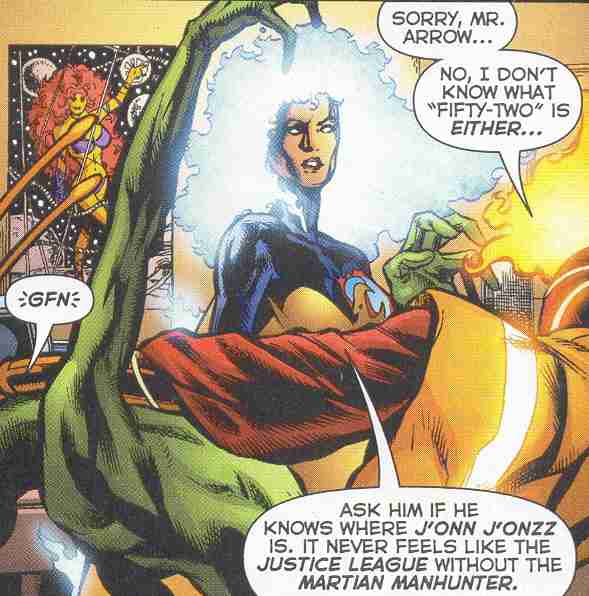
52 #24 – Holy collapsing boundaries, Batman. The texture of allusion and metafictional reference in the best series of 2006 reaches a new level in this issue. There seem to be at least three categories of allusion at play here: (1) allusions to contemporary popular culture (Taylor Hicks, Johnny Depp’s Jack Sparrow); (2) allusions to Marvel-related comics events and characters (“Just Imagine” [Stan Lee Creating the DC Universe], “Justice is served,” J’onn says, recalling Scourge’s tag-line, a fourth-wall busting Ambush-Bug whose sound effects and costume changes recall those of the Impossible Man—the metafictional Marvel greenie); and (3) allusions to significant DC writers (Elliott S! Maggin, Julius Schwartz). What does it all add up to? No idea, but it’s fun to guess, and I love Ambush Bug’s “This shirt’s a clue” clue. If, indeed, we are to take this metafictional “clue” at face value, then perhaps all the boundary breaks between our world and the DCU in this issue are indicators that the nature of the new DCU is precisely metafictionality. Could it be that Morrison’s teased “sentient universe” idea will involve a kind of bringing of the very process of making comics into DC continuity itself, albeit in a somewhat displaced or veiled form? This wouldn’t be a new idea (Marvel was notably playful about this in the 1970s), but certainly integrating it into the very fabric of the continuity as a kind of causal agency would be a daring move (this seems to be the implication of integrating the title of a weekly comic that refers to its publication schedule into some mystery that involves the “Guardians of the Universe”). More generally, the increased merging of our universe with the DCU in the pages of 52 (a merging that is inherent in the very weekly “real time” concept) helps to account for some of the allusions to Marvel as well, a company that has always emphasized the parallels between its universe and our own. Interesting too that Julius Schwartz was the inventor of the parallel universes concept—is the notion of “parallel universes” being redefined here so that the Universes in question are not Earth 1 and Earth 2, but literally our earth and the new DCU’s? Added bonus: Jimenez’s homage to Perez’s nifty Starfire pin-up. (Interesting how it is juxtaposed with Firehawk—another DC heroine with a fussy, challenging hairstyle that only a Perez or a Jimenez could love to draw.)

Tales of the Unexpected #1 and Mystery in Space #2 – If you like genre fiction and flip-books, you’ll be as delighted as I am with these double-digest series. And in any case, the return of occult “heroes” like the Spectre, Dr. 13, and another old favorite (yes!!) revealed on the last past of Tales of the Unexpected #1 is cause for special celebration in any form, especially when they’re all handled with such a deft touch. Lapham, Battle, and Rollins’s Spectre is gritty and truly creep-inducing. DC needs a mainstream horror title and this is it (though Niles and Justiano’s The Creeper is another promising successor to pre-Vertigo Swamp Thing). Also enjoyed Azzarello and Chang’s Dr. 13, which feels like a kind of updated Tintin adventure with a square but fraying hero. The pairing of horn-rimmed 1950s dad Dr. 13 with his 2006-savvy teenaged daughter Traci creates a charged dynamic (to say the least) and begins what appears to be an amusing riff on the relation between the denial of supernatural beings and the sexual repression of the 1950s. Smart and fun. Mystery in Space is a treat as well, though I wish they hadn’t de-aged Captain Comet because one of the best things about him was those grey Reed Richards temples – us old guys need points of identification too for Pete’s sake. Nonetheless, an interesting mystery is brewing about the Captain’s strange resurrection. Starlin’s return to The Weird in the back-up feature is nicely drawn but too exposition heavy for my taste; it does at least offer some tantalizing hints about the Captain Comet mystery.

Ms. Marvel # 8 – This is a great book, but I have to agree with fellow reader Lawrence Stewart who writes, “I love what you’re doing with Ms. Marvel. Yet, I have to say, all this Civil War nonsense is leaving a very sour taste in my mouth… I’m starting to wonder how I can justify rooting for a main character I don’t actually like much anymore. Can you fix this? Or is Carol destined to be a government stooge and Iron Man flunky forever more?” Amen, brother. Marvel is either currently engaged in the bizarre process of destroying many of its greatest characters by turning them into idiots, or pulling the the most annoying bait-and-switch in recent memory. Either way: bleah. Sounds like writer Brian Reed is going to come through and redeem this mess in this title though. Looking forward to the Rogue story next issue.

Omega Men #1 – a bit of a pastiche, but nicely illustrated and off to a flying start, especially with appearances by the Guardians and the Zamarons. Looks like I should go reread Millennium (that other DC weekly miniseries of times past). Echoes of Chuck Dixon’s wonderful nuns-in-space Evangeline series as well. Henry Flint’s style is a pleasing Frank Miller/Moebius hybrid.

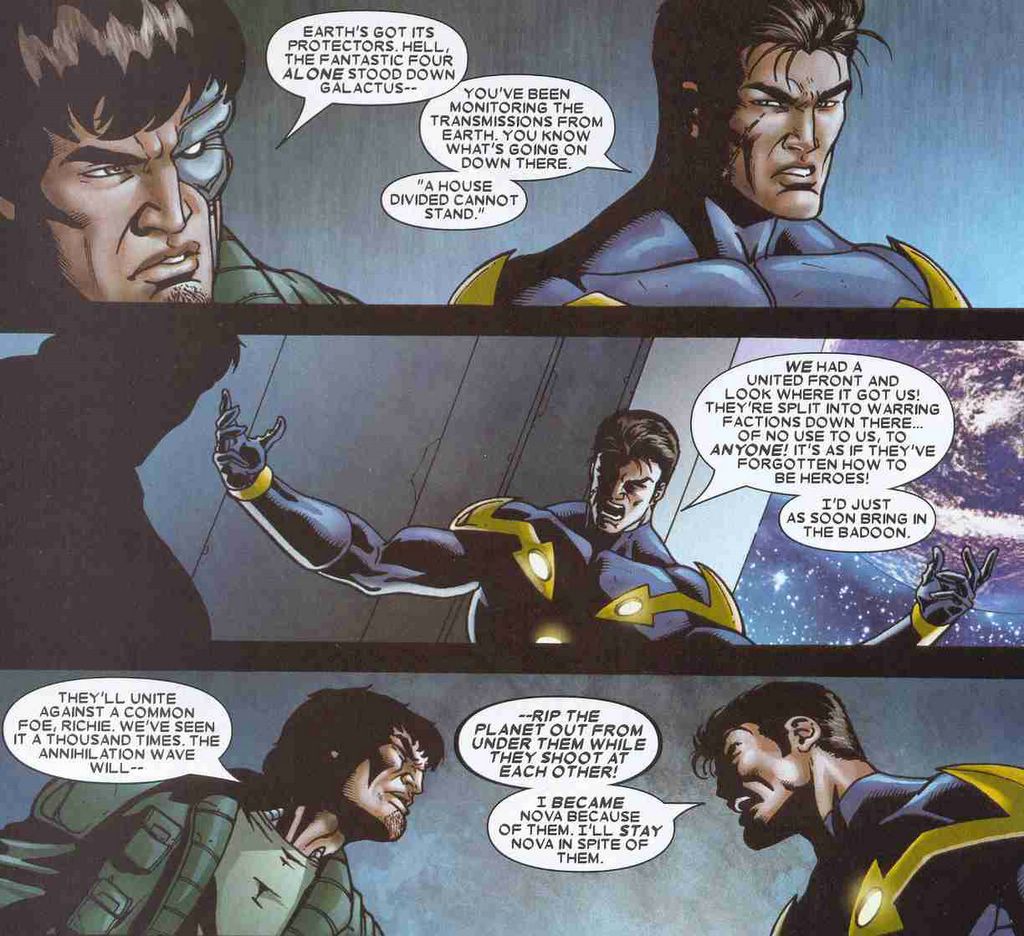
Annihilation #3 – I’m enjoying this series perhaps more than it deserves and yet not quite as much as I’d like to, no doubt in part because it is a break from the Civil War storyline running through the rest of the Marvel books. The cosmic stakes are certainly big enough, but, with the notable exceptions of Nova, Thanos, and Drax, many of the players still feel more like action-figures than characters; Annihilus certainly takes the prize for most boring villain. Nonetheless, a fairly exciting military saga with gorgeous pictures by supertalented and superunderrated Andrea DiVito.

Thunderbolts #107 – Feel so mixed about this news. On the one hand, the new series looks gorgeous, and Ellis will no doubt energize things. But I love what Nicieza, Grummett, and Erskine have done with the book and hate to see them booted off at the very moment that things have finally achieved critical mass. If only we could have a West Coast Thunderbolts title and enjoy the best of both worlds.

Saturday, October 14, 2006

Too Much of a Good Thing: Pleasure and Its Discontents

It’s times like these that I look back to the days of drought with a pang of longing. You remember the nineties, right?

Everything today is just…too good. And there’s too damn much of it. I’m not talking about Marvel, of course: there, at least, you can still experience that quickening of the heart that once attended the discovery of a sand dollar or a shell or a starfish on a grey and empty beach. When confronted with a wall of Marvel monthlies, it’s still possible to remember what it truly was to “collect.” Not simply to accumulate or even to read, but to choose. To exercise what was once called, without even a hint of embarrassment, “taste.” Everyone knows that that is the earliest and still most basic act that we perform as comic fans—the exercise of taste, the perfection of a certain style of choosing through which we begin to become ourselves. It is for this reason that the depressing nature of so much of Marvel’s current output these days turns out to be a blessing in disguise, because it at least restores the possibility of taste—of scanning the grey beach of Marvel for the glint of one of its “minor” but wonderful titles. Remembering this pleasure is of considerable value in a market that is already overstuffed with high quality mainstream books. Yes, now I’m talking about DC. No point in pretending that this is an objective account.

It’s a very good time to be a DC fan. Too good—especially if you’re a mid-thirties overgrown DC fan, because everything—everything—DC makes is being made just for you. All that Dan Didio and Geoff Johns and Grant Morrison and Gail Simone and Bill Willingham and Mark Waid and Greg Rucka think about when they butter their toast or walk their dogs, or kiss their partners as they turn out the lights is your—by which I mean my—pleasure. They must! Because every new title, every assignment of writers and artists, every revival of some obscure but secretly treasured eighties character, everything is calculated to stir some pleasurable memory or to unveil some new zone of delight, a zone that is nonetheless always, always moored to the dock of our adolescent dreaming. It’s glorious, dizzying, wonderful… Too much…

And that’s the problem with pleasure, isn’t it? Because pleasure is not, strictly speaking, a positive quantity, even though it might often appear that way. It emerges always in relation to other things—things that are less pleasurable, less thrilling. You know: boring. Maybe even bad.

So when the comic store—that special corner of the world that’s always been the secret laboratory of your self-invention, the place where you first “chose” your way towards being, where your “taste” was born and perfected—when that place becomes so saturated with products that all lay equal claim to your attention, you’re faced with an entirely perverse catastrophe: your power to choose has been overwhelmed by a veritable embarrassment of riches. You discover, to your horror, that you no longer have any taste. Or rather, that the “taste” you cultivated so carefully for all those years has been rendered obsolete. And banal too, because everyone shares it.

Suddenly, you’re buying more comics than you can read. You’re enjoying them all. You glut yourself. But something terrible is happening. You’ve not only lost the pleasure of choosing—a snob’s nightmare, a narcissist’s crisis—you’ve lost another, profounder pleasure too. I tried to describe that pleasure once; I’m not sure I managed it. It’s the pleasure of self-forgetting. Of an act of reading so consuming that you go…elsewhere. Away. “Into the panels” sounds silly and naïve. But it’s something like that. A child’s pleasure. But not only that. The horizon of pleasure. Barthes called it jouissance. And when it happens, you’re lost, blissfully…

That particular experience of pleasure feels increasingly remote. When you have succumbed entirely (almost entirely) to the engulfing tide of DC’s Brave New World, of its pleasurable Crises, of its Seven Soldiers and Holy Trinity, of its Leagues and Societies, of its seamless colonizing of every Wednesday for 52 weeks—when you have succumbed to all that—you begin, to your dismay and astonishment, to find yourself not engulfed, not overwhelmed, not consumed, but a little aloof, even a little ungrateful. Like any addict worthy of the name, you don’t ever want the high to stop, of course. You would prefer it, in fact, if 52 became Infinity. But you can’t help but notice that when things achieve a pitch this fevered and intense, the pleasures you were seeking begin to feel stretched a little thin. You don’t read with the same eyes you once did. You forget what it’s like to linger. To really lose yourself. You become that most awful thing: a speed reader. You skim.

It’s times like these that I remember the late nineties. The bad old days, when everything was godawful. Or nearly so. That was an era of austere pleasures, when the exercise of “taste” was forced to discover a new suppleness, to invent compromises. Everyone has their own version; for me, it was an era defined by two artifacts: Dan Jurgens’s Teen Titans series (a travesty of the sacred Book of Wolfman-Perez; I’m still not over it) and the emergence of CrossGen, which, although initially off-putting, eventually drew me in and taught me to read in an entirely different way. To slow down, to look—to really look. Almost to fall into those panels again… It was a rediscovery of the power of “archetypes” (though I hate that term) and especially of the magic produced by color in comic art. The evolution of “taste” in a time of drought.

Perhaps, then, I have something to learn from my reading practices of the late nineties, for the comics on the shelves today are simply a kind of inverted image of the majority of those books of those bad old days. The conversion, as far as I’m concerned, has been total and symmetrical: by some alchemical process, DC’s writers and artists have turned the array of titles on the comic shelves from lead into gold. The irony, as I’ve been musing on it, is that although this alchemical trick has in a certain quantitative sense produced more “pleasure,” the pleasure it makes possible is of a qualitatively different kind than that of those rare oases of pleasure we were capable of discovering in the nineties. That pleasure was a rediscovery of the inaugural act of choosing (the education and refinement of taste); this pleasure is the totalizing, somewhat exhausting pleasure of a genie’s bottle that gives you everything you want and were afraid to even wish for (too much of a good thing). But the inverted similarity of these two eras carries with it a kind of solution to my gripe: just as it was necessary to discover a subtler form of reading to spin gold out of the dross of nineties comics, so might it be necessary to refine one’s tastes all over again, to separate the still gold-tinged dross from the real gold of the comics of today. Oh curses. That sounds like work. Somewhere along the line, I got lazy about taste. I’ve been forgetting how to be a snob.

Pfft. Comic fans, huh? Hard fucking bunch to please.