Tuesday, August 29, 2006

SPOILERS ABOUND: an occasional digest of reviews, notes, and rants

Vol. 2, No. 8
- - - - - - - - - - - - - - - - - - - - - - - - - - - - - - - - - - - - - - - - - - - - - - - -

In this issue:
reviews of Justice League of America #1 and Batman #656 / notes on Spider-Man Loves Mary Jane, J.G. Jones, my new favorite novel, Dame Darcy, Penguin's 'Toon Covers, Bazooka Joe, the summer's best superhero flick, and the Bat Guys / rants about new books in need of CPR


- - - - - - - - - - - - - - - - - - - - - - - - - - - - - - - - - - - - - - - - - - - - - - - -


reviews


Justice League of America #1 (DC Comics)
Brad Meltzer (Writer) / Ed Benes (Penciller) / Sandra Hope (Inker) / Alex Sinclair (Colorist) / Rob Leigh (Letterer)

Now THAT is what you call a tour de force. From the bouncy and dead-on characterizations of the issue-long summit between DC’s superheroic trinity to the heart-squeezing final page, Brad Melzer’s Justice League of America #1 gets it right.

There have been several great incarnations of the League over the years. Giffen & DeMattheis’s Blue and Gold cut-ups and Morrison’s cosmic oddities were by far the best of the recent revamps (hat-tip to Mark Waid for his inspired Tower of Babel story), and if this issue is any indication, Meltzer’s league will easily step into the company of those great eras. It will do so, however, in a very interesting way.

Both the Giffen/DeMattheis- and Morrison-era Leagues drew on the past, but understood themselves as fairly drastic reinventions of the JLA. And in both cases, the changes involved a hyper-stylized modulation of tone—gonzo humor in the case of G&D, “wonder” in the case of Morrison. In fact, their tonal distinctiveness made both books, even at their most satisfyingly conventional and nostalgic, still felt more like auteur projects than typical mainstream fare (much like a Woody Allen film or Bendis’s New Avengers, where it is impossible to forget, even if you try very, very hard, the hand of the writer at work). Meltzer of course brings considerable baggage to the JLA following his controversial Identity Crisis series (which, for the record, I enjoyed), and the distinctive quality of his dialogue, pacing, and plotting will no doubt give his Justice League run a bit of that auteur quality as well. But in this case, and unlike his predecessors, Meltzer’s League combines a fresh sensibility with a more profound return to basics in both character and story.

I really enjoyed those older eras of the JLA, but a change was overdue and what I find most satisfying about Meltzer’s general approach is that it shows so little interest in the G&D and Morrison Leagues, indeed, seems almost to repudiate their quirky histories. This repudiation is deliciously evident in the way that Meltzer’s JLA lineup at least partially draws on and redeems a very specific period of League history—the moment when the old League ended. If memory serves, this ending occurred in at least two-parts: first when Batman quit to form the Outsiders, and then when the Detroit League was destroyed. It’s perhaps no coincidence, then, that Meltzer’s League includes both Black Lightening (an original Outsider who is overdue for recognition) and Vixen (the best member of the Detroit incarnation). The promotion of Arsenal and the passing references to Tatsu and Trident are also of course nice nods to this mid-eighties period as well. Meltzer’s League is, in other words, an elegant return to roots. His writing gives the book a strong, contemporary sensibility, while at the same time appearing to restart the series precisely where its classic model left off some twenty three years ago.


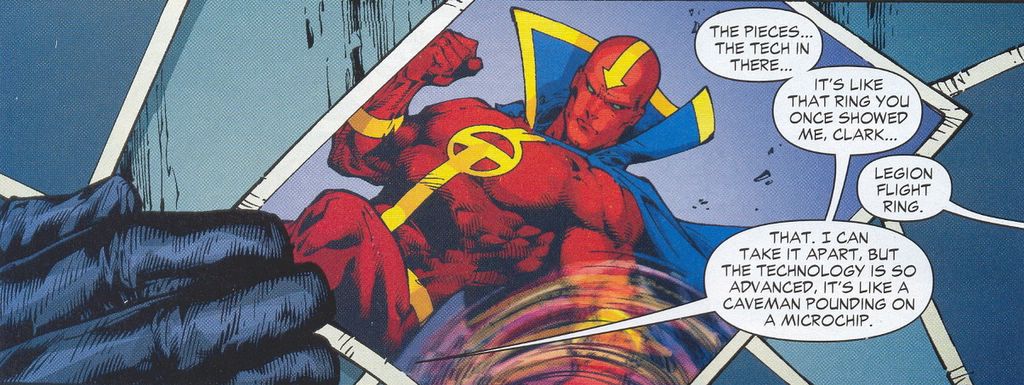
Hence the prominence of Red Tornado in issue #1. Why does Meltzer begin with him? Because, in addition to his tantalizingly enigmatic connection to the original Crisis, Red Tornado is now the most iconic member of the original JLA. Unless I’m forgetting some important history, Giffen, DeMattheis, and Morrison all but ignored the character, and the simple fact of his absence from the most high-profile League relaunches in recent memory has made him into a sort of relic in whom the older tales of the original Justice League of America could be nostalgically and uncannily embodied. The fact that Red Tornado has an android body and is thus in a certain sense a “blank” or “empty” signifier just waiting to be filled enhances the uncanny effect of this embodiment. Who (What?) better to act as a placeholder for a previous era of comic book adventures than an artificial hero? The ultimate metafictional character for a superhero universe. I’m pushing my luck, as always, but I can’t help speculating that Meltzer was in some manner attracted to the Red Tornado character for this reason, and had something like this in mind when he made “Reddy’s” (apparent) shift from a synthetic to a human body the subject of the first issue of his Justice League of America. In any event, whether he did or not, issue #1 still presents us with an incredible metaphor for Meltzer’s new League: an artificial man of the past who takes on flesh (“I’m sweating and tasting!”) is the ideal analog for how Meltzer breathes life into old genre clichés, without ever giving up on the pleasures and satisfactions that classic genre storytelling provide. Indeed, the Red Tornado’s extensive history of destruction and rebirth is also an ideal metaphor for the Justice League of America itself—both the team and the comic book. A fitting and engrossing first issue.


Batman #656 (DC Comics)
Grant Morrison (Writer) / Andy Kubert (Penciller) / Jesse Delperdang (Inker) / Dave Stewart (Colorist) / Nick J. Napolitano (Letter)

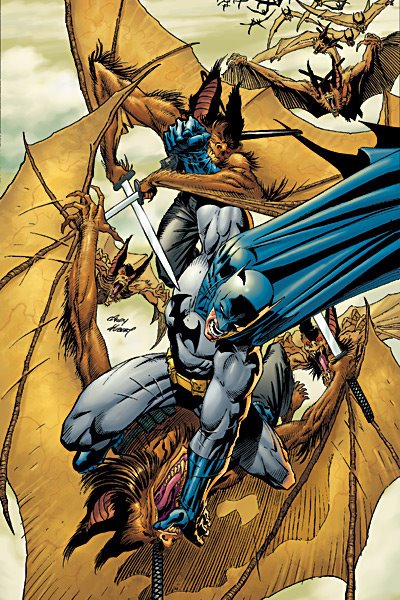
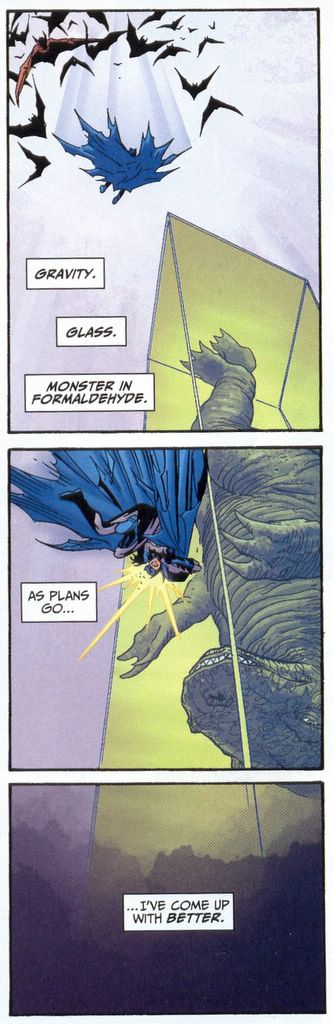
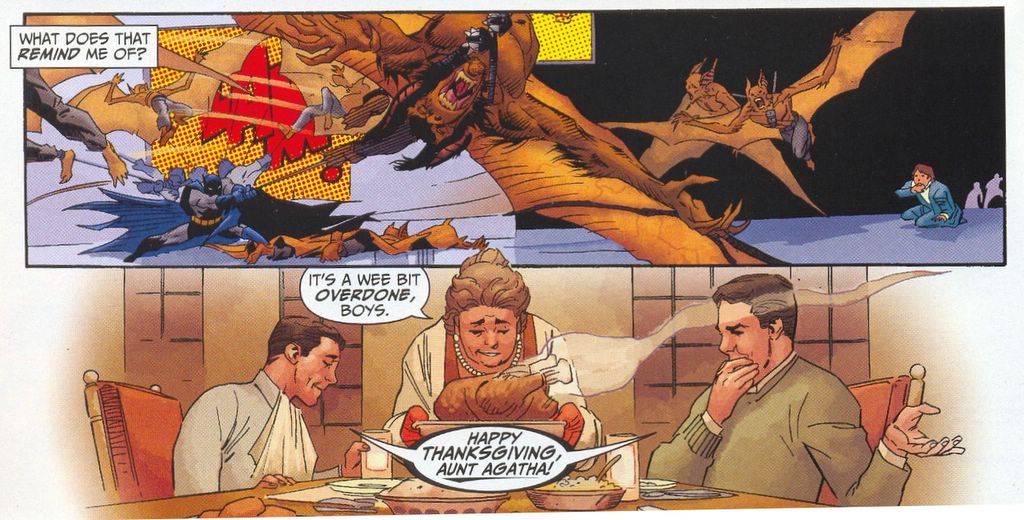
Isn’t it nice to read a fun Batman comic? The first issue of Morrison and Kubert’s run got off to a bumpy start with its Joker-in-the-trash shtick, but by this issue, everything’s roses, er…ninja Man-Bats. This review could rapidly descend into raptures about Morrison’s witty and ingenious Litchtenstein tribute, which gleefully announces, in ever more amusing ways, Morrison’s intention to travesty Batman’s Dark Knight image and restore a sense of frivolity, colour, and LIFE to this character. The gallery’s upside-down dinosaur in formaldehyde—a wry echo of the big green dinosaur “trophy” in the Bat Cave and presumably the work of provocateur Damien Hirst—is the symbolic centerpiece of Morrison’s vision of the new Batman, who, like the Green Dinosaur, is finally out of the Bat Cave, upside-down, and in a bright, madcap postmodern setting.

Batman’s hilarious battle-cry, “If there’s one thing I hate…it’s art with no content!” manages to be simulataneously an ironic wink at the absurdity of ninja Man-Bats (art with no content writ large!), an ironic nod to the lighter tone of the book, and an apt comment on the difference between a Roy Lichtenstein exercise in form and the comic book medium itself (art with content because, unlike the decontextualized and amusing but alienating Lichtenstein panels, it has an involving narrative). But wait—I said that this review could rapidly descend into raptures of this sort, so before things degenerate any further, let me just offer two observations about what makes this series such a welcome and diverting breath of fresh air.

First, thank goodness for Morrison’s efforts to humanize Batman through the renewed focus on Bruce Wayne. Focusing on Wayne’s playboy alter-ego is the most obvious way in which Morrison frees Batman from the more neurotic (if not psychotic) recent iterations of his masked persona: by spending considerable panel-time showing Wayne as a pleasure-seeker (even if it is to a large extent an act), Morrison effectively dispels the repressed, pleasure-denying Wayne that has implicitly driven the grim Batman persona of the past twenty years. The daring choice to explore the taboo idea of a Bat-Son is the logical extension of this new focus on the sexually freer “hairy-chested love god” version of Batman that Morrison has proclaimed his interest in reviving. More subtly (or perhaps less subtly), Morrison heightens his humanization of Batman by shifting unexpectedly between the Batman and Bruce Wayne identities mid-battle: for example, when Batman compares the Man-Bats (“six hundred pounds of meat, gristle and hide”) to Aunt Agatha’s overcooked Thanksgiving turkey.


This is unexpected identity-shift provides a great cheap-laugh, but it also erodes the distinction between Batman and the free-spirited Wayne-identity to make Batman himself more human and less dour.

Significantly, such a renewed focus on the hero’s civilian alter-ego characterizes DC’s new approach to Wonder Woman and Superman too. Historically, Superman has had the strongest relationship to his civilian identity, and, beyond his “blue Boy Scout” persona, it is perhaps for this reason that the character has often sustained a sense of lightness and fun more effectively than either Wonder Woman or Batman. Across the board, DC’s strategy for reinvigorating its Holy Trinity has been to humanize them through a focus on their civilian personas (Diana’s new job over in the superb new Wonder Woman series and the Clark Kent-focused “Up, Up, and Away” and “Metropolis stories” over in the Super-titles). In this regard, Morrison’s Batman is emblematic of the welcome new tone that has taken root in the post-Crisis DCU. The bottom line is that this is new territory and it feels damn exciting, in large part because the increasingly humanized characters now offer much stronger points of fantasy-identification, even as they hold out the possibility of narrative growth and change for the characters themselves. All while fulfilling the genre expectations of high-adventure superheroics in spades, er…ninja Man-Bats.

Contributing to this radical change in the feel of the Batman book is Andy Kubert and Jesse Delerdang’s art, which is, on its own terms, wonderful. Morrison gives them incredible things to draw of course—things that make the book’s visuals recall the Batman Family era when gangsters in a darkened museum plunged at Batman from the balcony on hang gliders (or were they kites?) painted with glorious Chinese designs. The pop art gallery is a throwback to that much older period of Batman gallery fights and Kubert has great fun updating it. More generally, though, the pairing of Morrison (the guru of retro-“newness”) with Kubert is a genius editorial move. That’s because, despite his past work for DC, Kubert is one of the industry’s most recognizable “Marvel” artists, and the added frisson of having an iconic DC character drawn by a dynamic Marvel artist reinforces the sense of a radical and refreshing change at a whole other level, drawing on fans’ awareness of industry politics in a most ingenious and satisfying manner. Historically, the difference between DC and Marvel characters has usually been characterized as the difference between Gods and humans; how clever of the new DC to poach an artist from that other camp to give their newly humanized stable of iconic heroes a humanistic shot in the arm.


notes


Trying New Things: Spider-Man Loves Mary Jane

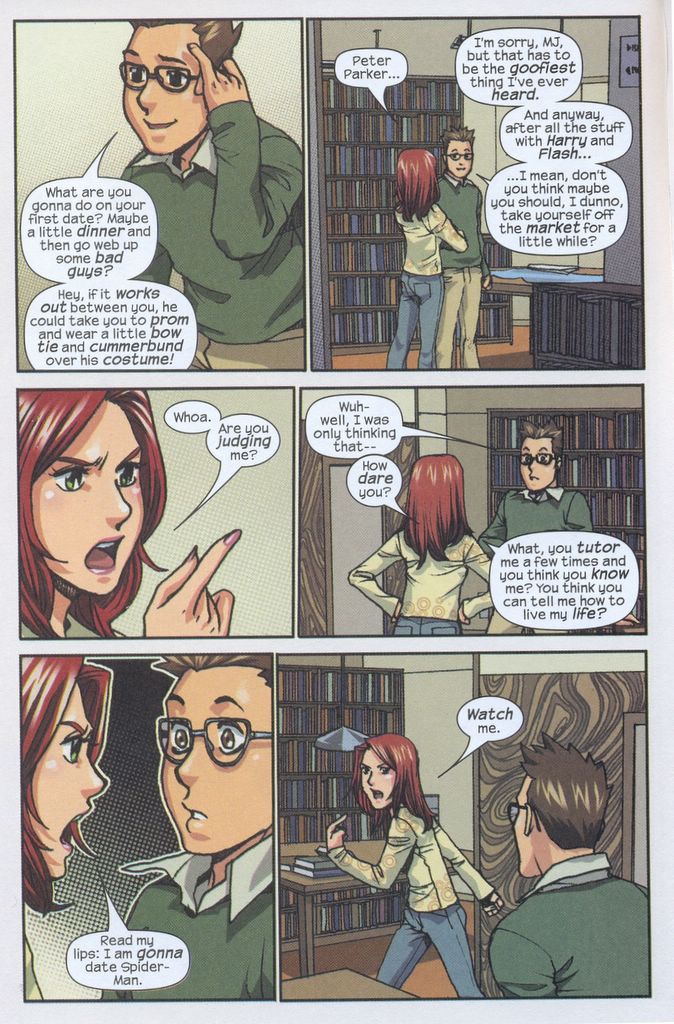
I always mean to try new things and I always enjoy others’ recommendations, but for some reason I have trouble actually taking the plunge. I must have been feeling impulsive last week because I picked up a copy of the Spider-Man Loves Mary Jane Marvel Digest (collecting issues #1-5 of the series) on the strength of a recommendation that Richard made awhile back here in the comments section of DA. All I can say is, I’m glad I tried it—I haven’t smiled so much or laughed out loud so many times while reading a comic in a long time. Sean McKeever’s script is intelligent and hilarious—a dead-on portrayal of the yearning, pain, and excitement of high school romance. Like all readers who read Manga for the first time, I feel compelled to register my shock and amazement at the subtlety and depth of human emotion conveyed by Takeshi Miyazawa’s witty, absorbing, and often touching art. This kind of confession is obnoxious, I know. Forgive my ignorance. I love this book. Thanks, Richard!


J.G. Jonesing

You all know about J. G. Jones’s 52 cover blog hosted by Wizard, right?


If You Like This Blog, You Might Enjoy...The Mezzanine

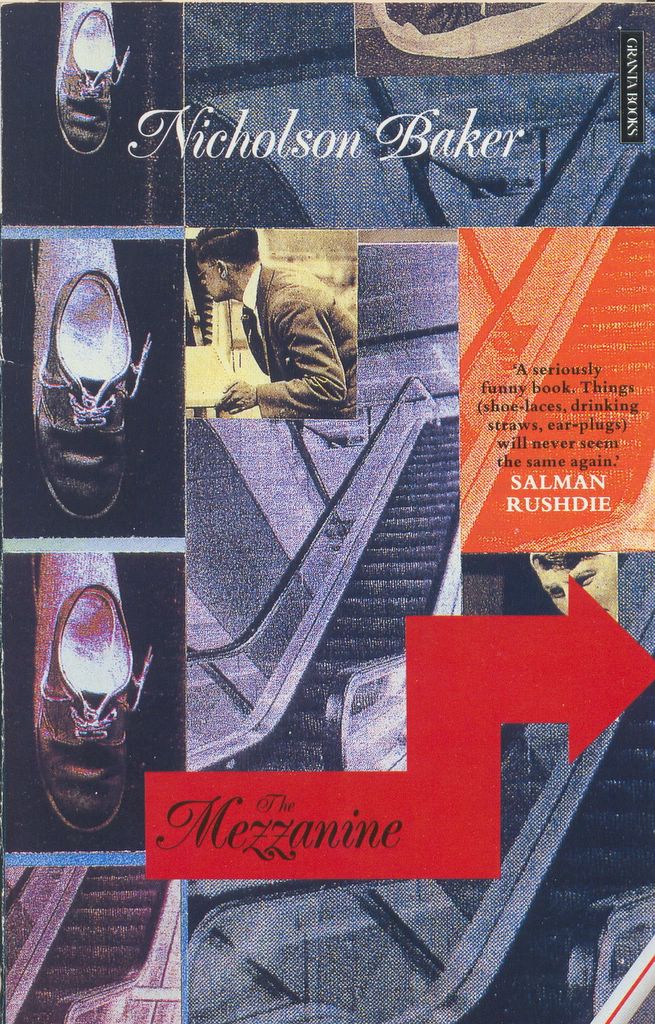
Friends, you know I sometimes exaggerate. That I sometimes get carried away with enthusiasm. This is not one of those times. I have recently been introduced to a slim novel called The Mezannine by Nicholson Baker. My friends: buy, borrow, or steal this book. NOW. It is the most jaw-droppingly beautiful-hilarious-poignant-true Proustian ode to everyday life that I have ever read. It will make you squirm with recognition and want to sing with melancholy joy—joy that someone else really is as neurotic as you are and really sees and experiences all these banal/profound things too. The premise of the book is simple (a man who works in an office takes his lunch break), but the execution is utterly dazzling. Baker is a master-stylist. Listen to this sentence in which the protagonists reflects on learning to tie his shoes: “Only a few weeks after I learned the basic skill, my father helped me to my second major advance, when he demonstrated thoroughness by showing me how to tighten the rungs of the shoelaces one by one, beginning down at the toe and working up, hooking an index finger under each X, so that by the time you reached the top you were rewarded with surprising lengths of lace to use in tying the knot, and at the same time your foot felt tightly papoosed and alert.” Tightly papoosed and alert. That’s writing. And, I submit, that’s how it feels to read The Mezzanine. Baker spends pages explaining the historic shift from paper to plastic drinking straws, recounting the Byzantine etiquette of office chit chat, rhapsodizing about the “black” Penguin Classics, philosophizing about what it feels like to run out of staples. And it’s all poetry. Oh…here. Just read it.


Reader, I drew her: Dame Darcy’s Jane Eyre

Dame Darcy’s Victorian nightmare Meatcake is one of underground comics’ most savory, slithery pleasures. And there could not be a more ideal artist to adapt Charlotte Bronte’s gothic treasure, Jane Eyre. Forget Jane and Rochester; Charlotte and Dame Darcy are the perfect couple.


Penguin Classics Deluxe Editions

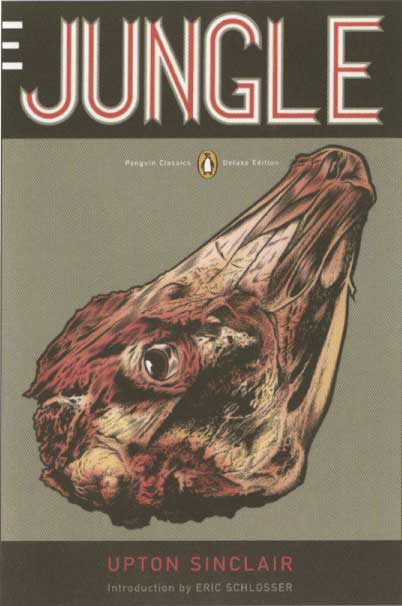
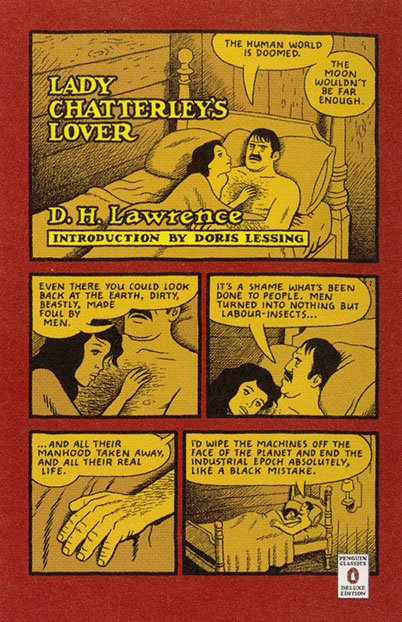
These gorgeous new Penguin editions with covers by many legendary comic artists and cartoonists are old news now, but they were new to me when a colleague of mine—one Hulk Hogan (no relation)—drew my attention to Frank Miller’s recent cover for a new edition of Gravity’s Rainbow. For a complete set of cover scans (including a brilliant Candide cover by Chris Ware and a sumptuous Sadean cover by Tomer Hanuka), see these posts at nifty book blog The Millions.


Everydude: The New Bazooka Joe

How do you make geriatric scamp and gum-cartoon star Bazooka Joe hip again? According to market research, you turn him into Ashton Kutcher. How do you package him for global consumption? Diversify the cast! For all the details on Joe’s new look and new posse, check out thisamusing New Yorker report. Meet his new gang at the official Topps website. And while you’re at it, why not relive some Bazooka Joe classics? My homage to Bazooka Joe:


My wife’s comment: “It’s really funny that it doesn’t make any sense.”
My comment: “But it sort of does make sense, y'see it... it... Never mind.”
Sigh.


Recently Viewed: Years after everyone else, I've finally discovered Parkour!

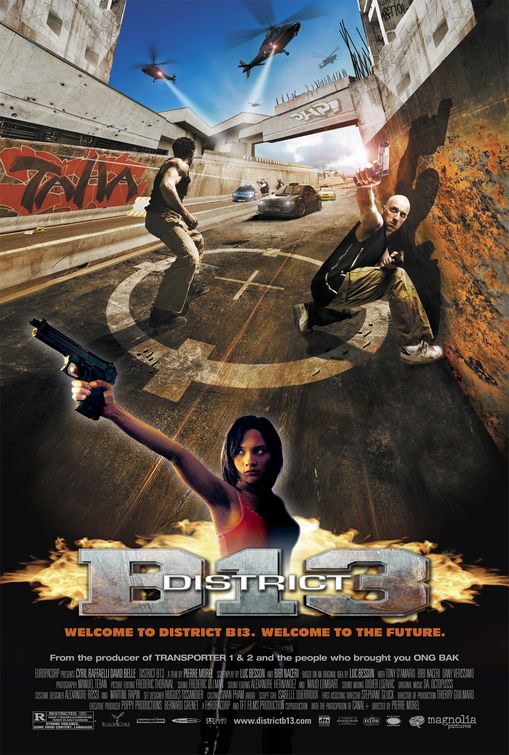
District B13 – All you cool kids know this already, but the best superhero movie of the summer isn’t Superman, and it sure isn’t X3. It’s Pierre Morel’s graceful and exhilarating and very French Parkour actioner from 2004 that I managed to catch at a local rep. cinema after missing it when it played for all of one week at the big multiplex. Richard Schickel, in his suitably glowing review of the film for Time Magazine, hits the nail on the head when he says that “The French thriller District B13 makes everything Hollywood has lately done in the action genre look clumsy, dull and stale. It is a short, nonstop stuntfest that, by going back to basics and placing them on the screen with simple, breathless stylishness, turns what is essentially a lowlife movie form into something one is not embarrassed to call ‘pure’ cinema--all energy, movement and high kinetic wit.” “Lowlife” seems a little snobby, Mr. Schickel, but I heartily agree! Moreover, it isn’t just the action genre that is raised to poetic hights here. Martial artist Cyril Raffaelli (the good cop) and Parkour-god David Belle (the reluctant partner) are essentially superheroes, out-maneuvering and out-doing even the sublime, computer-generated Spider-Man films precisely because their “stunts” (an ugly, leaden word for what they do) are not performed in the zero-gravity of cyberspace. I hear that the new Bond will battle a Parkour-practicing terrorist (Sebastien Foucan) in the upcoming film. I guess someone’s paying attention. Watch the trailer here.


Don’t Tell Alfred…


From my local newspaper. It amused. Was it the invitation? The concept of “humane bat removal”? The idea that there are “bat removal and prevention experts”? Naw…it was that second “S” in NO-BATSS—just to make it scary! Three cheers for...the Bat Guys!


rants


DC Sentences You to Death...By a Thousand Fill-In Artists

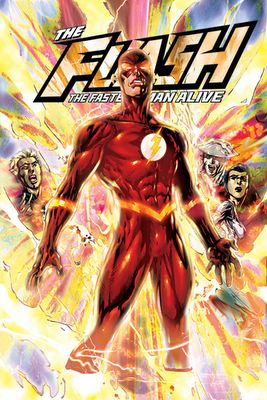
Last week I expressed my annoyance over the clunky relaunch of The Flash and my dismay over the parade of guest-artists on barely-begun Shadowpact. Last week, the new issue of The Flash seemed to combine both of these gripes in an all-new, all-weird way: Karl Kerschel and Serge LaPointe’s stunning guest-art on issue #3 is a cruel act for regular penciller Ken Lashley to follow on a series that has already had such a rough start. To this list of puzzling new-series foibles and fumbles, I also now have to add the latest issue of Blue Beetle (a title I just got through praising), which features…yet another fill-in artist. I have very fond memories of Cynthia Martin’s ultra-pretty work on the old Marvel Star Wars series, but having her attempt to emulate the indie style of “regular” series penciller Cully Hamner is sort of the worst of both worlds because no one is fooled by the imitation and it curtails Martin’s naturally smoother, more beautiful style. Hamner’s Blue Beetle work is fantastic, but he’s now drawn only 3 of the first 6 issues of the new series, which is lame by anyone’s standards. DC is producing the most exciting books in the business right now, but what is the point of launching a new title if you are not going to set it on a solid creative footing? The writing on Blue Beetle and Shadowpact is excellent, but the art is inconsistent and these titles feel amateurish as a result. The problem with raising the bar, as DC has unquestionably done, is that fans’ expectations rise with it. Come on, DC. Get these titles on track, or they won’t last a year.

Sunday, August 20, 2006

SPOILERS ABOUND: an occasional digest of reviews, notes, and rants

Vol. 2, No. 7
- - - - - - - - - - - - - - - - - - - - - - - - - - - - - - - - - - - - - - - - - - - - - - - -

In this issue:
reviews of Superman #654-655 and Omac #1-2 / notes on the new DC, that D&D guy, Hostel, The Descent, and Out of Sight / rants about a speedster's stumble and other pull-list casualties


- - - - - - - - - - - - - - - - - - - - - - - - - - - - - - - - - - - - - - - - - - - - - - - -



reviews


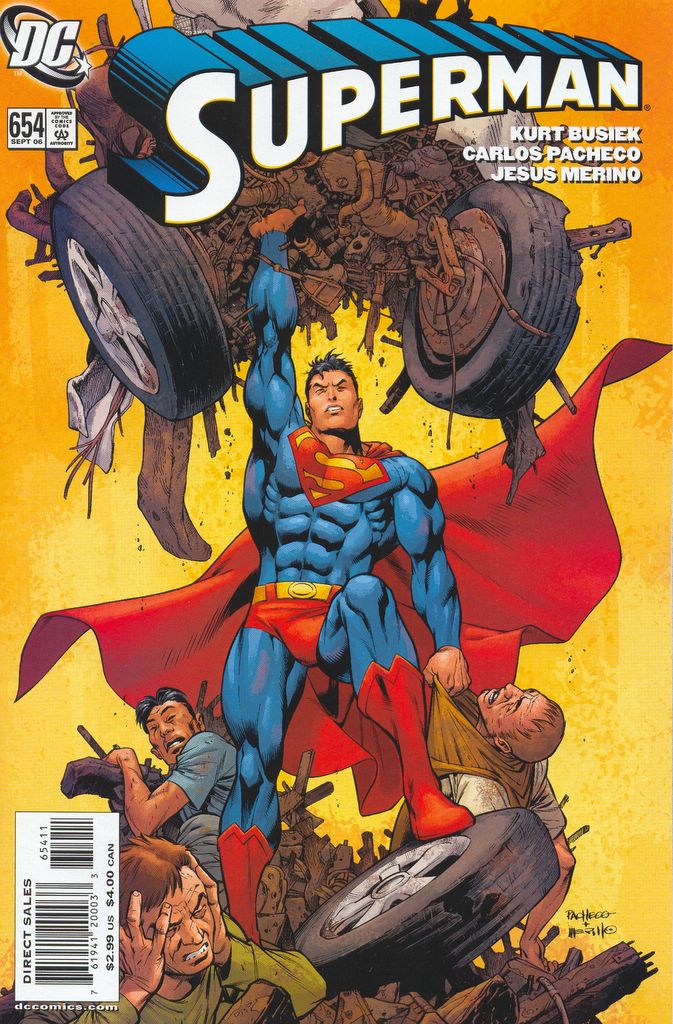
Superman #654-55 (DC Comics)
Kurt Busiek (Writer) / Carlos Pacheco (Penciller) / Jesus Merino (Inker) / Dave Stewart (Colorist) / Comicraft (Letters)
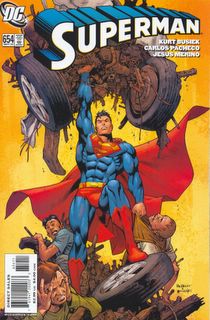
No one doubts that Grant Morrison and Frank Quitely’s literate SF All-Star Superman is one of the most delightful comics on the stands, and Superfans now have one more reason to rejoice: Kurt Busiek and Carlos Pacheco are doing an absolutely stellar job of reinvigorating Superman’s flagship title. If Morrison and Quitely go mythic to capture the archetypal resonance and sheer dizzying wonder of Siegel and Schuster’s super-powered strongman, Busiek and Pacheco go classic to capture a very different flavor of Supertale that is a particular favorite of mine.

My favorite Superman stories have always been those that create a web of criminal and law-enforcement intrigue in Metropolis (Intergang, Gangbuster, Luthor, the Metropolis Special Crimes Unit, S.T.A.R. Labs) and focus on Lois and Clark’s skill as reporters and on their rapport as husband and wife while still giving Superman a chance to throw some punches at a big, cool, supervillain. It’s precisely this focus on the Lois-Clark relationship and the human skills of the protagonists as they explore the Metropolis milieu that makes me think of this Supersubgenre as “the Metropolis story.”

In its classic (and in my view ideal) form, the Metropolis story implicitly restricts the significance of Superman’s powers, which become merely the signifiers of Clark Kent’s moral authority and the pretence for giving the conflict—at heart a 1940s or 50s crime adventure or conspiracy tale—a cool science fiction gloss. It wouldn’t be a Superman story without the SF trappings, but the story itself is really about Clark Kent’s ingenuity as he faces off against crime bosses, crooked billionaires, and secret scientific syndicates. The simulacrum of workaday grittiness that characterizes Superman’s friends and foes in such stories has the effect of rooting Superman in a crime genre that, while artificial in its own right, feels remarkably realistic next to the alien grandeur of Superman himself. This anchoring effect produces a totally unique frisson that is, for me, no less thrilling (though differently so) than a Morrisonian Superman who makes baby suns to feed his pet sun-eater. And it goes without saying, I hope, that Metropolis stories need not take place in Metropolis to qualify. The Metropolis story is not about setting so much as about the extension of a certain storytelling sensibility whose essence is rooted in the juxtaposition between retro criminal intrigue and wild science fiction that finds its purest form in Metropolis stories, but often extends beyond city limits.
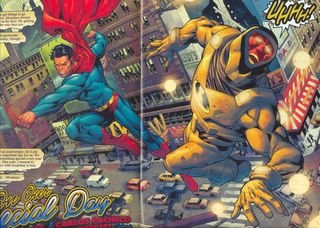

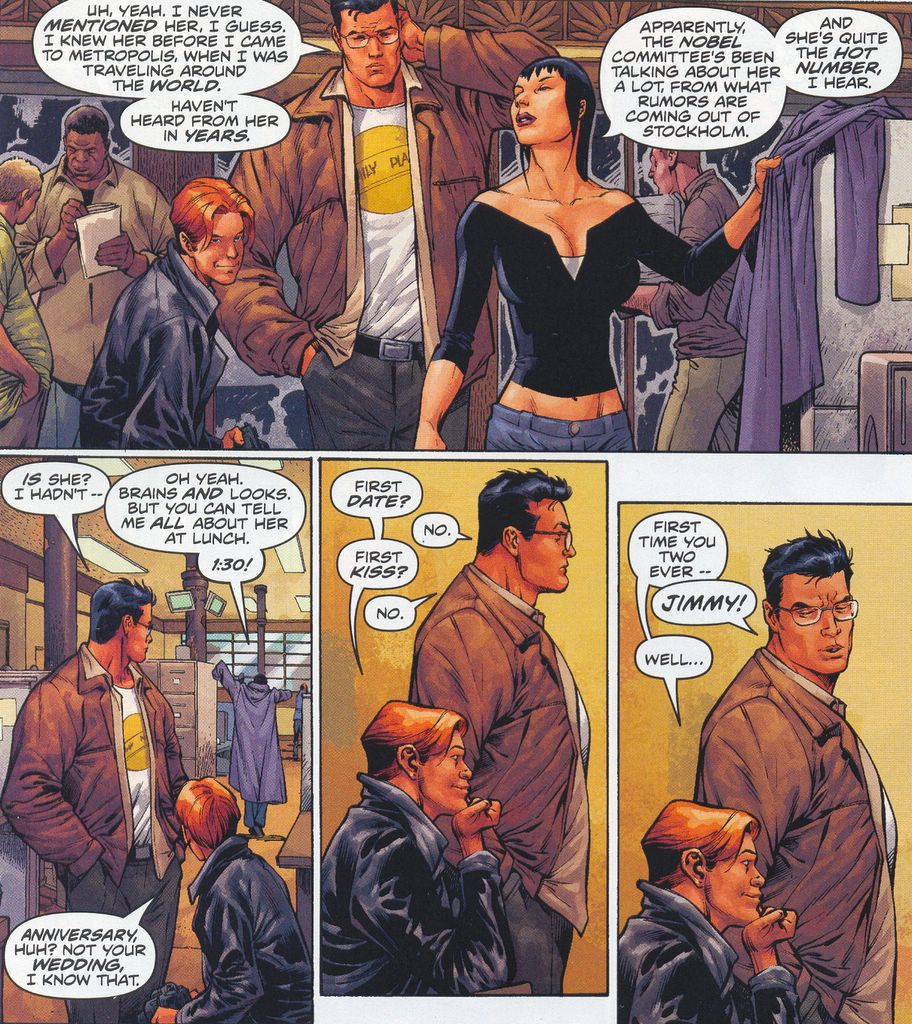
Busiek seems to like these kinds of stories as much as I do. His first two solo-written issue of Superman (#654 and #655) are absolutely packed with classic Super-goodness. The first story, “On Our Special Day,” features a satisfying tour of Metropolis and the Daily Planet offices; deftly introduces new S.C.U. division, “The Science Police”; makes a point of sidelining a silly villain like the Prankster in favor of dust-ups with Neutron (a perfect third-string Superman foe) and a mysteriously mutated Intergang Boss Mannheim (a perfect second-string Superman foe); establishes a tantalizing mystery (who is the “them” behind Mannheim’s mutation and dangerous new gadget?); resurrects not one but two old flames of Clark’s (Lana in a surprising new role and news-to-everyone “arcanobiologist” Callie Llewelyn); and best of all, frames all this fun with a pitch-perfect snapshot of Lois and Clark’s ironclad relationship.
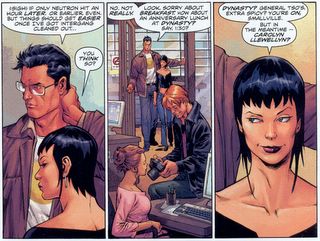

Lois’s discovery of a half-made anniversary breakfast, her unflappable response to the radio report explaining Clark’s absence, her needling of Clark over his old flame Callie, her final surprise for Clark at the end of the day—all of this serves as Busiek’s sweet (but not saccharine) reminder of why Clark Kent loves Lois Lane and why their happy marriage is such a delight to behold.
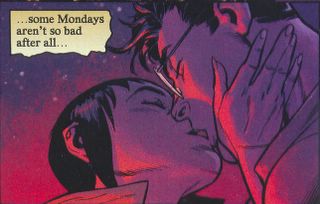
The final scene of the issue’s main story, of Lois and Clark (not Lois and Superman) taking to the sky to reprise their first dance in the clouds twelve years earlier, is magical, and sets the tone, I think, for the kinds of stories Busiek seems interested in telling. At least, I hope it does. And I think I have cause for optimism, given that one of the most significant plot points of the issue is the (re)establishment of two other women from Clark’s past in significant roles. Hopefully the prominence of Lana and Callie signals some enjoyable testing of Lois and Clark’s relationship in the near future.
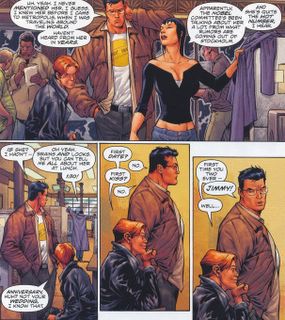
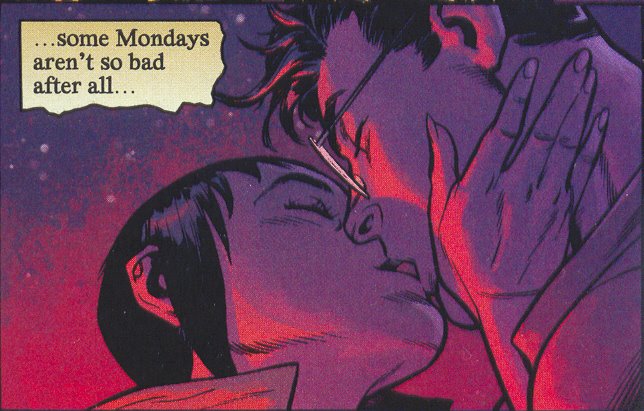
The fact that the entire issue is organized around the conceit of “Mondays” is an artful touch. While punching Neutron in the face, Superman ironically remarks of Mondays, “You try and you try to get things to go smoothly, but somehow, Mondays always manage to smack you in the face.” Over the course of the issue, this becomes a running joke about the bad-luck Clark experiences—not only is his anniversary breakfast interrupted by Neutron, his Daily Planet assignments are interrupted by a variety of super-threats that seem to spell deadline disaster for Clark. The point of all this is of course to reveal Lois as the one thing that makes “Mondays” (and all the headaches and responsibilities they stand for) endurable for Clark. More broadly, however, “Mondays” are also an appropriate beginning for Busiek’s run as series writer because Metropolis stories in their classic form are in a sense about the ordinariness connoted by “Mondays”: they emphasize the parochial human dilemmas and banal challenges of being both Clark Kent and Superman, as opposed to, say, the sublimity and awe that characterize Morrison’s more mythic, even mythological approach to the same material. This is why these stories emphasize the ordinary human face of crime and justice in Superman’s world, often featuring super-powered variations on regular blue- or white-collar criminals and organized crime, rather than more outlandish science-fiction villains. And when they do feature wilder SF supervillains like Darkseid, their presence is often delayed by or folded into the apparatus of petty crime, criminal undergrounds, and military science conspiracies. We see exactly this type of thing in “Cold Comfort,” the gripping next issue (Superman #655), which features Superman’s encounter with Subjekt-17, apparently the monstrous leftover progeny some secret Soviet science lab with some as yet veiled connection to Arion, Lord of Atlantis. All of which is to say that Busiek understands what makes classic Metropolis Superman stories fun and unique: layers of criminal and scientific intrigue to be navigated by ace reporters, all anchored by the Lois and Clark love story, with a dollop of superheroics thrown in for good measure.
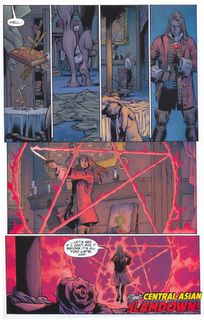
And I haven’t even mentioned Pacheco and Jesus Merino’s glorious art. My god, does this book look fantastic, or what? When Pacheco was drawing Green Lantern, his art was pared down and austere. I once made the case that this was a deliberate aesthetic choice, but seeing his work on Superman I almost wondered if maybe he was just bored. Lois, Clark, Jimmy, Perry, Lana, and the rest haven’t looked this slick in ages. Pacheco’s Metropolis hums with life. The villains and guest stars look great too, particularly Neutron (whom Pacheco draws with a wonderful Kirbyesque face, as if to suggest not just the amorphousness of “radiation in a man-shaped suit” but also the sheer power of this villain). Subjekt-17 is a creepily-rendered Hellboy reject. And Arion is suddenly cool. (Apparently, to be cool, you just need to be drawn as a sort of latter-day Count Orsino or Vicomte Sébastien de Valmont, lazing in bed with two gorgeous women. Fanboys are such an easy bunch, aren’t we?)
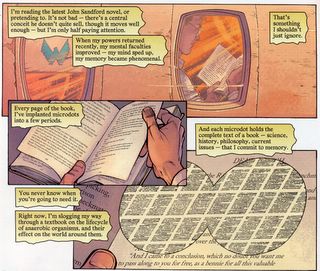

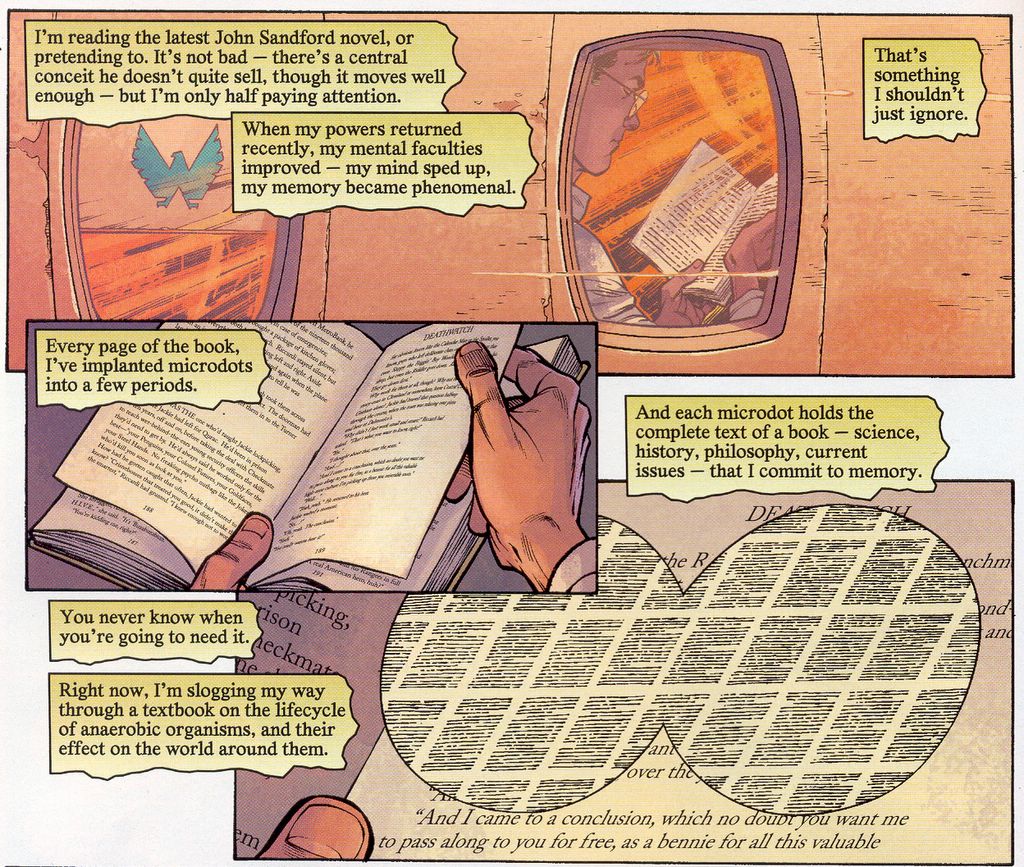
There are so many nice touches in this comic—among them the use of the cover to Action Comics #841 for Metropolis tabloid, Action Bulletin News and, on the same page, the most envy-provoking use of Superman’s power’s I have ever seen: the implanting of the page of a paperback thriller (“the latest John Sandford novel”—a Da Vinci Code rip-off?) with microdots that hold the complete texts of other books—“science, history, philosophy, current issues”—that Clark can read with super-vision and then commit to super-memory. Now THAT’s a fantasy that I can relate to. It’s also a nice nod to the play between pulp fiction (the Sandford novel) and reality (science, history, philosophy, current issues) that is the very stuff of comic books in general and of Metropolis stories in particular.

Kurt, Carlos, Jesus...take a bow.


Omac #1-2 (DC Comics)
Bruce Jones (Writer) / Renato Guedes (Artist and Colorist) / Phil Balsman (Letterer)
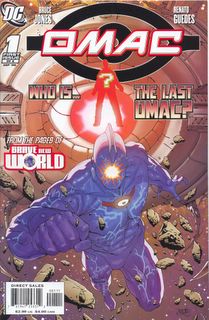
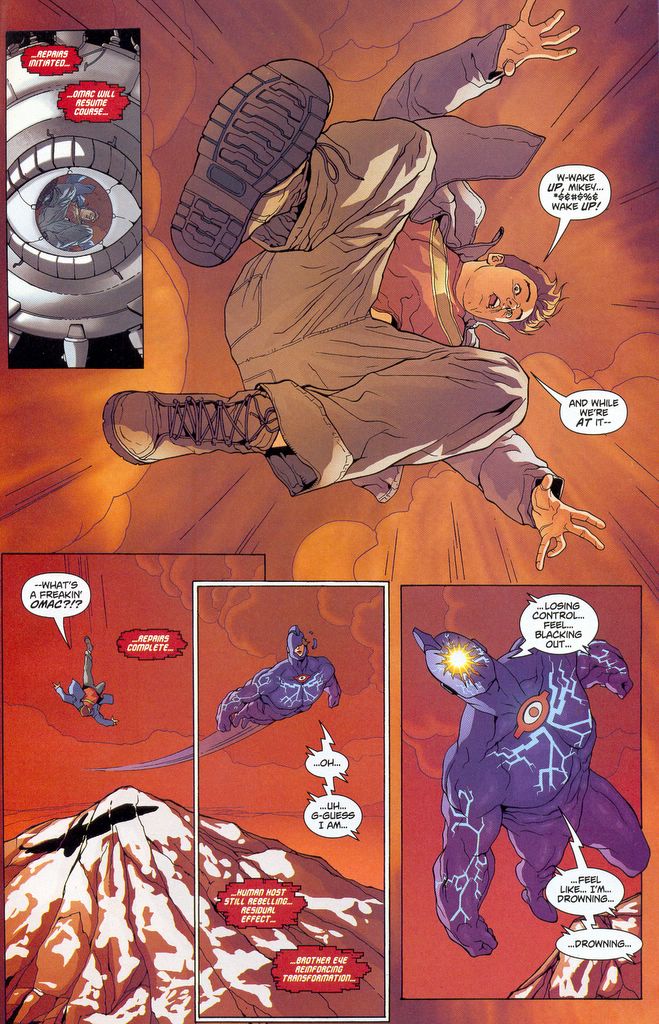
By all rights I shouldn’t like Omac at all. Despite my nearly infinite willingness to defend Infinite Crisis, not even I could defend the utter lameness of the Omacs—surely one of the silliest visual designs of recent times. They made me laugh, not shudder, and I was dismayed to see that their presence in the DCU was going to be perpetuated beyond the passing of the Crisis. And then the Brave New World Special made me think again. The new Omac series by Bruce Jones and Renato Guedes is as gripping as it is gorgeous—and it is damn gorgeous. Guedes inks and colors his own work and the results are stunning; he draws a little like Geoff Darrow, inks mainly outlines, and uses a subtle color palette in areas of both light and shadow, giving the action a soft, coherent delicacy. Heck, he even makes the ridiculous Omac suit look neat and occasionally menacing, and if that isn’t a testament to his artistic skill, I don’t know what is! His people look great, but his real specialty is drawing streets and buildings. The action of issue #1—in which seventeen-year-old junkie Mike Costner discovers that he is “the last Omac”—takes place within a truly impressive array of concretely visualized inner-city settings. This kind of visual concreteness is everywhere in DC’s books these days: Pete Woods’s beautiful Metropolis settings, for example, and the incredibly detailed training academy in the Green Lantern books. Part of the much touted “brightness” and “sharpness” of the new DCU comes from this attention to setting, and I hope that DC’s amazing stable of artists doesn’t let up on this kind of attention to detail because it makes a huge difference to the quality of the storytelling.
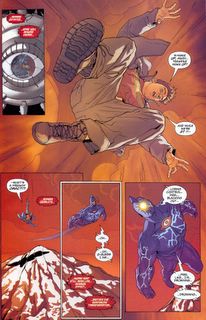
And the story of “last Omac” has so far been a blast. Jones has created an appealing underdog hero in Mike and is currently putting him through his paces in a very interesting way: whenever the Omac armor takes him over (Brother Eye needs to get this back-up “sleeper” Omac unit to an Alaskan NORAD facility in order to repair itself) Mike loses most—but not all—of his bodily control and risks going from petty thief to murderer. In other words, Jones is clearly playing the Omac armor as a metaphor for the destructiveness of drug addiction and the loss of control that addiction entails. At the same time, Jones keeps a wry, often satiric eye trained on the pervasiveness of addiction in contemporary culture and on the ambiguous issue of criminalizing drug use. In the first issue, he uses the conceit of Brother Eye’s scanning of the neighborhood for its missing Omac to identify, among other things, traces of nicotine, alcohol, and marijuana in the cops—with a nod to the medical marijuana lobby on page seven. A very nice elaboration of the central theme.

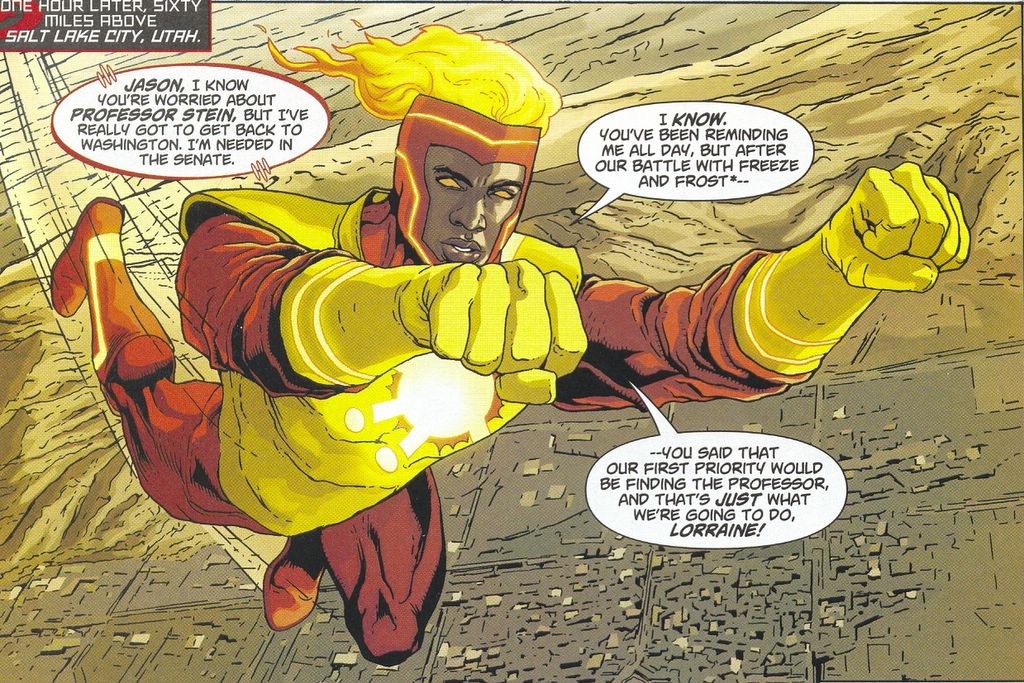
Beyond the clever welding of the addiction theme to the parasitic alien armour premise, Omac is just plain good reading—good reading that is significantly enhanced by the racial diversity of its cast, something that DC has been particularly vocal about lately. Jones writes realistic often very funny dialogue, and he makes superb use of two prominently-featured guest stars: Firestorm (Jason Rusch) and Cyborg (Vic Stone).
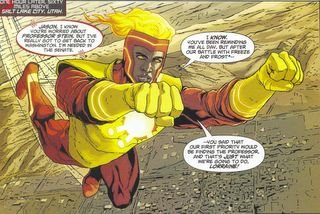

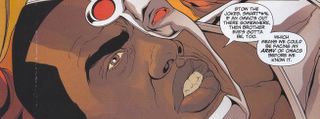
In addition to being one of DC’s most complex and interesting black heroes, Cyborg is one of the few older Titans without his own series that deserves more exposure, if not a crack at an ongoing title; likewise, the new Firestorm series by Stuart Moore, Jamal Igle, and Keith Champagne, has turned Jason Rusch into one of DC’s brightest new characters. It’s a sad comment on what the state of minorities in comics has been that it actually feels novel and exciting to have not one but two black superheroes guest-starring in the same book—but there it is. Geoff Johns has been subtly pushing this agenda on JSA using this strategy of multiplication (Mister Terrific, Jakeem Thunder, Crimson Avenger) for some time now, and I’m delighted by the prominence of Black Adam and the introduction of the Chinese team of heroes in 52. In most of these cases, the work of diversification has been to strike a delicate balance between proclaiming and deemphasizing the significance of race—of making an impression without necessarily foregrounding the fact of racial or cultural difference as a point of plot—though not ruling out that possibility either. DC’s general approach to this—and I think it’s a good one—has been to emphasize character complexity and multiply differences across many characters, producing, for example, not a single new Chinese hero, but a whole team of Chinese heroes. The Cyborg-Firestorm team-up in Omac is another instance of this strategy. On its own, the assignation of more culturally-diverse guest-spots would hardly be a solution to the overarching problem of racial and cultural diversity in comics but in this context it begins to address the imbalance and moves away from a more conventionally tokenistic approach to black characters, particularly in a story that juxtaposes black heroes with a white drug addict.

If you’re enjoying the new DC, then chances are you’re savoring Omac for some of the same reasons I am. If you haven’t yet been tempted, Omac is a great place to hop on board. Here’s hoping the creative team sticks around to make this outstanding miniseries an ongoing—or better yet, that they launch a Cyborg series when they wrap up their eight-issue run on this one.



notes


The New DC: There’s No Stopping Us Now!

In case it wasn’t clear from the reviews above, I dig the post-Crisis DCU. 52 is like a drug and the relaunches of the flagship titles of major characters like Batman, Superman, Wonder Woman, and Green Lantern have been impressive to say the least. What really gets me, though, is the number of incredible NEW titles I’m suddenly buying, starring heroes (and villains) I barely know. If you’d asked me a couple of years ago to predict what would be at the top of my pull list today, I certainly wouldn’t have guessed Omac, Checkmate, Firestorm, Uncle Sam and the Freedom Fighters, Secret Six, or Blue Beetle. But there they are, and the list just keeps growing…
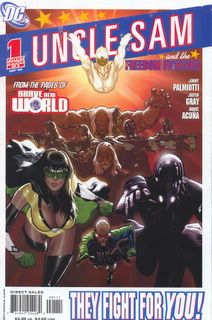
I’ve rhapsodized about Omac already, and it’s no surprise that I think highly of Gail Simone and Brad Walker’s dark, cheeky follow-up to the Villains United soap opera (can’t wait to see what Gail does with dysfunctional first-family the Doom Patrol next month), but what about Greg Rucka and Jesus Saiz’s super-espionage extravaganza or Jimmy Palmiotti and Justin Gray’s Grant Morrison-inspired satire of Homeland Security in America? Not only are their stories topical, exciting, and smart, these series all do a superb job of marrying writing and art. I was skeptical at first because I loved Dale Eaglesham, but Brad Walker has completely won me over. His loose, lush pencils are a perfect fit with Gail’s twisted, erotic, emotionally gripping storytelling in Secret Six. Saiz brings an appropriate level of gritty realism to Rucka’s intrigue laden spy-scripts, and Daniel Acuna’s hyperreal Norman Rockwell style is such an ingenious choice for bringing Morrison, Palmiotti, and Gray’s American satire to life that I am dumb with admiration.
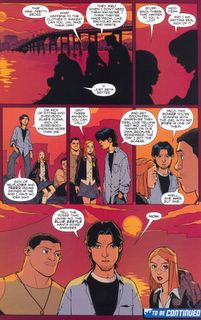
Among DC’s more standard superhero books, Firestorm and Blue Beetle really stand out. Stuart Moore and Jamal Igle’s Firestorm is slick superhero drama with an emphasis on great characters and classic superhero action. Keith Giffen, John Rogers, and Cully Hamner’s Blue Beetle is even better. I don’t care that much for the new Beetle armor, but the new Blue Beetle himself, teenager Jamie Reyes, and his friends Paco and Brenda are such an entertaining and authentically imagined trio that I’ve been hooked since the first issue. Set in El Paso and drawn with an indie flare by Hamner (and guest artists Cythia Martin and Duncan Rouleau), the series has so far been concerned with setting up mysteries concerning a gang “extras” (metahumans) named “The Posse” and a sinister metahuman collector named “La Dama” and her magician-henchman. The Phantom Stranger has also appeared to offer gnomic teases about Jamie’s place in the new age of magic (following the events of Day of Vengeance). This is classic “with great power comes great responsibility” stuff, but with a totally modern sensibility. Jamie Reyes is the first teenaged protagonist to come along in some time who truly captures the spark of a Peter Parker. The Beetle armor needs a redesign, but this series certainly deserves to be a big, fat mainstream hit.


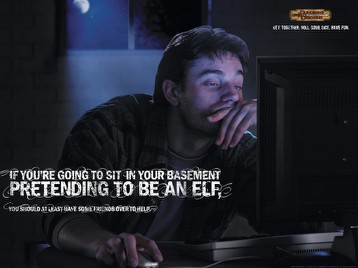
The Basement Elf: Boomerang Poster-Boy?
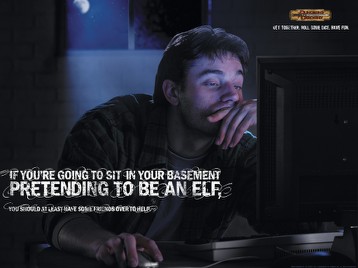

Despite a few lunch-hour D&D skirmishes in junior high and a brief flirtation with the ElfQuest RPG in high school, I’ve never really been much for fantasy games, but this IS a sensational ad. Aside from the guy’s priceless expression, posture, and droopy right eye, the basement/dungeon overlap is inspired, making a nifty play on the stereotype of the geek who’s “still living in his parent’s basement.” Interesting that it’s caught the attention of zeitgeist-meter Boing Boing. I wonder if its attention-grabbing resonance isn’t due as much to its capturing of the ennui of the boomerang generation as to its intrinsic cleverness. Or maybe it’s just that we all feel a little stunned by all our face-time with the world wide web, regardless of whether we play online games or not. Friends? Come over? You mean...in person?


The Screening Room: Recently Viewed
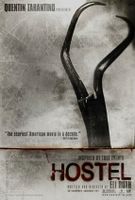
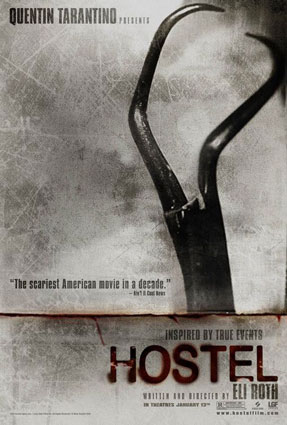
Hostel – I really enjoyed this. And so, to my surprise, did my squeamish wife (who initially lost all respect for me, but then promptly caved in and watched over my shoulder, fleeing from the room for the nasty bits). Despite being well-acted and attractively shot, it received mixed reviews, especially from disappointed horror fans who wanted more torture and defilement. Certainly the fact that the film was tamer than I’d expected made it much easier to watch for folks like us who are, um...a little less hardcore in our cultivation of Slovakian dungeon porn. The real selling point for me, though, was that the film layered its obvious exploitative charms with a dead-on satire of sex-tourism and the suppressed homosexual panic that attends certain rituals of male bonding. In this regard, the film’s central reversal manages to be both harrowing and amusing, right down to the bloody details—Paxton’s “castrating” loss of his two fingers and his subsequent (consequent) failure to genuinely rescue the girl. The only significant weakness was the film’s failure to capitalize on Paxton’s flight from the sadists’ gulag, which should have been more suspenseful. Nonetheless, far more interesting than expected.
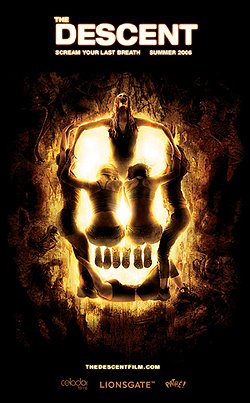
The Descent – The tension level during the first hour of this film was so high that I was actually relieved when the scary things in the cave finally made an appearance. Je-sus! This is a smart, scary, nail-biter of a horror picture with riveting performances by its all-female cast. I’m terrified of small spaces (a recurring nightmare of mine is of being chased through the collapsing and ever-narrowing passageways of a university building until I get trapped—I wonder what that could mean?) so this movie was a fairly excruciating experience from the get-go. Cave-diving? Not for me. Especially not now. The director-approved ending change makes the film’s periodic birthday cake crosscuts seem superfluous, but the original British ending which makes sense of the damn cake doesn’t really make complete sense either—at least, not if you like your twists to be of the fair-play variety, which I do. Ultimately though, it doesn’t really matter. This is great character-driven horror by a director (Neil Marshall) who understands suspense and isn’t shy about playing nasty. The most unsettling scene? Not the lake of blood (which was awesome) but the horrible, horrible surprise that awaits Sarah at the window in the cabin... Upsetting and nerve-wracking...but in a good way.
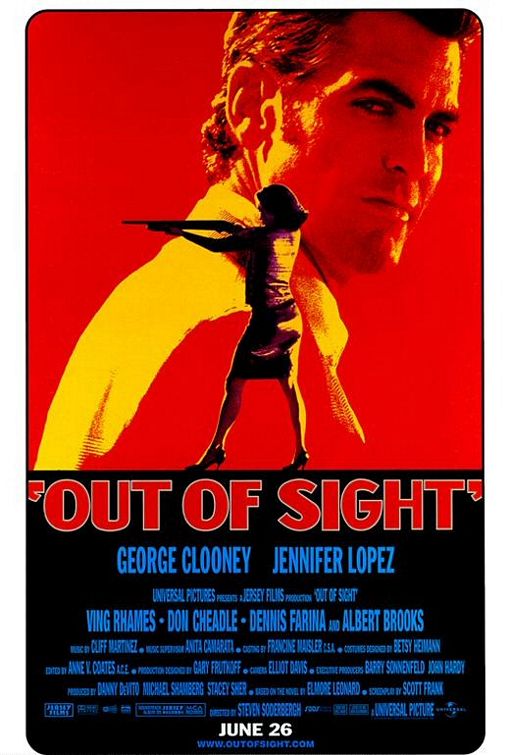
Out of Sight – If it’s been awhile since you’ve watched Steven Soderbergh’s most successful exercise in style and wit, do yourself a favor and rent it again. Jennifer Lopez is unbelievably good as Federal Marshall Karen Sisco and George Clooney couldn’t be more charming as escaped bank robber Jack Foley. The scenes between them—in the car trunk and in the hotel bar—are so natural and so genuinely romantic that you forget for a few moments that this is all just pretend. I guess that’s what they call chemistry, not to mention a great script. The fact that Soderbergh swiped the cross-cutting technique of the bar conversation with the bedroom consummation from the brilliant sex scene in Don’t Look Now (a theft Soderbergh fesses up to in the largely skippable director’s commentary) in no way harms the immediacy of these magical soft-focus scenes. Needless to say, this movie had me from the opening freeze-frame. Watching it again made me pine for the short-lived but superb TV spin-off, Karen Sisco, that starred Carla Gugino in Lopez’s role. There’s a TV DVD that needs releasing.



rants


Annnnndddddd...he’s off! DOH!

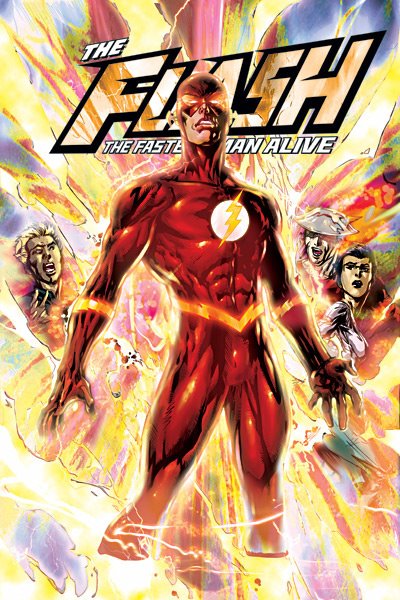
I hate to be an asshole, but the new Flash is barely out of the gate and already the relaunch has been a stumble. It’s at the very least ironic that the fastest man alive is getting the slowest start imaginable for his new series, which is mired in exposition and choppy storytelling. I was willing to give a pass to the first issue, but things really haven’t improved very much in issue two. A large part of the problem is Bart’s sped-up metabolism, which has aged him prematurely. This kind of thing can work in TV soap operas because the intimacy of the medium (five episodes a week) allows you to become involved with the suddenly grown-up character very quickly. In comics however, the much slower monthly schedule militates against this kind of rapid re-involvement, especially when the character in question already has a substantial history. Exacerbating the problem of identification is that the suddenly-older Bart has simultaneously undergone a significant personality transformation. In other words, this new Bart literally feels like an alienating soap-opera recast—not only has the character been artificially aged, he’s also being taken “in a new direction” by an actor who bears no resemblance to the earlier versions. I realize that there’s supposed to be some kind of mystery about the identity of the new flash and that Bart might not be it; the problem is that the story has been so alienating that I don’t much care who the new Flash is. Truth be told, I’ve never really been much of a Flash fan. I only started reading because I was transfixed by the artwork of Scott Collins, and ended up staying because of Geoff Johns’s fantastic scripts. The new team had better pick up the pace, if they want to hang onto readers like me. You know…the curious, but uncommitted.


Tales from the Pull-List: Endangered Books

I mentioned above that I’ve been buying tons of new comics, which means that unless I suddenly win the lottery, something’s gotta give. I’ll be sticking with the new Flash series for awhile to see if it can find its legs but it’s fallen to the bottom of the pile and it’s certainly not the only comic on the endangered list.

I was originally ecstatic about Bill Willingham’s double duty as writer/artist on Shadowpact, but after four-issues and two guest artists, I’m wondering if it might not be time to get the series on a more even keel by finding a full-time penciller. I loved seeing old-favorite Blue Devil in solo action again this month, but moody, atmospheric visuals are essential to a magic-oriented series and not even Willingham seems quite in tune with the weird majesty of Justiano’s Day of Vengeance visuals. Also, I hate the superhero costumes on Enchantress and the chimp. There, I said it.

I really, Really, REALLY want to like this, but the All New Atom series is clearly going to be a perverse test of my love for Grant Morrison and Gail Simone. I’m trying to be mature about it.

I’ve been getting JSA: Classified since the beginning and added JLA: Classified to my pull list after that breathtaking Ellis/Guice arc, but after the recent Detroit League saga in JLA: Classified, which is now being follwed by a sort of “sequel” in JSA: Classified, it’s beginning to look like DC needs a reminder about how easy it is to alienate readers from satellite series like the “Classified” ones. Remember a little book called Teen Titans Spotlight that was launched to capitalize on the success of that team back in the mid-80s? Remember how BAD that was? It drove even the most slavering fans away. Things haven’t quite come to that in the JLA and JSA Classified series, but it is asking A LOT of readers to sign on for what appears to be a seven or eight-issue Steve Englehart/Tom Denerick Detroit-League mini. I’m all for revisiting the Detroit League characters and I’m a huge fan of Steve Englehart—I even realize that these are in a sense “period” pieces. But these stories do not meet the high standard that has been established for the Classified series so far.

Oh, AQUAMAN. I just don’t know. I shouldn’t have to try so hard to enjoy this. It doesn’t help that I have to reread the entire series each time a new issue comes out (every two months?) to remember who these characters are.

Off the list: Hawkgirl (a catastrophe), Legion of Superheroes (for real this time), Nightwing (I tried it; I don’t get it), Outsiders (good riddance).

Wednesday, August 09, 2006

What I Did On My Summer Holidays

You may have noticed that things have been kind of quiet at Double Articulation for awhile.

That’s because I’ve been on vacation. What felt like my first real vacation in two years—the highlight of which was nine blissful days with my wife in Northern Ontario, a.k.a. Tom Thomson country: lakes, granite, jack pines, sunshine, and somewhere in there, tucked away in a quiet corner of a quiet lake, The Cabin.

My parents designed it in the late seventies, and it was built over the course of many summers by (mainly) four pairs of hands: my dad’s, my mom’s, my sister’s, and—to my utter amazement—mine. The cabin’s floor plan is basic; its decor, homey; its construction, solid enough to withstand a tornado—if not a nuclear attack. It’s the setting of many of my happiest childhood memories, and today, it is a nearly sacred place of retreat. Practically the only place I go where I genuinely relax.

Anyone who’s experienced it from a young age understands the lure of cottage country, particularly in Canada where “wilderness” and the “return to nature” remain central to the tourist-brochure version of our national mythology that many of us urbanites cling to, even if we feel somewhat sheepish about the privilege entailed in owning a cottage when we think about it too much. I was lucky enough to be immersed in this world of weekend wilderness early, thanks to my sturdy and industrious parents whose Luddite sensibilities crafted a “return to nature” more rigorous than most. Envisioning the good life as a sort of indefinite return to the nineteenth century, my folks developed an austere family version of Canada’s wilderness mythology by building a cabin that defiantly resisted plumbing, electricity, motor boats, and phones for more than 25 years. And am I ever grateful to them for their trouble and foresight. I wouldn’t trade the wooden rowboat my dad built for a motorized version if you paid me. I’ve been able to forgive my parents’ very recent “improvements” to the place—the installation of a solar panel, generator, modest interior lighting, and composting peat toilet—only because these things all hew (albeit barely) to the “right” side of my family’s snobbish line between good old-fashioned rusticity and the creature comforts of modern life.

Unsurprisingly, at the heart of my love of the cabin are satisfactions of simplification: getting around on your own steam, shedding attachments and responsibilities, leaving all the gizmos behind and entering into—if only in moments—a heightened relationship with this thing we call nature. This is never more true than when I take the rowboat across the lake on a calm day.

Ah, rowing. What I love about rowing is how its sheer physicality permits an escape from consciousness, replacing thought with a feeling of Zen-like oneness between you, the boat, the lake, and the landscape that all rowers know. That feeling of giving yourself up to the rhythm of the oars that sets your body rocking like a pendulum. The way the pleasing resistance of the water propels you forward (backward) as the boat cleaves the surface of the lake. Rowing is a heady and hypnotic mode of travel; it sends you forward through space and backwards into the past with every stroke. The rowboat is literally a time machine, your joints, muscles, bone, and heart its moving parts. For me, it is the cottage experience in its purest form. And perhaps its truest form also, because the boat, like the cabin itself, is a machine that interposes itself between you and the ruggedness of the landscape, domesticating it in a way that paradoxically allows you to experience nature more profoundly and more intimately.

In a related way, vacationing at the cottage recreates a pleasurable fantasy of some earlier historical period of settlement—pleasurable because it is obviously much more comfortable than the real thing. (Susanna Moodie didn’t have a cooler full of ice-cold Keith’s to cool off with, much less a composting peat-toilet to piss in. But that’s precisely the beauty of “roughing it,” cottager-style.) My mother’s recent implementation of a cabin “Record” has made this connection to the fantasy of a benign and idyllic settlement even more intense, for the “Record” is a logbook of sorts where such details as the weather, progress on cabin projects, and encounters with nature are lovingly noted for posterity and rainy days. In other words, this wonderful addition to the cabin experience lets you channel your inner Catherine Parr Traill and Ernest Thompson Seton, letting you assume the role of settler diarist and amateur naturalist for the duration of your visit.

Maybe this is why it felt so right to sit on the porch all day reading 19th- and early 20th-century classics of Canadian literature, as I did during that nine day sojourn, in preparation for the CanLit survey-course I’m teaching in September. Where better to read Goldsmith’s “The Rising Village,” Sangster’s “Sonnets, Written in the Orillia Woods,” Isabella Valancy Crawford’s “The Dark Stag” and “The Canoe,” anything by Charles G.D. Roberts, Bliss Carman, Archibald Lampman, D.C. Scott, or Pauline Johnson? Where better to browse through a dog-eared copy of Seton’s Wild Animals I Have Known (my dad’s) or be charmed almost to the point of anguish by Stephen Leacock’s Sunshine Sketches of a Little Town? And then there’s Martha Ostenso’s flawed masterpiece of prairie titanism, Wild Geese, and F.R. Scott and A.J.M. Smith’s modernist hymns to the blasted Northern Ontario landscapes of Tom Thomson. Even E.J. Pratt’s somewhat turgid railway epic, Towards the Last Spike, has a special savor out in the bush, since the train tracks pass directly through the community on the other side of the lake and you can hear the VIA’s whistle wail through the jack pines and poplar any night of the week.

The slide from wilderness landscape to wilderness literature to which I’ve just fallen prey (the feedback loop of the wilderness myth) brings me to the second dimension of the cabin experience that makes me so deeply (and compulsively) happy: the bookcase. Our cabin’s bookcase has fourteen shelves, two of which house cashew containers from Costco that are now filled with nails, leaving ten shelves for books and two additional shelves for magazines and (of course) comics. (You knew there had to be comics in this shaggy-dog story somewhere, didn’t you?)

Of the books and magazines, there are many different types, so many, in fact, and of such curious variety, that I am forced to rely on the ingeniously flexible method employed by Borges’s famous “Chinese encyclopaedist” to categorize them all. There are, in no particular order: (a) old books belonging to my parents that intrigue me, but that I am unlikely to read: my father’s Gerald Durrell collection, my mother’s biographies of Louisa May Alcott and Queen Victoria, the toxic and voluminous output of Ayn Rand, for which no one is eager to claim ownership; (b) books belonging to my parents that have forced me to reevaluate my adolescent prejudice that everything they read was boring: my mother’s shelf of Agatha Christie mysteries, my father’s P.G. Wodehouse and Ross MacDonald collections, a stray Ian Fleming novel; (c) classic adventure books that I pick up every time I come, but put down again because “I’m not in the right mood”: Sherlock Holmes’s Greatest Cases, The Coral Island, King Solomon’s Mines, Journey to the Center of the Earth, and the like; (d) books I will never read that I acquired at thrift stores and library sales for practically nothing during one of my aggressive “beach reading” campaigns, apparently forgetting that the person supposed to be reading them was me: Night Sins by Tami Hoag and Rum Punch by Elmore Leonard, for instance; (e) a small collection of parables and “occult” matter such as Zen Flesh, Zen Bones, a Herman Hesse novel, Your Happiness is in the Stars by “Constella” and The Sexual Key to the Tarot (the latter two contributed by, of all people, my late grandmother); (f) capital-L “Literature,” frequently lesser works by great novelists: Dombey & Son, Of Mice and Men, Four Plays by Ibsen, The Tin Drum, Dr. Zhivago, Jacob’s Room, Short Story Masterpieces, Muriel Spark’s The Prime of Miss Jean Brodie, Main Street by Sinclair Lewis, Vonnegut’s Mother Night, assorted novels by Orwell and Graham Greene, an entry from Lawrence Durrell’s Alexandria Quartet that torments and irritates my wife; (g) my dad’s childhood copy of Pinocchio with disturbing illustrations by Louise Beaujon; (h) books I bought in Kenora: a spy novel by Jack Higgins and Sudanna, Sudanna—funny SF by Frank Herbert’s son, Brian; (i) miscellaneous things that come from god knows where: The Guinness Book of World Records (1973 and 1978 editions), garage sale favorite The Cradle Will Fall by Mary Higgins Clark, a novelization of Flatliners (remember that?), and my personal favorite in this category…Lincoln’s Wit: Humorous Tales and Anecdotes About Our 16th President; (j) theme books of doubtful value with titles like At the Cottage that I for some reason feel compelled to give as gifts to my parents; (k) genuinely useful and oft-consulted guidebooks: Up North: A Guide to Ontario’s Wilderness, Instant Weather Forecasting in Canada, Wildflowers Across the Prairies, Medicine for Mountaineering, Birds of North America, Guide to Animal Tracks, and of course, Hoyle’s Book of Rules; (l) assorted nonfiction with nondescript titles like The Prometheus Project, Overlord (not to be confused with Arthur Hailey’s Overload, on the same shelf), The American Magic (not about magic), and The Challenge; (m) a selection of Soap Opera Digests from 1994 to the present whose presence shall pass without further comment, as will that of several well-thumbed issues of Star, Us, and In Touch, of whose contents I am forced to deny all knowledge, not to mention rather impressive collections of sailing magazines (belonging to my father) and Gourmet magazines from the 70s (belonging to my mother), neither of which tempt me, but whose presence I find reassuring.

Collectively, these books and magazines form what might be considered the crust, or upper layer of the bookcase. They are the stuff of recent, present, and possibly future reading. Below this layer, however, is a maze of deep, interlocking caverns. If you dig a little, you find the teenaged years—only for the stouthearted or the archaeologically curious, I assure you. Appropriately, perhaps, the first thing you’ll hit is a thick vein of horror. Two shelves of Dean Koontz, Stephen King, and an embarrassing profusion of paperbacks sporting devils, daggers, and breasts on their covers. Dig a little further and you’ll reach a smattering of fantasy and science fiction novels, most of which were purchased from the old McNally Robinson in Kenaston Village or from Bookfair in downtown Winnipeg between 1984 and 1986. Leigh Brackett’s Skaith novels, for instance. The entire output of Dennis L. McKeirnan. Asimov’s Foundation novels. The first trilogy of Margaret Weis and Tracy Hickman’s perfect D&D fantasy. Piers Anthony’s Incarnations of Immortality series (as usual, I stalled after Book Two). Dig further still and you’ll come to the detritus of puberty: Clan of the Cave Bear and the addictive sleaze of Sidney Sheldon and Lawrence Sanders. Under that, there are the stories and poems of late childhood: Kay Hill’s beautiful collections of Wabanaki legends, Glooscap and His Magic and More Glooscap Stories, a stray Three Investigators novel (I have the rest at home), Aileen Fisher’s Cricket in a Thicket (rhyming nature poems), about two thirds of The Adventures of Tintin, and my favorite Asterix story: Asterix and the Soothsayer. Then there are the picture books that I loved or that my sister loved: Three Little Kittens (wittily illustrated by Lilian Obligado) , Tawny Scrawny Lion, The Hole in the Fence, Richard Scary’s anthropomorphic extravaganzas About Animals and All Day Long, Lamont the Lonely Monster, Angela Banner’s weird and wonderful Ant and Bee books…

Now, finally, we’re getting somewhere—into the muck of real childhood. And it turns out, not coincidentally, that we’re getting back to the wilderness myth with which I began. For at the next level we encounter crumbling stacks of Owl Magazine from 1977, Canada’s answer to National Geographic’s far glossier World Magazine. World is here too, of course. Also making strong showings in this category are a stack of my sister’s Chickadee magazines (Owl for younger children) and an assortment of the National Wildlife Service’s more obscure (to a Canadian kid) and thus clearly hipper nature magazine, Ranger Rick (the gift of a more worldly childhood friend). These other magazines were all great, but in my (so Canadian) childhood, nature was what happened in the pages of Owl: those dusty-looking monochrome photospreads of children picking up leaves, skating on a pond, or building walkie-talkies. The see-through illustrations of logs or snow banks where the exterior was cut away to reveal a teeming (or hibernating) world of animal life. I can’t even calculate the number of hours I spent pouring over Dr. Zed’s science experiments, the comic book adventures of the Mighty Mites (3 kids who shrink), Groan Time (your bad puns), and Hoot (Owl’s backpage “newsletter”). Much of the content was too complicated for a 5-year-old to fathom, but it was all mysterious and fascinating nonetheless.

This, perhaps, is the real bedrock of my Canadian cabin fantasy: the purely innocent and private childhood “nature” of Owl. A nature that is inseparable in my mind from the cozy x-ray drawings of “Animals Underground,” from the micro-pioneering of the Mighty-Mites, and from undemanding lessons about plant and animal names. This is no doubt why I love my mother’s “Cabin Record” and my father’s coverless copy of Seton so much now. They’re all Owl, in different forms.

I haven’t spoken yet about the modest collection of yellowed comic books that sits in a tattered heap on one of the lower shelves. I’ll save that heap for another day. In an act that felt like a true violation of the spirit of the cottage, I brought this pile of comics home with me because I wanted to write about them. And I will. But the enjoyment I’ll get from revisiting them in this context doesn’t dull my sense that a storehouse of ancient relics has been disturbed. That a grave robber in the guise of an archaeologist has been poking around when he should have left well enough alone.

How did the cabin bookcase come to acquire such absurdly mythic dimensions in my mind? It isn’t just that it’s become the dumping ground for so much of my childhood reading matter, though that is certainly a big part of it. The more important reason, though, is that the cabin bookcase has become a concrete microcosm of my family’s collective reading experiences—of our intellectual adventures and obsessions. And it’s an extremely rare and precious object because it is, in truth, the only physical place where all of our reading pleasures, past and present, meet and mingle. What a marvelous thing it is to think of the shared experiences that occur at that bookcase in the wilderness when my sister or I read one of my mom’s Agatha Christies, when my wife reads one of my dad’s P.G. Wodehouses, when my dad picks up a science fiction book, or when my mom pores over my old copies of Man-Wolf and Magnus Robot Fighter. Okay, I’m lying about that last example. But make no mistake: the bookcase too is a kind of wilderness. A wilderness of memory, for one thing. And an anarchic no-man’s-land of the family, for another. A place where all the familiar roles and rules of family are suspended. A place where adult children recover traces of their parents’ childhoods and youth, where comic books rub covers with biographies, and where the solitary act of reading turns out not to be so solitary after all.

Wednesday, June 28, 2006

On America: Steve Gerber’s Wundarr and the Alternate Fantastic Fours of Marvel Two-In-One #1-8

A number of very silly things happen during Steve Gerber’s brief tenure as the writer of Marvel Two-In-One #1-8, a sequence that is part of what plok has ingeniously recognized as the longest graphic novel in the world. Silliest of all, perhaps, is the appearance of dimwitted “sky-child” Wundarr, who blunders through several issues like an overgrown toddler. First he is lusted after and then mothered by nubile Atlantean It-girl Namorita. Then he is babysat by longsuffering Ben Grimm. Eventually he just goes away, and it’s difficult to lament the departure of this “22-year-old orphan from space with the mind of an infant and the strength of an elephant” because, in many ways, Wundarr is just another in a long line of Forest Gumps—those irritating simpleton-everyman figures through which American popular culture seems determined to reflect an image of the national self as idiot savant.

That “America” is on the agenda of Gerber’s Marvel Two-In-One stories cannot be doubted. In issue #3, guest-starring Daredevil, there’s a hilariously overwrought set piece in which Matt Murdoch and Foggy’s sister, Candace Nelson, attend “an avant garde patriotism play” called America Shall Endure. With typically Gerberesque understatement and restraint, it begins with a black man dressed as a slave delivering a jeremiad to Lady Liberty, features Captain America as a white supremacist, and concludes with Adolph Hitler blowing his brains out as a suicidal personification of America! Set alongside this sort of shrill but (I must admit) amusing agitprop, Wundarr’s story feels a lot like counterpoint, providing a less critical, more romanticized take on America as a naïve “star-child”: a little immature perhaps, even dangerous, but not yet the suicidally fascist state that Gerber parodies so savagely in the avant garde theatrical provocation being stage-managed by hypnotic agents of “Black Spectre” and hate-mongering femme fatale, Nekra, Priestess of Darkness.

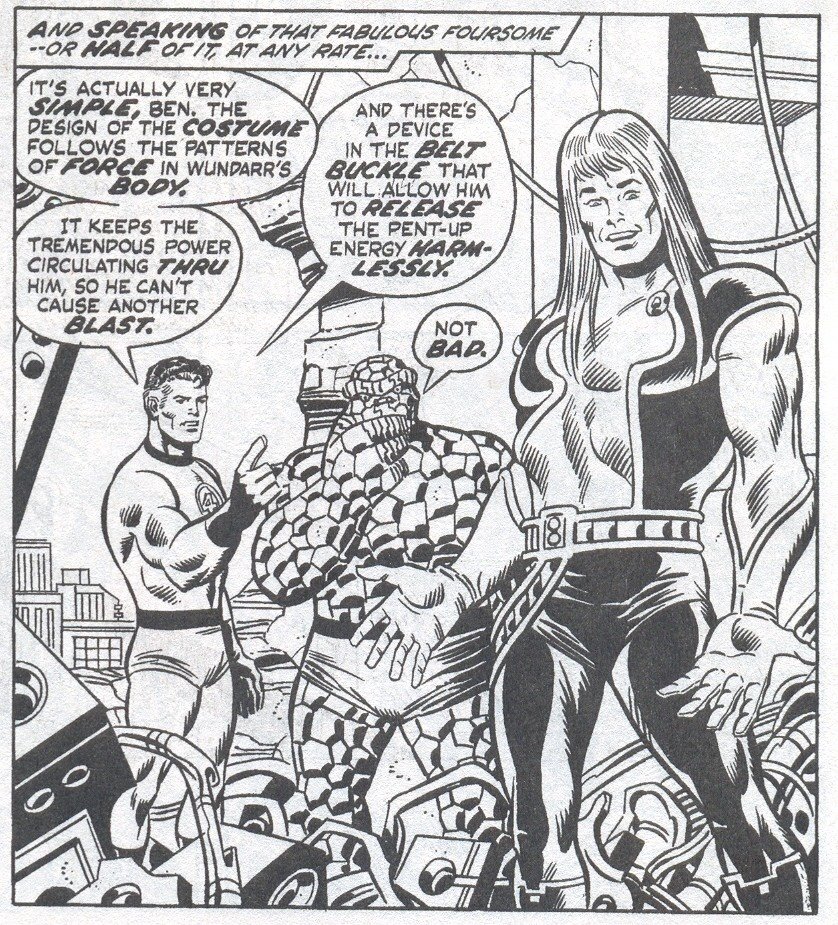
Indeed, by the end of this issue, Reed Richards has even come up with a way of dealing with Wundaar’s excessive energy build-up that would allow him to make love, not war: a costume that “keeps the tremendous power circulating thru him, so he can’t cause another blast.” Naturally, Wundarr’s bare-chested love-god duds include “a device in the belt buckle that will allow him to release the pent-up energy harmlessly.” Indeed! It’s as if Gerber has substituted a masturbatory Wundarr for a suicidal Hitler in this issue’s parade of national allegories. This is all quite funny, if patently ridiculous, but there is something intriguingly ambivalent about Gerber’s depiction of Wundarr. Something that reflects a deeper ambivalence that Gerber feels about America during the mid-1970s.

That is, as much as Wundarr might be construed as an idealized, or at least optimistic image of the potential innocence of American power, Wundarr is more obviously Gerber’s parody of Superman, that other great symbol of Truth, Justice, and the American Way. Like Supes, Wundarr is not only super-strong, but the last of his race, the lone survivor of an exploded planet, launched into space as a baby. Lest we miss the point, Ben helpfully telegraphs Gerber’s parodic intent by mocking Superman’s famous catch-phrase.


But what is the point exactly? Does this parody of DC’s Nietzschean “overman” intend to place Superman in the category of the white supremacist “Captain America” and the suicidal Hitler of America Shall Endure? Or is the parody murkier than that? Does it mock national fantasies with one hand, while covertly recuperating them with the other, making Wundarr less a parody of Superman than a sort of tongue-in-cheek reiteration of his most ambiguous aspects? Or is it simply a meaningless filigree on the age-old inter-company rivalry between Marvel and the Distinguished Competition? It’s difficult to separate these strands, and one suspects that that is partly because Gerber has only half-worked out this mishmash of ideas and references. But it also seems likely, given the violent oscillation between utopian and dystopian versions of America in Gerber’s MTIO stories, that the ambiguities inherent in his treatment of Wundarr (parody of “fascist” America? romantic-satiric national self-image?) are symptomatic of a more fundamental ambivalence that stems, it would appear, from an authorial point of view fixed upon an often dystopian national present that nonetheless contains the seeds of a potentially utopian future.

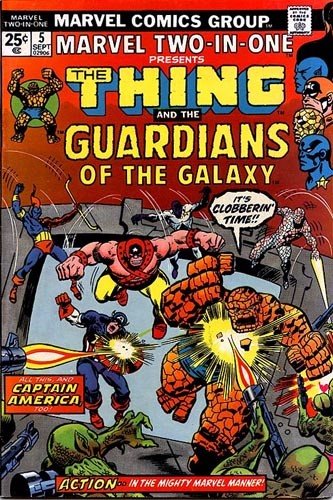
We can see this interesting dynamic being played out particularly in issues #4 and #5 which guest-star Captain America and the Guardians of the Galaxy respectively. The story in a nutshell is that the Thing, Captain America, and Cap’s S.H.I.E.L.D.-agent/girlfriend, Sharon Carter, must use Doctor Doom’s old time-machine to journey into a dystopian future-America, where all that survives of humanity is enslaved to “the Brotherhood of Badoon” and their drone-like army of “Zoms.” Their guide from the future is bewildered but sexy refugee Tarin, an earth gal from tomorrow who helps them team up with underground rebels the Guardians of the Galaxy to achieve a symbolic victory over the despotic Badoon. Captain America, “our symbol of liberty,” as Tarin calls him, pronounces the tale’s moral: “Man won’t settle for a fleeting taste of liberty. We’re not made that way. The need to be free is in our blood. Your empire will fall because it must—because we are human.”

The storytelling is not spectacular. But that’s because Gerber seems only interested in the symbolism—and more broadly in the sometimes head-spinning political allegories that his narrative establishes. As this brief synopsis suggests, the present-day Captain America, “a living symbol of liberty,” acts as an inspiration to the rebels of the dystopian future and is the spiritual source of their victory over the embodiments of oppression—the Badoon. But as we’ve already seen, Gerber’s acerbic satire of contemporary America in the avant garde patriotic play from issue #3 suggests that America is far from the ideal that Cap symbolizes for the future—heck, it even features a Cap doppelganger who hypocritically beats the black slave while preaching respect for minorities! The neat thing is that, in Gerber’s narrative, this isn’t a contradiction—at least, it isn’t a careless one. Rather, what these two stories demonstrate is the split within Gerber’s vision of present day America as a nation containing simultaneously utopian and dystopian elements.

In these stories, Captain America shifts between representing the corrupt and the idealized version of American “liberty,” suggesting that Gerber diagnoses current injustices as corruptions or betrayals of original ideals that stubbornly persist in certain peculiar but increasingly marginal forms; Gerber thus dramatizes the solution to America’s problems in the present as a nostalgic return to the ideals of the past. This is perhaps why the temporal jump into the dystopian future of 3014 A.D. feels so vertiginous. At the level of the science fiction story, it is a dystopian future that foregrounds the utopian aspects of the present in Captain America, a move which seems to celebrate at least some aspect of the present and which puts the responsibility for social transformation squarely on the reader’s shoulders. (This move is perfectly consistent with the political dimensions of Gerber’s existentialist fable in MTIO #6-7.) Yet, at the same time, the veneration of Captain America as the inspiring embodiment of liberty in this story ironically implies the need for present-day America to conduct a similar return to the ideals of the past. This strange paradox is suggested by the doubling of Captain America by future Guardian of the Galaxy, Vance Astro. As Vance explains:
You were my boyhood idol, Cap. I even saw you in action in person once, with your partner the Falcon, back in 1972, I think… I was born in 1962, Cap…but I spent most of [the intervening 1000 years] asleep, in suspended animation…aboard the first American rocket headed for the stars. I left the earth in 1988, traveling at a velocity of a million miles per hour. Even at that speed, the journey to earth’s nearest stellar neighbour required a millennium. But a mere 200 years after I left, a man named Harkov came along with a new theory that made faster than light space travel a reality. When I came out of my ship on Centauri-IV, a colony of earthmen was there to greet me! I felt as you must have, Cap, when you were released from that iceberg back in 1964, after decades.
In effect, Vance is a transplanting of the Captain America concept of “past ideals for present ills” into the future, a move that makes this future time stand as both a warning about how bad the present could become and as a symbol for how bad it already has become—a representation of the dystopian aspects of the present that Geber exaggerates in the stage-play in issue #3. The dystopia of 3014 A.D. is thus both a satirically exaggerated representation of the dangers of the present and a fictional technique for highlighting what is most potentially redemptive about it.

So what is redemptive about it, according to Gerber? What is the “utopian” element that somehow survives in present-day America? That Captain America sometimes represents?

In political terms, it’s obviously something like democracy; in social terms, it’s something like harmonious diversity, a sort of existential multiculturalism. What makes Gerber’s representation of these political and social ideals so distinctive and so enjoyable are the ways that he makes them inseparable from a critique of the traditional family—that social institution that is most strongly linked to insularity, conservatism, and aristocratic social forms.

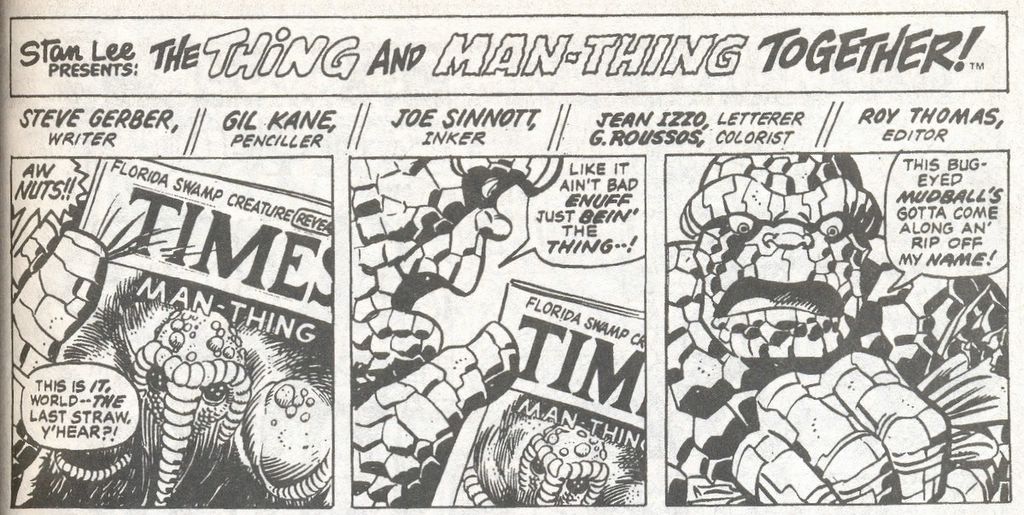
Perhaps not surprisingly, Gerber’s gleeful travestying of the traditional family focuses in on the “First Family” of Marvel Comics: the Fantastic Four. There’s a significant irony here, for as I’ve mentioned before, the Fantastic Four is already a wonderful example of how Marvel Comics opened up and challenged the model of the traditional nuclear family, rather than simply reaffirming it. In a sense, Gerber seems to recognize the weirdness and a-typicality of the FF, but his project in these issues of MTIO is to push the family team’s strangeness and heterogeneity much further. It’s interesting, for instance, that the very first panels of MTIO #1 concern Ben’s irritation that Gerber-favorite Man-Thing has stolen his name—as if Gerber were announcing that the Thing was going to have to fight for his status as the family freak.


(After his space ship crash lands, Wundarr also mistaken believes that Man-Thing is his mother—quite possibly the most delectably absurdist Oedipal parody ever penned!) Moreover, that first issue of MTIO concerns the Molecule Man’s failed attempt to revenge himself on the FF, which is foiled by his inability to locate them. (He is trapped by a “nexus of mystic forces” that prevents him from teleporting out of the Man-Thing’s swamp!) The point is that we’re in the position of the Molecule Man here, for Gerber’s MTIO issues never really deliver the Fantastic Four either, even though many members of the team appear on the fringes of the stories.

What Gerber delivers instead are two alternate versions of the Fantastic Four, examples of what I’ve earlier called Gerber’s “strange communities.” In issue #4, it’s “chrononaughts” Captain America, Sharon Carter, Tarin, and the Thing who form an alternate version of the FF, referencing and changing the FF’s original use of Doctor Doom’s time machine from FF #5—an adventure in which the Thing himself underwent a strange transformation into Bluebeard the Pirate! (The presence of team-alternate Medusa, rather than Susan Richards in MTIO #4 is also a suggestive detail.) In MTIO #5, the four alternate-FF “chrononaughts” from the present are themselves supplemented by yet another alternate FF: The Guardians of the Galaxy, “four lone survivors of four lost worlds, each pledged to destroy the Brotherhood of Badoon!” Like the makeshift team of “chrononaughts” who unite for a common end in issue #4, the Guardians of the Galaxy are a team notable for their lack of blood ties. In fact, their difference and separateness from each other is hyperbolically represented by the “last-of-their-race” trope.


These alternate FFs, I think, are representations of Gerber’s ideal of social, political, and national collectivity: strange communities that are also communities of strangers, brought together for a common purpose (the defense of liberty), but with more particular individual differences and interests that are radically non-totalizable. In the case of the four “chrononaughts,” the team itself is only a temporary assemblage, the members of which will separate and recombine as the need or desire arises. Welcome to the Gerberverse: Reed, Sue, Johnny, and Ben reinterpreted through the lens of the Defenders.

This, at least, is what I was getting at in that earlier post for plok’s Seven Soldiers of Steve, when I claimed that
Gerber’s stories in Marvel Two-In-One (as the book’s title and concept suggest) are really all studies of the strange community motif that is not just a consolation but (I suspect) a genuine political goal… In Gerber’s work in these issues of MTIO, the strange community emerges as a vision that is at once philosophical, ethical, and political: democracy, or perhaps, “America” as non-team.
Does Gerber ultimately provide any concrete answers? Beats me, True Believer. But he definitely has a compelling way of posing the important questions.

Monday, June 12, 2006

SPOILERS ABOUND: an occasional digest of reviews, notes, and rants

Vol. 2, No. 6 - SPECIAL ONE YEAR BLOGOVERSARY EDITION
- - - - - - - - - - - - - - - - - - - - - - - - - - - - - - - - - - - - - - - - - - - - - - - -

In this issue:
reviews of Wonder Woman #1, The Sensational Spider-Man #26, and Green Lantern #11 / notes on recent Marvel comics, Omega Men, and more recent rentals / rants about Double Articulation: One Year Later


- - - - - - - - - - - - - - - - - - - - - - - - - - - - - - - - - - - - - - - - - - - - - - - -


reviews


Wonder Woman #1 (DC Comics)
Alan Heinberg (Writer) / Terry Dodson (Penciller) / Rachel Dodson (Inker) / Alex Sinclair (Colorist) / Rob Leigh (Letterer)

Alan Heinberg, you do not disappoint. Wow.

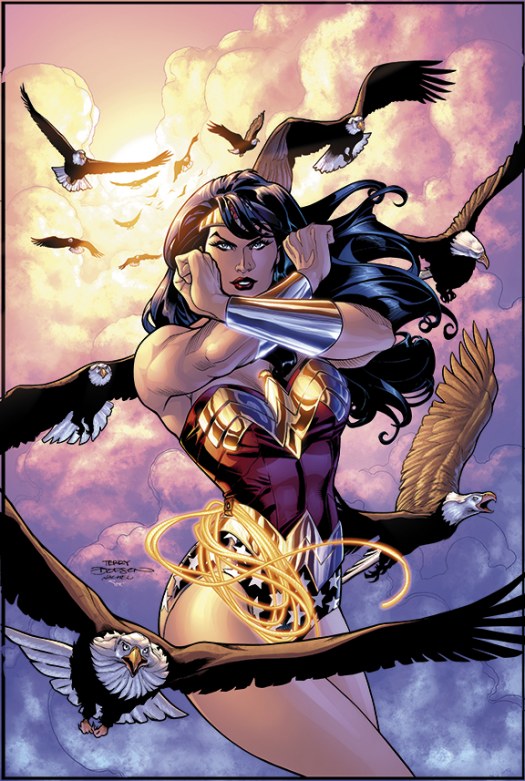
This is the best first-issue relaunch of a major superhero title since George Perez released his Wonder Woman #1 back in 1987. The story is superbly paced and packed with action, surprises, and tantalizing teases. The games that Heinberg plays with the reader in this one are also cleverly knitted together by the motif of deception and unmasking that runs through the issue. And the art. Oh boy. The art! This is the best-looking Wonder Woman comic I’ve seen in ages. Without in any way abandoning their signature style, Terry and Rachel Dodson have passed through to the other side of cheesecake art. The women in this comic are gorgeous, tough, and heroic.

And then there’s the little matter of Donna Troy. Judging from some of the other responses to this issue that I’ve read, I am probably in a very small minority here, but the spread on pages 2-3 made my jaw drop and my heart beat a little faster—not with horror, but with sheer unbridled fanboy delight. Even if this is not a new status quo, Alan Heinberg and Terry and Rachel Dodson have done more to repair the damage to Donna Troy than even the combined talents of Phil Jimenez, Jose Luis Garcia-Lopez, and George Perez were able to accomplish. It was so simple: just restore her connection to the Amazons. Suddenly, her character makes sense again. And looks better than she has since the heyday of the star-spangled red jumpsuit. A+

The Sensational Spider-Man #26 (Marvel)
Roberto Aguirre-Sacasa (Writer) / Clayton Crain (Artist) / Cory Petit (Letterer)

So, who is this Clayton Crain dude?

I flipped through The Sensational Spider-man #26 at the comic shop on a whim this week and just about fell over. That is some beautiful artwork. I felt momentarily transported back to the gloomy brilliance of Brent Anderson’s painted covers for Somerset Holmes, that exceptional but short-lived series from Pacific Comics back in the early 80s. Crain’s computer-colored work has sharper lines than Anderson’s covers, but the sensibility is similar—and perfect for a good, dark Spidey story, which this one, by Roberto Aguirre-Sacasa, about Spidey and his more bestial foes going feral, seems to be. Even if you don’t like the costume, there’s an image of Spider-man emerging on those creepy golden limbs from a lake on page 20 that is almost worth the price of the whole comic. Visually, Crain’s take on the new Spider-man is a throwback to the mud-caked, rainy, Gotham-style gothicism of Kraven’s Last Hunt, done up in surprisingly expressive and dynamic three-dimensional digital painting. (For a nifty video of Crain’s art-process, visit this link on his website, Hey Cat.) This is just a guest-spot for Crain while regular series artist Angel Medina takes a breather, but even if you don’t intend to buy the rest of the story, this issue is still one of the more satisfying visual takes on Spider-man that I’ve seen in quite awhile. The perfect impulse-buy.


Green Lantern #11 (DC Comics)
Geoff Johns (Writer) / Ivan Reis (Penciller) / Oclair Albert (Inker) / Moose Baumann (Colorist) / Rob Leigh (Letterer)

I forgot to mention this title during my overview of DC One Year Later series and that was a significant oversight. This book has been a strange one since its relaunch, and although I’ve enjoyed the stories and the high caliber of artists who’ve worked on them, this title has lacked the creative stability necessary to build long-term reader involvement in what is, after all, a serial, not a set of Green Lantern: Classified arcs. It’s therefore a great pleasure to see powerhouse penciller Ivan Reis take over as full-time GL artist at the same time that the title itself seems finally to be digging into some really exciting storytelling territory: the introduction of a Doomsday-like GL, the return of the Cyborg Superman, more Guy Gardner, and a tantalizing subplot involving the reformation of the Global Guardians (VERY stoked about that). What feels different about Green Lantern OYL is the sudden sense of depth and richness the events have been given, courtesy of that one year of blacked-out time. As much as I liked the austerity of that first story arc, this is what the early issues of the series were missing. The villains and subplots of this particular issue also connect Hal Jordan up to the bigger DCU in a way that I think the series needed. The Green Arrow and Batman guest spots were nice, but those aren’t the kind of continuity crossovers I’m talking about. Those were “small” stories, and it’s really great to see the seeds of larger events (such as the founding of the Global Guardians) being planted in a series that should be one of the lynch-pins of the more fully-integrated DCU.


notes


For the Record: Recent Marvel

Despite that little burst of enthusiasm a couple of months ago, I’ve been kind of wary of Marvel lately. I no longer read many of the Marvel titles that were once staples (Uncanny X-Men, Amazing Spider-man, Fantastic Four) because I’ve been burned so many times by their false starts, rotating creative teams, and lousy storytelling that I just kind of lost interest. Those new versions of old favorites that I hang onto despite my better judgment (New Avengers, Astonishing X-men) currently test my patience as much as they entertain me. And Marvel’s latest event-comics are either vaguely depressing (Civil War) or disappointingly executed (Annihilation). So what am I enjoying from Marvel these days? Not too much, but not nothing either.

Charlie Huston, David Finch and Danny Miki’s brutal new Moon Knight series, for instance. Sick though it is, I love the ugliness, abasement, and sheer nastiness that Huston brings to the developing story of Marc Spector’s slow crawl out of (and back into?) the gutter. What Moon Knight does to his opponent in issue #2 was a real shocker and gruesomely sets the tone for a series that looks like it is really willing to visit some scary places—I’m totally hooked. David Finch’s detailed pencils and knack for prettified violence are perfect for this series; I hope he hangs around longer than he did for New Avengers. If the creative team sticks it out, this could be a classic in the making.

In a very different vein, there’s Brian Reed, Roberto de la Torre and Jimmy Palmiotti’s terrific new Ms. Marvel series. This is basically Dazzler version 2.0, harkening back especially to the slightly tougher Dazz who emerged fighting beside Wolverine and Colossus in the final few issues of her series, once it was already basically slated for cancellation. As Marvel’s new Alison Blair, Carol Danvers frets and fights her way through dangerous alien and human predators in what is turning out to be a very well-written, attractively-illustrated story of a second-rate superheroine trying to make it in the big-leagues. As his use of the Brood in the first couple of issues demonstrates, Brian Reed has an extremely good grasp of what it is that makes Carol Danvers cool—it’s not her brush with New Avengers status (as the cover of the first issue suggests), but fans’ memory of her as the underdog tag-along to the X-Men’s space-faring adventures. I wonder how long it will be before Rogue shows up (also, significantly, an old Dazzler antagonist). Great fun.

Another Marvel series that I actually look forward to these days is Fabian Nicieza, Tom Grummett, and Gary Erksine’s Thunderbolts. The series, which has been floundering since its rocky relaunch, has finally hit its stride in issue #102, which tells the origin of Janice “Joystick” Yanizeski. After the delicious reveals in this issue, I’m now going to have to go back and re-read the New Thunderbolts from the beginning, and possibly re-evaluate my earlier assessment of the story. Thanks to Tom Grummett’s slick superhero art, the title looks extra sharp, and the presence of characters like Nighthawk and the Grandmaster (who plays chess in his celestial living room!!) make this series too much fun not to love. Whew! I think I’m finally ready to relax and enjoy the ride.

Finally, although I haven’t been thrilled with most of the Annihilation miniseries, I am enjoying Dan Abnett, Andy Lanning, Kev Walker, and Rick Magyar’s Nova. Like the rest of the Annihilation prologues, this one’s a slow-starter, but dynamic duo Abnett and Lanning are writing a nice character piece here and Walker’s pencils look sharp. If this team did a Nova ongoing, I’d plunk down my two nickels.

I’m still looking forward to Eternals and the constantly teased possibility of a new Alpha Flight. And of course, there are some other good Marvel series that still await me, either because I’m waiting for the trade or because their storylines are already so far along that I just haven’t worked up the energy to jump on board yet: She-Hulk, Runaways, Daredevil and possibly Captain America. As always, suggestions welcome.


Omega Men

I read the spectacular Adam Strange: Planet Heist recently, so I’m tickled to hear that DC is going to give the Omega Men another shot, even if it is only just a miniseries to start with. Here’s what series writer Andersen Gabrych has to say about the team line-up: “Tigorr, the take-no-BS leader, Broot the pacifist powerhouse, Doc, the TV-Headed team physician who has learned to use his healing powers to devastating results, Elu the living cosmic storm, and Ryand’r, brother to Teen Titan, Starfire, who has a whole new set of powers and a brand-new codename which has everything to do with our story. We also will pick up a new lady-member who has roots deep in the DCU’s cosmic mythos and an old Omegan will return in an entirely new way.” And here’s what he has to say about the story: “This goes right to the heart of faith, quantum mechanics, death, God, and the beauty of existential diversity. With lots and lots of kick-ass fighting, featuring guest appearances by Superman, the Teen Titans, Green Lantern, and more!” Gee, sounds almost as if it was being written specifically for, well...me! All these guest appearances sound great too, especially for a reader like myself who isn’t actually all that well-versed in Omega Men lore, but who remembers the group mainly as cool supporting players in other comics. Like many, I was first introduced to the team in New Teen Titans #24 during the Blackfire/Tamaran space-epic—the storyline that cemented my love of the Titans after the amazing Brother Blood issues. I didn’t buy the subsequent Omega Men series (despite gazing rapturously at Keith Giffen’s sumptuous cover to the first issue), but I did pick up the odd issue here and there over the course of that run and really enjoyed it. From the impressive reconstruction of the Green Lantern Corps, to the reintroduction of classic pulp-style space heroes like Adam Strange and Captain Comet, to the relaunching of fan-favorites like the Omega Men from the Perez-era Titans, DC’s gradual rebuilding of its universe continues to gather steam.


The Screening Room: Recently Viewed

My retreat from reality continues:

Close Encounters of the Third Kind (1977) – I’m no doubt the first person in history to watch this film because of its Days of Our Lives cameo (thanks Tom), but am I ever glad I finally did. This film really is as special as its reputation would have us believe. Spielberg’s obsession with “family” has become increasingly grating over the years, but it is charming and even moving in this film. The unearthly little boy who just wants to see his alien playmates captures something so authentic about childhood that it makes you ache, and Richard Dreyfus is surprisingly good as the UFO-witnessing father (if you're a sentimental slob like me, the mashed potato scene where he says “I guess you’ve all noticed that there’s something strange with dad” might actually make you blubber like a little kid). Moreover, the film makes storytelling-choices about his relationship with his family and with fellow witness Melinda Dillon that reminded me how conservative Spielberg has since become on this topic. The real treat, though, are the memorable, spectacular images of the mothership rising above the butte, of the light through the keyhole, of the little boy opening the door, of Richard Dreyfus surrounded by the childlike aliens… All of this is infinitely better than the more commercial version of these tropes in E.T. (1982). In a lot of ways, Close Encounters felt like “pure” cinema: the entire plot turns on the issue of seeing something that isn’t just magical-seeming, but something actually made of light and sound. And does it ever deliver. Maybe I’m just tapped out on the virtual datascapes of CGI, but the visual lighting effects in this film are as sublime as anything I’ve seen on screen in the last 20 years. Magic.

The Keep (1983) – I cannot convey to you how strange a viewing experience this was. Directed and adapted for screen by Michael Mann, with a youngish Ian McKellen and Lance Henrickson look-alike Scott Glenn in starring roles, this movie about Nazis who unleash an ancient supernatural being from a Romanian Keep looked like fun. (It’s also based on a novel by horror-scribe F. Paul Wilson, whose work I’ve enjoyed in the past.) But you know there’s a problem when your patient and loving wife who is sitting through all this nonsense remarks, about halfway in, that it sort of reminds her of Xanadu (1980). She might have something there. The film is so lovingly made and flirts with such high-minded ideas that it’s hard not to feel a little protective of it. But not even Michael Mann’s stylish aesthetic sensibility can fully unify what turns out, somewhat disappointingly, to be a morality play masquerading as a horror film that is itself rather disconcertingly decked out in the garb of science fiction. (Its visual signature is glowing laser beams in fog and the climax falls just short of a full-fledged light-saber duel.) Strangest of all, though, is the unremitting eighties-electronica soundtrack by Tangerine Dream, which is perfect for the hilariously choreographed (and out-of-the-blue) sex scene between Scott Glenn’s “wanderer” and Ian McKellen’s daughter, but provides an odd accompaniment to the machinations and death-shudders of the Nazis at the ancient citadel, who seem to be caught in a misty, back-lit music video. I can’t really recommend it, but it has a certain charm.

The Substitute (1996) – Worse than you might think. Even if the equally appalling but at least entertaining Dangerous Minds (1995) has a place in your secret trunk of guilty pleasures, this reactionary tale of sensitive white Merc (Tom Berenger) who discovers his inner-Pfeiffer while stomping out a drug ring at an inner city high school is 114 minutes you will regret giving up. A distinctly mid-nineties example of ass-whooping with a bad-conscience.

X-Files (1998) – I remember the excitement leading up to this film…and the letdown when I actually saw it, even back in 1998 when my X-philia was at a fever-pitch. Some great visuals—Scully and Mulder in the beehive, for instance—but it mainly just felt like an overlong, poorly paced episode of the series. It didn’t help that the leads were strangely uncharismatic on the big screen. Hasn’t aged well.

The Matrix (1999) – This, on the other hand, has aged wonderfully. I haven’t seen the original installment since I was first caught off-guard by it in the theatre, but it’s lost none of its kicky gloss in the interim. Hugo Weaving’s Agent Smith may actually improve with age. Near-perfect sci-fi.

The Transporter (2002) – Supremely silly and supremely awesome. I loved every minute of this slick, stylish adrenaline rush for fourteen-year-old boys of all ages. As nattily-attired ex-Special Forces “transporter” Frank Martin, Jason Stratham is the coolest action hero since Matt Damon’s Jason Bourne. The beautifully-choreographed fight scenes avoid the gravity-defying sublimity of the Matrix films in favor of a slower, more deliberate, more naturalistic weightlessness: Stratham moves like a sort of Gene Kelly with guns and kung-fu. The “story” (and I use the term loosely) is ostensibly the old chestnut about how a stiff, by-the-book hero’s life is turned upside down by the appearance of a beautiful girl (Qi Shu), but the pleasures of the film rest entirely on the fetishistic precision of Frank’s wardrobe, house, driving, and ass-kicking.

A History of Violence (2005) – I find it very difficult to believe that this was nominated for best adapted screenplay (much less that William Hurt was nominated for best supporting actor). Was I supposed to take this seriously? Peter Travers, Lisa Schwarzbaum, explain yourselves. The most overrated film I’ve seen in recent memory. I watched it with a similarly bewildered group of intimates and I’d relate our post-viewing evisceration, but why bother? The comments by metacritic users Lance C., Jennifer R., Mark P., Steve A., and others say it all so eloquently already. Not good.


rants


On Blogoversaries: Double Articulation…One Year Later

Am I still here? Huh.

I’m as surprised as you are. Probably more.

You see, I’m famous for starting things and not finishing them. For flaking out at the first sign of trouble. Novels. Hobbies. Diets. Exercise regimens. I’m easily-distracted, fickle, and lazy. If I weren’t also obsessive-compulsive and a perfectionist, I probably wouldn’t be able to hold down a job, much less sustain irregular contributions to a little space on the web. And so, here it is, one year later, and Double Articulation continues to putt along, a testament to the awesome power of caffeine-fueled narcissism. And of course, to you, dear reader! When I put up that first portentous post on My Golden Age a year ago today, I harbored the secret, terrible hope that maybe as many as four or five people might read it and might find, in some small manner, that it spoke to them. And to my surprise, they did! And some of you even linked here or sent along a nice word or two.

To everyone who’s stopped by over the past year to skim through my obscure and tendentious musings, whether you’ve commented, linked, or just read, I’d like to say a very sincere thank you. Double Articulation has been a lot of fun for me—too much fun, really. Comics have long been a mainly private pleasure, so being able to spout off about them to fellow geeks and interested hangers-on has been a treat. The conversations that have developed, both here and on your own blogs, are a continued source of delight for me.

Thanks to one and all!