 On Saturday, I looked at my favorite books of the year. Today I cast an eye over books that are ripe with potential but are still finding their feet, as well as books (or partial runs of series) worthy of particular praise, even if they don’t quite make the cut for “Best of the Year.”
Promising and Notable Books (2006)
1. Justice Society of America – The most exciting #1 of the year. Hands down.
2. Batman (Morrison/Kubert) – A tantalizing and overdue return to a more colorful Bat-sensibility, but where’d it go? There’s something cozy about the merely passable Ostrander/Mandrake “Grotesk” story arc currently in progress, but its tone couldn’t be further removed from the James Bond Batman that Morrison was developing. A “re-imagining” of the magnitude Morrison promised requires consistency to work, even if it is only within a single Bat-title. It would be too bad if Morrison’s jauntier playboy Batman ends up to be just a missed opportunity.
3. Wonder Woman – Alan Heinberg and the Dodsons? I love it. I’m even prepared to wait for it. My only complaint is that there are too many superheroics (and heroes and villains) hogging the spotlight in this frantically-paced opening arc. Let’s hope this is followed up by one of those “day in the life” issues laden with character moments and subplots, hmm?
4. Checkmate – Intelligent and compelling. Arguably DC’s slickest, most adult mainstream book. And it reintroduced the sorely missed Suicide Squad.
5. Justice League of America – I haven’t liked the pacing of this opening arc at all. (Meltzer needs to worry less about the feints and reveals and more about basic storytelling.) It has been an undeniably exciting ride nonetheless. More than anything else, I’m excited about the possibilities for this book down the line and the incredible JLA line-up that exploits the as yet untapped potential of DC’s lost 80s generation (about which you will be hearing a lot from me this year). Vixen? Geo-Force? “Doctor Jace”? Black Lightening? Arsenal? Trident? Cyborg? This is the first time since Morrison that the JLA has felt like a truly fresh property.
6. Nightwing – Wha… huh? You bet. The Wolfman is back, baby. Granted, Marv’s first story arc was saddled with the turgid pencils of Dan Jurgens, but thank goodness for the return of some old-school storytelling. The half dozen issues of this title prior to Wolfman’s assignment as writer were mind-bogglingly unreadable. Truly awful stuff. What a breath of fresh air to have this character back in the hands of the writer who defined him. You show those punk kids how it’s done, Marv. Your reward? The talented Jamal Igle!
7. Manhunter – May the appearance of Wonder Woman in the new arc finally help this entertaining and distinctive book find the elusive wider audience it’s been seeking.
8. Green Lantern – I’ve been enjoying the return of Hal Jordan for the last couple of years, but I haven’t been completely grabbed by the series until the last few Global Guardians issues (I especially enjoyed the reintroduction of all those weird Green Lantern science fiction villains in issue #15). After a year or so of housecleaning and set-up, the series finally feels like its heading into interesting territory. And finally, the return of the only Green Lantern villain worth getting really excited about: Star Sapphire! Reis is the ideal artist for this series, and I hope he stays because the book would take a serious hit without his sumptuous visuals.
9. Jonah Hex – It’s wonderful to read a book as assured as this one, whose gritty and engrossing re-energizing of the Western genre continues to impress. The current Hex origin story is fantastic, and I wish that Bernet would stay on as artist indefinitely; failing that, I’d love it if they could tap Eduardo Barreto as regular artist.
10. Detective Comics – It’s been awhile since I’ve been a regular Batman reader, and I’m enjoying Dini and Kramer’s stand-alone Bat tales quite a bit. Kramer’s art looks better here than it did on JSA and Dini is doing a very nice job of rebuilding Batman’s rogues gallery—in fact, the storytelling “model” here feels very similar to what Geoff Johns did on Flash, and that’s a good thing.
11. Moon Knight – Brutal, ugly, gratuitous...and ingenious. One of the few Marvel books that I enjoyed this year. Can Huston and Finch sustain the momentum? Here’s hoping.
Wednesday: Year in Review Continues with: On Probation, Disappointments, and Unmitigated Catastrophes
Sunday, December 31, 2006
Double Articulation Digest: The Year in Review (Part 2)


Saturday, December 30, 2006
Double Articulation Digest: The Year in Review (Part 1)
 Let’s take a look at the old pull-list, shall we? It’s always tricky to evaluate comic books by year, given the wild fluctuations in quality that perennially afflict ongoing titles (and even miniseries) over the course of twelve months. In an effort to make some meaningful distinctions, I’ve categorized the books I buy according to several sub-lists that I will be posting over the following week: The Best of My Pull-List (2006) (today), Promising and Notable Books (Monday), On Probation, Disappointments, and Unmitigated Catastrophes (all on Wednesday). Not included on any lists are several books that I’m way behind on and buying as trades (Fables, Y the Last Man, Godland--all excellent).
The Best of My Pull-List (2006)
1. All-Star Superman – Despite a disappointing cinematic interpretation, 2006 was Superman’s year. Who cares if this series only comes out every six months—it’s one of the few that can legitimately make the argument that great art takes time. These are stories for the ages.
2. Seven Soldiers of Victory – Morrison at his most maddening and dazzling. The last page of Seven Soldiers #1 is perhaps the purest encapsulation of Morrison’s beautiful secularization of religious themes yet. I want the poster.
3. 52 – I can’t really argue with Ian Brill’s charge that many of the individual issues seem uneven or even (sacrelige!) mediocre, but this series is greater than the sum of its parts and has reset the bar for comic book “events” by addressing the temporal experience of reading and the distribution schedule of the medium rather than just focusing on the content of the story itself. (What other event can claim to have captured the “Wednesday” experience in a bottle?)
4. Birds of Prey – What can I say that I haven’t said already? If you’re still not reading this book, you’re missing DC’s best monthly.
5. Infinite Crisis – Uneven, but riveting. Although it never quite achieves the gravitas of the original Crisis, it hopscotched its way through a memorable series of emotional (and adrenaline filled) highs and lows.
6. Superman (Busiek/Pacheco) – With only a handful of issues under their belt, Busiek and Pacheco have infused more excitement and sheer coolness into Superman than I thought possible. Morrison and Quitely’s All-Star Superman is a science fiction myth; Busiek and Pecheco’s Superman is a seamless blend of Metropolis story and sf superhero saga.
7. Doctor Strange: The Oath – Remember wit? This one was a very pleasant surprise, and Entertainment Weekly agrees. Finally, the Doctor is in! Er, out! Er…whatever!
8. Action Comics (Johns/Donner/Kubert) – Exhilarating. But be warned: for sentimentalists only.
9. Secret Six – Not quite as good as Villains United, but pretty damn close. Brad Walker stepped into Dale Eaglesham’s considerable shoes from out of left field and completely made these characters his own. Simone’s lurid, titillating, so-wrong-it’s-right, Alice-in-Wonderland script does not disappoint.
10. Freedom Fighters – I have enough Canuck prejudice in me that I never thought I could enjoy a book whose primary theme was American patriotism. Palmiotti, Grey, and Acuña proved me wrong—waaayyy wrong. In an entirely different league than the silly miniseries that spawned it and a tonic for its line-wide counterpart at Marvel. (Sure, it’s cartoon politics, but still!)
11. Thunderbolts – Nicieza and Grummett have recaptured the magic of the Byzantine original, and how does Marvel thank them? By kicking them off one of the last bastions of classic Marvel storytelling. Hmph. Ellis and Deodato had better be worth it, gang.
12. Annihilation – A rip-snorting cosmic adventure that gathers steam with every issue. Jaw-dropping moments galore, even if, like me, you only recognize about half the cast. Pure militaristic fanboy fun.
Monday: Promising and Notable Books of 2006
Wednesday, December 27, 2006
Mirth Without Mischief: Twelve Pleasing Pastimes
Holy cow, is it Christmas?

Not quite sure what happened to December, but I have briefly (and temporarily) reemerged from work-related things long enough to clean up the apartment, deck a fake tree, and read plok’s dangerously head-swelling post from December 3rd (!) on that enigmatic little triptych of mine. What a Christmas present—bless you, sir!
I had grand ideas for this year’s holiday post, but I’m sufficiently burnt out from term that the follow through just wasn’t in me. Maybe next year. Instead, let me recycle last year’s reflections on a favorite Daredevil Christmas story of mine (I would have found a way to say the same things again in a different form anyway), and offer a few remarks on twelve things that have kept me afloat these last few months and for which I give thanks on these (already in progress) Twelve Days of Christmas.
12. James Bond - Stephen King recently remarked after seeing Casino Royale: “I came out of the theater thinking it was the best Bond since Goldfinger. A subsequent viewing of Goldfinger…has convinced me it’s the best Bond ever.” I couldn’t agree more, but that’s no reason not to give in to the temptation of the 4 vol. James Bond Ultimate Edition collecting the twenty (official) films of James Bond B.C. (Before Craig). I watched many of these films a few years ago during a TBS Bond Marthon (“Superbond on the Superstation”)—over Christmas break, I believe. I was doped up on Sinutab at the time and all the movies sort of bled into each other in an extraordinarily pleasing way.
11. The Wild Wild West - And when you run out of Bond, there’s always West, James West. Please, forget everything you think you know about this series from the dreadful-looking Will Smith/Kevin Kline summer suckfest of the same name (I didn’t see it). Yes, the 1960s TV show is a rip-off of James Bond set in the American West, but it’s a spectacularly entertaining rip-off, and that’s all that matters. Season 1 (currently out on DVD) is in black and white, but don’t let that discourage you. These episodes are perfect '60s mixed genre tales with a little something for everyone: a cowboy/martial artist (!) hero (the usually shirtless Robert Conrad), an affable, resourceful, and long-suffering sidekick (Ross Martin), gorgeous, dangerous women (usually femmes fatales rather than damsels in distress, though often both), scenery chewing villains with world-conquering ambitions played by an array of classic character actors (who later had careers on nighttime soaps in the 1980s), more gothic traps (and trappings) than you could shake a stick at, an endless stream of steampunk sci-fi spy gizmos, and, of course, a seriously pimped out train. The stories—precisely because they were camp to begin with—stand up remarkably well.
10. Birds of Prey - Rarely is a first-tier series that is already running like a finely oiled machine retooled so gracefully. Gail Simone and incredible new find, penciller Nicola Scott (hopefully destined for a long run on the book), are keeping the Birds flying high—possibly even taking them to new, more exhilarating heights with the expansion of the cast to include such unlikely (but delicious) additions as Big Barda, Manhunter (star of another stellar book), a new Spy Smasher, and an unexpectedly appealing fangirl/Batgirl wannabe. Under Simone’s tenure (and with the help of a great group of artists), Birds of Prey has reached a level of storytelling quality, creative energy, and consistency that makes it one of a handful of DC’s unmissable books. It is quite simply the best treatment of a primarily female superhero cast in recent memory, and it is probably the best character-driven book in contemporary comics period.
9. Justice Society of America - And speaking of impressive retoolings of already excellent books… Dale Eaglesham? Geoff Johns? Dawnstar?? Kingdome Come??? The excitement level for this book is off the charts. The relaunch of JSA as the cornerstone book of the new DCU looks simply incredible. I met Eaglesham at a convention this year and learned that, in addition to being a superb artist, he’s also one heck of a nice guy—I couldn’t be happier that he’s the artist on this title. I’m also delighted that Johns will be pouring his energies into this book, since JSA has been, arguably, the strongest and most consistent work of his career so far. (I think it’s time to pass the Teen Titans on to someone else—Marv?) The first issue of Justice Society of America was a winner, stuffed with great new characters, tensions, mysteries, revelations, and teases—all wrapped up in an immediately engrossing story foregrounding the series’s legacy theme, which I love. Time to collect All-Star Squadron and Infinity Inc, DC.
8. YouTube - There is much that is (delightfully) ridiculous about the content on You Tube, but occasionally the ridiculous takes a detour through the sublime. Exhibit A: the lo-fi stop-motion mini epic, Tony vs. Paul. Spectacular. Less sublime, but still gratifying is the ubiquitous Live Action Hamster Video Game. And on the subject of YouTube and gaming, is it wrong to be a fan of the elastic-faced Angry Video Game Nerd and his sophomoric profanity? He has an informative rant that attacks sequel numbering fuckups in movies and videogames with a rigor that I appreciate.
7. Andy Goldsworthy - This is who I would like to be, if I were a talented, faintly tortured artistic genius. Goldsworthy’s fleeting and profound art/nature “installations” are a perpetual source of wonder. He provides the best gloss on the significance and power of his art in this clip from Rivers and Tides (the stunning documentary on his work) when he says, “I am so amazed at times that I am actually alive.” Here is a second excerpt from that film. Stefan Beyst has a nice essay on the artist. And here are some photographs of the work.
6. Calvin and Hobbes Snowman Cartoons - I certainly don’t want to encourage the war on Christmas lunatics, but now that the snowman has become the prime signifier of ecumenical winter cheer it’s nice to remember that he need not be as dull as he often seems. This is nice too.
5. George Perez Storyteller - A Christmas gift from a good friend that I tore through on Christmas day. There have been collections on Perez before, usually in the form of interviews, but this is the first time I’ve been walked through his entire career. What a trip. Particularly fascinating for Perez fans will be the middle sections on his post-Titans decline, his mid-career fumbles, and the subsequent rejuvenation of his reputation following his run with Kurt Busiek on the “Heroes Return” Avengers. Perez recounts a priceless convention moment when, after his Avengers work allowed his “discovery” by a new generation of fans, one kid told him that he was such a good artist, he had the potential to be the next Todd McFarlane! Ever-gracious, Perez resisted the cheap shot. An attractive and surprisingly revealing book. (Finally, the cringe-inducing Sachs and Violens at least makes sense.) The Newsarama interview here. And a preview of Storyteller too.
4. Tintin: The Complete Companion - Tintinology 101 by noted Tintinologist Michael Farr. A superb account of Herge’s career and influences, and also a fascinating record of the twentieth century. I received this as a gift from a friend earlier in the year and have been delving into it with enormous delight for the past few months. I have been intending to explore my fixation on Tintin ever since I started this blog, but have always held off—I think for fear of not doing justice to a body of work that means a great deal to me. Working on it…
3. The Office - I’m usually not all that fond of comedies. Cheers, Seinfeld, Fawlty Towers: these are the obvious exceptions. Comedies whose humor seems (almost) timeless. Don’t know if the American version of The Office will stand the test of time or not, but few comedies make me actually ache with laughter, and this one does. Not sure I’ve ever seen such a deft juggling of mockery and sympathy.
2. 52 - Still the first comic I read every week, and always among the most enjoyable. But even when a given issue fails to dazzle, the momentum of the weekly experience carries me through. Watching it unfold is exhilarating for many reasons. Partly, it is the form—the thrilling momentum of weekly seriality as such. Partly it is the brilliant interweaving of high-pleasure comic book staples such as the training of a successor (The Question/Renee Montoya), the “who is behind the mask” mystery (Supernova), and the Romance-Quest (Ralph Dibney). Partly (and this is a big part), it is the focus on secondary characters. But beyond this, it is the sheer line-wide scope of the storytelling, both at the level of plot and in terms of stakes and implications (what is “52”? the “Grant Morrison factor”, etc.). Thrilled to hear that DC plans to revisit this kind of storytelling in the future—it’s the essence of comics, comin’at’cha every seven days. Wonder what Marvel could do with this?
1. Battlestar Galactica - Just watched the miniseries and am starting Season 1. OMFG.
Happy New Year, everyone.
Monday, November 27, 2006
Kirby’s Best Character Design: The Thing

The idea of a creature composed of living rock is one of humankind’s oldest myths, but Kirby gives this myth its most viscerally human embodiment with one brilliant design feature: the brow. Yes, the orange rocks are essential, but it is the craggy brow shading Ben’s mournful baby-blues that creates a visual metaphor of the character’s extreme vulnerability and gives this pop version of Frankenstein’s Monster the true spark of life. And let’s not forget that Ben Grimm’s connection to Mary Shelley’s monstrous Adam (or is that Eve? or Satan?) extends beyond a visual referencing of the Boris Karloff movie version: Shelley’s original alienated Monster is, in many ways, the existentialist precursor to Grimm as well.
Additionally exciting, I think, is the way the Thing design so successfully sublimates Kirby’s primitivism. The astonishing modernist vitality that Kirby cannot help imparting to everything he draws achieves something unique here: in contrast to his more overtly thematized designs, the Thing is a truly modern primitive, and this means that he uncannily embodies an emotional intensity that (politically incorrect though it now is) modernist art routinely associated with “pre-modern” cultures. The Thing’s living rocky hide makes him a humanized version of the “primitive art” that was in many ways at the heart of Kirby’s own style. That Kirby himself was a stout figure gives Ben Grimm the additional savour of a self-portrait.
The real shame is that Marvel seems unable to imagine a meaningful place for its most adult character in its current universe. Is it a coincidence that the Thing left the FF just as Civil War began? I don’t think so; perhaps he found the whole debacle as depressing as I do. May his exile at least be short-lived.
Wednesday, November 22, 2006
Sunday, November 12, 2006
Double Articulation Digest #2

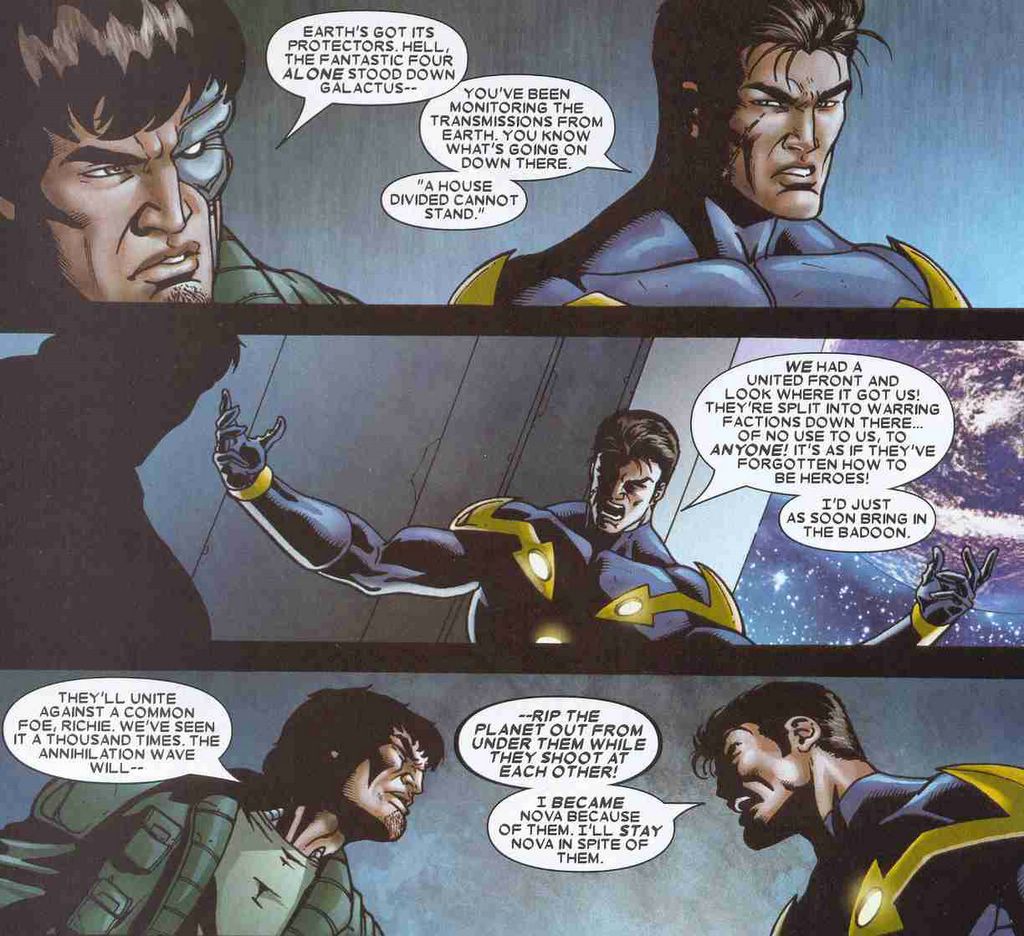
52 #25,#26, and #27 – There’s no shortage of things to praise about 52, but one thing I’m especially enjoying is its revival of DC’s more freakish characters, as well as its invention of new ones. Oh, Grant Morrison.
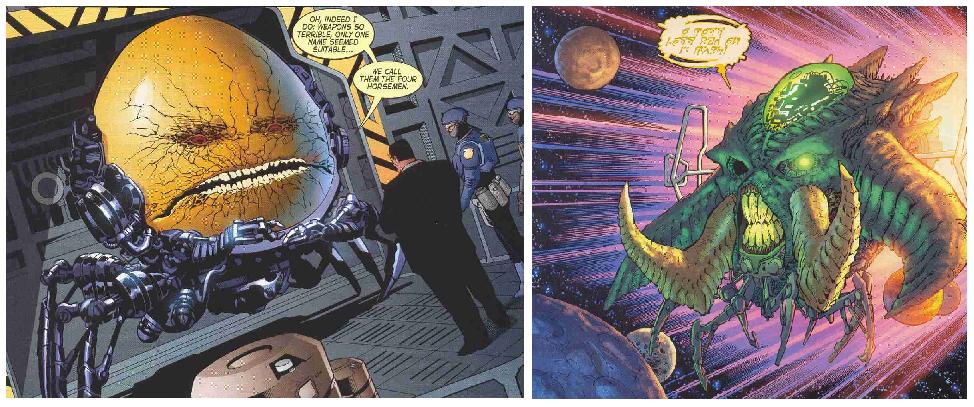
Is Chang Tzu “Egg Fu”? And more importantly, why do both he and Emerald Eyed Ekron have all those crazy robot legs?? (And who’s “driving” Ekron??? Or do my eyes deceive me?) Can we expect more disturbing monster-heads? 52 is so entertaining that someone is going to have to invent a special industry award just to honor it. Am also loving Ralph’s Orphic Odyssey. Not to mention the promised integration and rationalization of DC’s time-travel characters. Interesting too that the most recent issue appears to confirm my (and probably everyone’s) suspicion that the little girl on the cover of week 25 foreshadows of Renee Montoya’s future. R.I.P. Vic Sage; long live The Question.

Superman #657 – This is turning into one of the best Superman stories ever told. Seriously. Busiek is on fire writing an apocalyptic future in which Superman’s own body becomes the missile that send the earth into a state of nuclear winter.
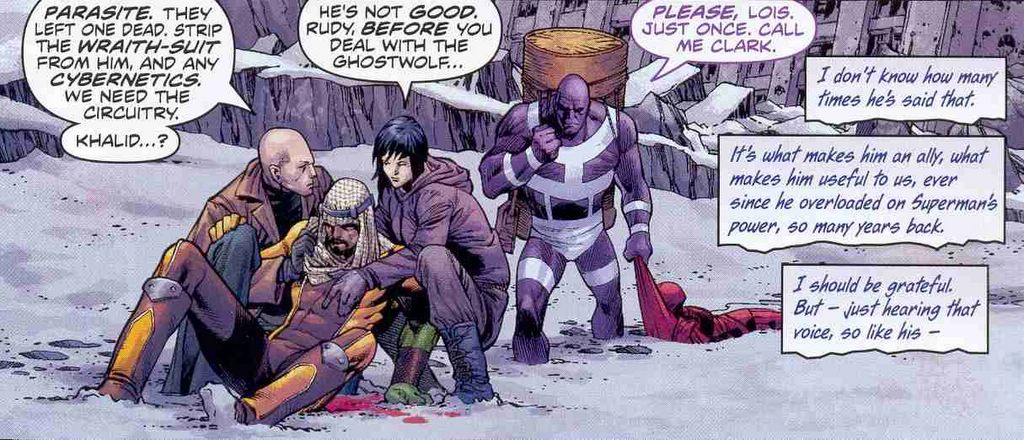
The apocalyptic future has long been a cliché of the superhero genre, but it feels different this time. The “superteam” of Luthor, Lois, Jimmy, and Parasite on the cover is...so cool. And Pacheco’s art…gasp! The cover. The two-page spread of Metropolis falling into the sea. Everything here is just so beautifully rendered. I have nothing intelligent to say about this except: more please!
Saturday, November 04, 2006
Kryptonian Fathers, Kryptonian Sons

Action Comics #844 – I wasn’t sure about this at first, but now that I’ve adjusted my brain to recognize this as a Richard Donner Superman film in the form of a comic (not a regular DCU Superman book), I’m enchanted. The orphan’s fantasy of recovering the absent father that pervades the Donner films is the driving force here too as Superman intervenes in what appears to be his own story being played out a second time. This is a compelling premise because while Superman’s intervention in this issue brings his own position in the orphan/foster-father narrative full circle, it does so in a way that may allow him to heal the initial gap between himself and the ghost-father/Mighty Oz, Jor-El. By becoming the space-boy’s guardian, Superman consciously steps into the role of archetypally good foster-father, Pa Kent; yet, because he and the boy are (apparently) both Kryptonian, Superman potentially transcends the position of “alien” foster-father to symbolically recover the original absent father, Jor-El—that is, he recovers his own father by “becoming” a “real” Kryptonian father in relation to a “real” Kryptonian boy/self.
No doubt, complications will ensue to muck with the promise of such mythic fulfillments. But it’s a tantalizing premise all the same, and its pathos is enhanced by the “filmic” visuals supplied by Adam Kubert in this issue. By “filmic” I don’t mean “grand” or “panoramic,” but quite the opposite: strangely subdued, realistic, plain. The banal details of the lab make it feel ordinary. Superman hovers cross-legged talking with the boy as he eats a sandwich on plastic toy furniture. The cubicles at the Daily Planet where Lois is working late have an exceptional degree of cinematic vraisemblance. There are no “supervillains,” yet. Barely any powers. That’s why the action sequences feel heavy—rather like “special effects.” (Could the producers not afford a conceptual artist to design a convincing spaceship? Is that why the child is “delivered” to earth in a giant wheel of brie?)

But this isn’t a criticism. What I am describing is the “austerity” that Hollywood cinema brings to the superhero movie because budget constraints require a stingy and very deliberate parceling out of visual departures from everyday realism. Superpowers are expensive, which is why the movie-Superman and his spandex-clad fellows spend so much time acting as brooding metaphors in superhero cinema rather than tossing bad guys around. When this kind of situational austerity is transferred to comic books—usually in adaptations of superhero films—the effect is almost invariably ugly, boring, and depressing. (I don’t think I’ve ever read a comic book movie adaptation that I’ve liked. And of course, that’s partly because such things aren’t written for me anyway; the adaptation is a “mediating” genre written for film goers who don’t read comics, though it’s hard to imagine that they’d be convinced to try more by such labored introductions.) Here, however, the Johns/ Donner script and Kubert’s translation of the restraint and austerity that comes from Donner’s (and Johns’s) film background produces a deeply gratifying effect, perhaps because the story is not an adaptation and because the paring down of the “color” of the regular DC Universe in the pages of Action Comics gives the plot a melancholy and nostalgic feeling that fits.

Tuesday, October 31, 2006
On Halloween: Shrouded Skeletons and Friendly Ghosts

Everything, everything that matters, is here. The greenish night. The house on the hill. The broken shutter. The bent and useless fences. The black claw of tree that reaches for the house and in the same moment frames it in the protective curve of its trunk. The spectral bat that frames it on the other side, flying us into the pinprick at the picture’s center: that eerily lighted room. (Look closely: it is a human figure.)
It is of course this room that has the broken shutter; like the house surrounded by broken fences, it must bear the signs of supernatural breach. Even these broken fences are doubled by the merely relative (and thus deceptive) frames of tree and bat whose ability to enclose depends on your point of view, as if you can never have too many signs of rupture.
And supervening all, the grey skeleton, veiled. Or is that “bed-sheeted”? A garment of ghostly mist that blankets the house, not so much framing as enveloping. Snugly and reassuringly. The garment of a grim Casper, an ultimately friendly ghost. A quaint spectre who “tucks us in.” A “familiar.”
For this is not an image of horror. Those images are different, and I would discover them in other places. (A coffee table book filled with giant color photographs of insects that I was afraid to touch. Pages swarming with ladybugs.) This is a picture of cozy transgression. It is “spooky,” not frightening.
No doubt, we could roll out the entire psychoanalytical machinery of Oedipus and the family to understand the domesticated “secret” of this skeleton in bed sheets. But must we? For me, the intensity of this painting resides not in the promise of unveiling, but rather in the satisfactions of deferment. Its signs of transgression are a ruse. The doubling, tripling of broken frames (shutter, fences, tree/bat) do not “disclose” the painting’s “secret.” They are the secret. It is literally an open secret, displayed on the surface. Like the pallid ghost stories behind the cover, the promised secret is too banal to read. (The stories inside have nothing to do with the cover—total detachment, infinite deferral; the revelation of the secret, what “only the ghost knows,” must be sought elsewhere, perpetually. A definition of pleasure.) This is a painting of the only true “secret”: the one that cannot be known. That yellow room. A pinprick.
In the end, this cover painting attracts me because it is an image of our profound delight in secrets. And this delight is condensed in the childhood bogey of the shrouded skeleton because—with its familiar, comforting bed-sheet and its only half-disclosed grinning skull—it is our most intimate, most reassuring signifier of the pleasures of secrecy. The keeper of a “chilling, thrilling” “mystery” whose solution is perpetually “in suspense.”
A friendly ghost.
Why I love Halloween.
__________
For more friendly ghosts, visit Keith Milford’s Old Haunts.
Sunday, October 29, 2006
Multiple Articulation: Links
Any Eventuality's Nobody examines the New Earth-Prime emerging from DC’s 52. And follow-up.
Chris Ware’s foldout history of intertextuality, Jonathan Lethem on Philip K. Dick, Steve Almond on James Frey, and more. (Thanks Thomas!)
Booby Kids. Panic Restaurant. Divine Divinity. 50 Worst Video Game Names Ever. Come for the names; stay for the biting sarcasm. (Thanks Dioscuri!)
With his usual wit and precision, Plok explains why Civil War falters at the level of storytelling and argues that we need to bring back thought balloons. I could NOT agree more.
Dave Campbell abuses the Nuclear Family, silly but beloved creations by Mike W. Barr and Jim Aparo.
Six-word Science Fiction Stories by Joss Whedon, Stan Lee, Alan Moore, Margaret Atwood, and many more. (Thanks again Thomas!) My contribution: Booby Kids. Panic Restaurant. Divine Divinity.
Anyone else want to play?


 Posts
Posts


